 Orcas Island Siding
 Siding Built for North Beach's Exposure
North Beach sits close enough to open water that homes here take a different kind of weather beating than houses tucked into the interior of Orcas Island. Salt-laden air, wind-driven rain off the Strait, and the deep shade that keeps moss thriving nine months out of the year all work on exterior siding at once. We've replaced and repaired enough siding around this part of San Juan County to know which failures are predictable and which products hold up when the marine layer never really lifts.
This page is about what that means for your house specifically — not generic siding advice, but what we actually see on North Beach homes and what we do about it.
What the Climate Does to Siding Here
Salt Air and Metal Fasteners
Proximity to salt water accelerates corrosion on anything metal — nail heads, trim flashing, hose bib fittings, light fixture mounts. On wood and composite sidings, corroding fasteners loosen over time, and once a fastener backs out even slightly, water finds the gap behind it. We use fasteners rated for coastal exposure and back-prime or seal every cut edge, because the fastener is usually the first failure point on a salt-exposed wall, not the siding panel itself.
Driving Rain and Wind-Loaded Walls
North Beach gets wind off the water that pushes rain sideways into walls rather than letting it run straight down. That means the water-resistive barrier behind your siding, the flashing details around windows and doors, and the lap overlaps on horizontal siding all matter more here than on a sheltered inland lot. A siding job that looks fine on a calm day can still leak during a wind-driven storm if those details were cut short during installation.
Moss, Shade, and Moisture Retention
Tree cover that blocks wind also blocks sun, and shaded north- and east-facing walls on Orcas Island can stay damp for days after a rain event. Moss and algae take hold on any surface that retains moisture, and on porous or absorptive siding materials, that surface film feeds into the substrate over years. Siding that doesn't absorb water in the first place simply doesn't feed that growth cycle the same way.
Why We Only Install James Hardie Fiber Cement
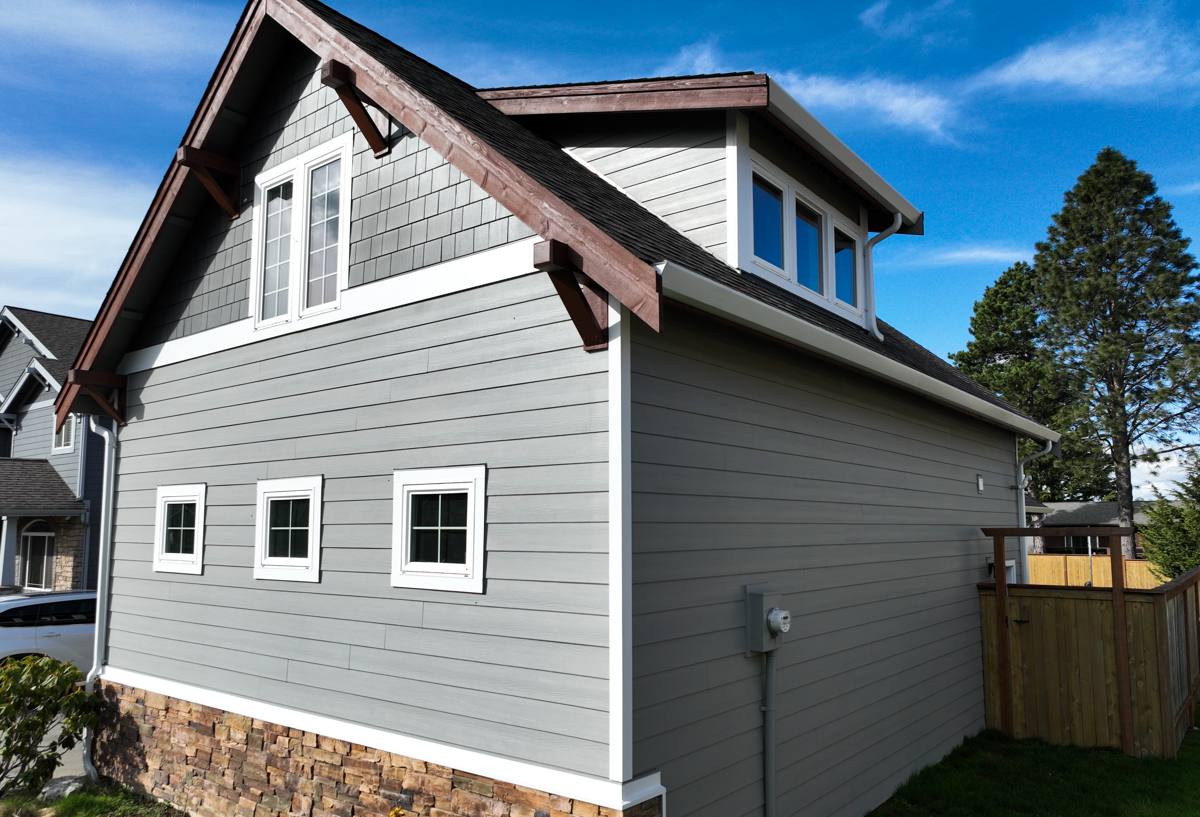
We made a decision a long time ago to install one siding system: James Hardie fiber cement. Not because it's the cheapest option on every job, and not because other products are without merit — but because for this climate, on this island, it's the product we're willing to stand behind for the long haul.
- Non-combustible — a real consideration for properties near dry vegetation, which is common across San Juan County in late summer.
- Doesn't rot or delaminate — fiber cement doesn't feed moss and mildew the way wood-based products can when kept damp by shade and salt humidity.
- Factory-applied ColorPlus finish — baked-on color that resists the fading and chalking that field-applied paint struggles with in direct coastal UV and salt exposure.
- HZ5 engineered formulation — Hardie's climate-specific product line built for wet, freeze-cycle-prone regions like the Pacific Northwest.
- Long, transferable warranty — backed by a manufacturer with decades of field performance data, not a newer entrant still building its track record.
We don't install LP SmartSide, vinyl, Cemplank, Allura, primed spruce, or cedar. Some of those products are reasonable choices in the right climate and budget — we just don't think North Beach's salt air and wet shade are the right conditions to test that on your home.
How a North Beach Siding Job Actually Runs
Assessment First
Before we quote anything, we walk the exterior and look specifically for the failure patterns common here: fastener corrosion, soft trim at window sills, moss buildup on shaded elevations, and gaps at penetrations like hose bibs, vents, and light fixtures. On older homes we'll also check what's happening behind the existing siding where we can access it, since hidden moisture damage changes the scope of the job.
Removal and What We Find Underneath
Tear-off is when we find out what's really going on — soft sheathing, compromised house wrap, or trim that's been quietly failing behind intact-looking siding. We flag this before proceeding rather than covering it back up, because fixing it now is a fraction of the cost of fixing it after new siding is already installed over a bad substrate.
Weather Barrier and Flashing Details
This is the step that determines whether siding lasts 10 years or 40 in a wind-driven-rain environment. We install a continuous water-resistive barrier, flash every window and door head properly, and make sure laps and overlaps are oriented to shed water the way wind actually hits North Beach walls — not just straight down.
Installation to Manufacturer Spec
James Hardie's warranty depends on installation matching their specification — proper fastener spacing, correct clearance from grade and roof lines, and correct gapping and caulking at joints. We install to that spec every time, which is also why we limit ourselves to one product system rather than juggling install requirements across several brands.
Siding Product Comparison for This Climate
| Material | Moisture Behavior in Salt/Shade | Combustibility | Typical Longevity Here |
|---|---|---|---|
| James Hardie Fiber Cement | Doesn't absorb water or feed rot/moss growth into the substrate | Non-combustible | Decades, warranty-backed |
| Cedar / Primed Spruce | Absorbs moisture; needs regular refinishing to hold up in shade and salt air | Combustible | Shorter without diligent maintenance |
| Vinyl | Doesn't absorb water, but can warp/fade under UV and doesn't handle impact well | Combustible | Variable; seams and fasteners are weak points |
| LP SmartSide / other engineered wood | Wood-based core is moisture-sensitive if edges or fasteners fail | Combustible | Installation-sensitive |
Beyond Siding: The Rest of the Exterior
Siding rarely fails in isolation on a North Beach property. The same wind and rain load that stresses siding also stresses roofing, window seals, and any deck exposed to the weather. We handle all four — siding, roofing, windows, and decks — because a leak at a window head or a failing roof edge will undermine even a perfect siding installation if it's left unaddressed.
Signs Worth a Second Look
- Soft or spongy siding near ground level or below windows
- Persistent moss or dark streaking on shaded walls that pressure washing doesn't fully remove
- Paint or finish that's chalking, peeling, or fading unevenly
- Visible rust or corrosion around fastener heads or trim
- Gaps or separation at seams, corners, or window and door trim
- Interior signs — musty smell, staining, or soft drywall near exterior walls
Why a Local Crew Matters Here
Orcas Island isn't like a mainland suburb where a contractor can run five jobs a day within a ten-minute drive. Getting materials, crews, and equipment to North Beach means accounting for ferry schedules, weather windows, and the reality that a callback isn't a quick same-day fix — it's a return trip. That changes how we plan a job: we order full material takeoffs up front, sequence work around weather rather than a generic calendar, and don't leave a house exposed mid-project when a storm is rolling in off the water.
It also means we've seen how houses in this specific part of San Juan County actually age — which elevations take the worst of the wind, which trim details fail first, and which shortcuts don't survive a few winters here. That's knowledge that's hard to substitute with a crew unfamiliar with island conditions.
What Homeowners Should Budget For
| Cost Factor | Why It Matters on Orcas Island |
|---|---|
| Material transport and logistics | Ferry scheduling and delivery windows affect project timelines more than on the mainland |
| Substrate repair | Hidden moisture damage found at tear-off is common on older, shaded, or salt-exposed walls |
| Trim and flashing detail work | Wind-driven rain areas need more careful (and more time-intensive) flashing than sheltered walls |
| Full ColorPlus finish vs. field paint | Factory finish costs more upfront but avoids repeat repainting in this climate |
| Access and staging | Waterfront and sloped lots common near North Beach can add scaffolding or access costs |
Getting Started
If your North Beach home is showing any of the wear patterns above, or you're planning ahead before the next wet season sets in, we're happy to take a look. We'll give you a straight assessment of what's actually happening with your siding, what it would take to fix it right, and a clear estimate — no pressure, no hard sell. Reach out through the form below to schedule a free estimate.