 Orcas Island Siding
 Exterior Contracting for Deer Harbor, Orcas Island
Deer Harbor sits on the western side of Orcas Island in San Juan County, a quiet marina community where homes look out over protected water and forested shoreline. It's a beautiful place to own a house, and it's also a demanding place to own an exterior. Everything out here has to travel by ferry, weather comes off the water with real force in the winter months, and a lot of homes sit close enough to the shoreline that salt air is a daily fact of life, not an occasional nuisance. We work with those conditions constantly, and it shapes how we think about siding, roofing, windows, and decks for every house we touch on this end of the island.
This page walks through what Deer Harbor homes typically face from the climate, how we approach siding and the rest of the exterior for properties out here, and why we standardized on one siding product instead of offering the usual mix of options.
What the Climate Actually Does to a House Here
San Juan County's marine climate is milder than a lot of people expect — winters aren't brutally cold and summers stay mild — but "mild" doesn't mean "easy" on a building. The combination that wears down exteriors around Deer Harbor is specific:
Salt Air
Properties near the water take on a steady low-level exposure to salt in the air, carried in on wind off the harbor and the wider straits. Salt accelerates corrosion on fasteners, flashing, and any exposed metal trim, and it's hard on paint and finish coatings that aren't built to handle it. Over years, an exterior finish that wasn't engineered for coastal exposure will chalk, fade, and break down faster here than it would twenty miles inland.
Driving Rain
When winter storms come through the islands, rain doesn't just fall straight down — wind pushes it sideways into walls, around window and door openings, and up under poorly lapped siding or trim. That kind of wind-driven rain finds every weak point in a building envelope: a gap in flashing, a caulk joint that's failed, a siding product that swells or wicks water at the cut edges. A house on Orcas needs a weather barrier and siding system that's actually detailed to shed water horizontally, not just vertically.
A Long Moss Season
Shade, moisture, and mild temperatures are a perfect combination for moss, algae, and lichen growth, and on this island that growing season runs long — often most of the year on north-facing walls and shaded roof planes. Moss holds moisture against a surface, which is bad news for any material that isn't dimensionally stable or that can absorb water and swell, rot, or delaminate over time.
None of this means a house here is doomed to fail early. It means the materials and the installation details matter more in Deer Harbor than they would in a drier, calmer climate, and cutting corners on either one shows up faster.
Why We Only Install James Hardie Siding
We get asked fairly often why we don't offer vinyl, LP SmartSide, primed spruce, cedar, or other fiber cement brands like Cemplank or Allura. It's a fair question, and the honest answer is that we made a standard for ourselves based on what holds up in this climate with the least maintenance and the fewest callbacks.
What We Won't Install, and Why
- Vinyl siding is affordable and low-maintenance in dry, moderate climates, but it can become brittle in temperature swings, its seams and butt joints are a real vulnerability against wind-driven rain, and it isn't a rigid enough material to hold up flat and tight against the kind of moisture cycling coastal homes see.
- LP SmartSide is an engineered wood product with a resin-treated strand board core. It performs reasonably well when installed and maintained exactly to spec, but wood-based siding is inherently more vulnerable to moisture intrusion at cut edges and fastener penetrations than fiber cement, and in a high-moisture, high-moss environment that vulnerability gets tested constantly.
- Primed spruce or cedar board siding is a natural material that a lot of people love the look of, but it requires an ongoing maintenance commitment — repainting, caulking, checking for rot — that most homeowners underestimate, and in salt air and a long wet season that maintenance interval only gets shorter.
- Other fiber cement brands (Cemplank, Allura) are legitimate products in the same general category as James Hardie, but we standardized on one manufacturer so we can guarantee consistent factory finish quality, warranty terms, and product engineering across every job, rather than juggling multiple systems and specs.
We're not going to tell you any of these products is garbage — they all have a place, and plenty of them are installed successfully around the country. We're telling you why we decided not to install them: the trade-offs didn't line up with what we think a Deer Harbor exterior needs to perform well for decades with minimal upkeep.
What James Hardie Gets Right for This Climate
James Hardie fiber cement is non-combustible, dimensionally stable, and engineered specifically for different regional climate demands through its HZ5 product line, which is built for the freeze-thaw and moisture cycling typical of the Pacific Northwest. The ColorPlus factory finish process bakes color onto the board under controlled conditions, which gives it better fade and chip resistance than field-applied paint and reduces the repainting burden that wood siding carries. It doesn't swell, rot, or feed moss the way wood-based products can, and it holds up to the wind-driven rain and salt exposure that define this part of the island. Backed by a strong transferable warranty, it's the product we're comfortable standing behind on every house we side.
Our Siding Process for Deer Harbor Homes
Every project starts with an honest look at the existing exterior — not just the siding itself, but what's underneath it. On the islands especially, we often find that the visible siding was the least of a home's problems; the real issues are in the weather barrier, flashing details around windows and doors, and how water has been managed (or not managed) at penetrations and transitions.
What a Proper Installation Involves
- Removal of old siding and inspection of the sheathing and framing underneath for hidden moisture damage
- Repair of any compromised sheathing before new material goes on
- Installation of a code-compliant weather-resistant barrier, detailed for wind-driven rain rather than just vertical rainfall
- Correct flashing and integration at every window, door, and roof-to-wall transition
- James Hardie siding installed to manufacturer fastening, clearance, and caulking specifications — proper gapping matters more in a climate with real temperature and moisture cycling
- Final detailing at trim, corners, and penetrations to eliminate the small gaps that driving rain will otherwise find
Fiber cement siding is only as good as its installation. A correctly engineered product installed with the wrong clearances or fastening pattern can still fail early — which is a big part of why we treat installation quality, not just product selection, as the whole job.
Roofing, Windows, and Decks in the Same Climate
Siding doesn't work in isolation — the whole building envelope has to function together, which is why we handle roofing, windows, and decks alongside siding rather than treating them as separate trades.
Roofing
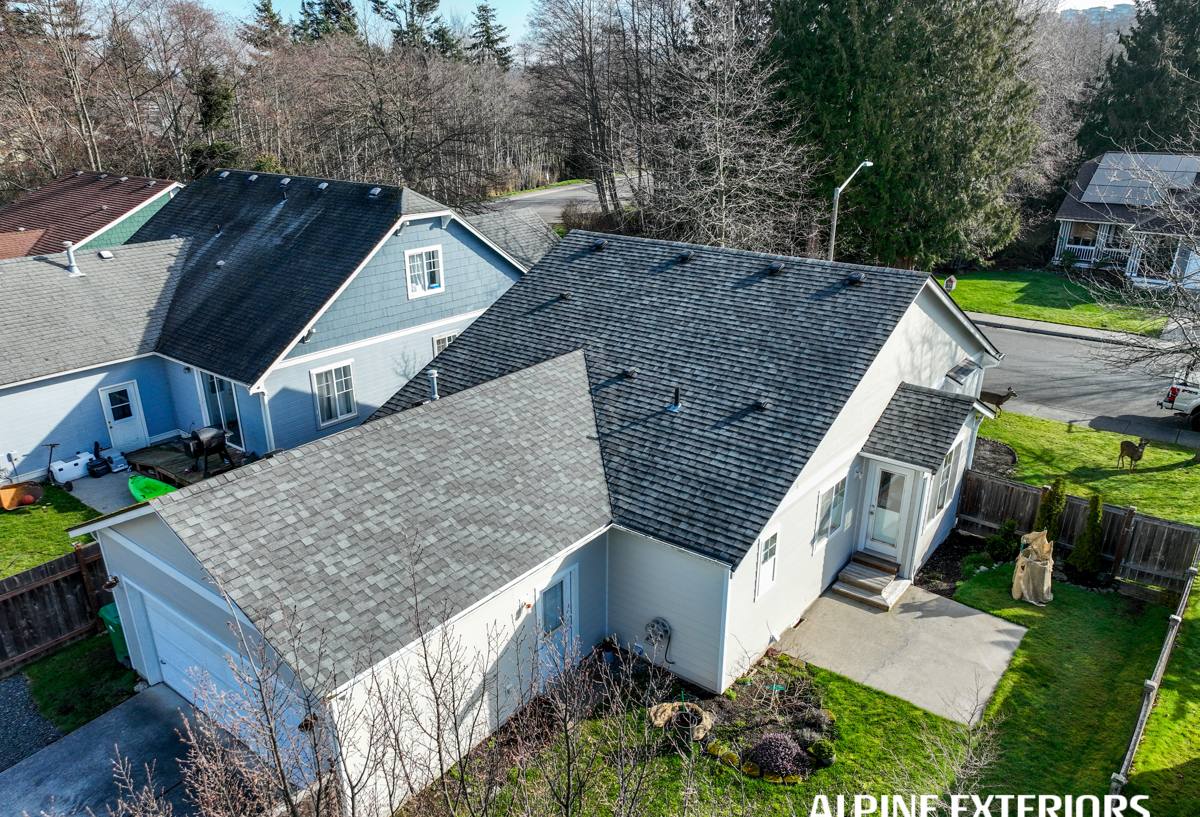
Roofs on Orcas Island deal with the same moss and moisture pressure as siding, often worse, since roof planes collect more standing moisture and see less sun on north- and east-facing slopes. Proper flashing, ventilation, and material selection all affect how long a roof lasts before moss and moisture start compromising it.
Windows
Window replacement is one of the most common places we find water intrusion tracing back to a poor original installation rather than a bad window unit. Flashing integration between the window and the wall assembly is what actually keeps wind-driven rain out — the window itself is only half the equation.
Decks
Outdoor living space near the water takes a beating from the same salt air and moisture exposure as the siding. Fastener selection, board spacing for drainage, and ledger flashing where a deck attaches to the house all matter more here than they would in a drier climate.
Cost Factors for a Deer Harbor Exterior Project
Every project is different, but a few factors consistently move the cost and timeline for homes in this part of San Juan County.
| Factor | Why It Matters Locally |
|---|---|
| Ferry logistics | Materials and crews travel by ferry, which affects scheduling and delivery lead times more than on the mainland |
| Existing moisture damage | Homes with long-deferred maintenance often have hidden sheathing or framing repair needed before new siding goes on |
| Home access and site conditions | Waterfront and forested lots can limit staging area and equipment access, affecting labor time |
| Siding profile and trim complexity | Board-and-batten, shingle-style panels, and detailed trim packages take longer to install than plain lap siding |
| Scope (siding only vs. full envelope) | Bundling siding with roofing, window, or deck work can be more efficient than separate projects over time |
Why a Local Crew Matters Out Here
Working on Orcas Island isn't the same as working in a mainland subdivision. Scheduling has to account for ferry timing, material deliveries need to be planned further in advance, and a crew that doesn't regularly work in San Juan County can underestimate how much the salt air and moss exposure will affect a project's long-term performance if details get rushed. A crew that knows this environment builds in the right margins from the start — on flashing details, on fastener choices, on how tight a schedule can realistically be — instead of learning those lessons on your house.
A Straightforward Checklist Before You Hire
- Ask what siding, roofing, and window brands the contractor actually installs, and why they chose them
- Ask how they handle moisture intrusion found during removal — is it priced separately or built into the estimate process
- Confirm whether the crew works regularly on the islands and understands ferry-based scheduling
- Ask about warranty coverage on both materials and labor, and whether it's transferable if you sell the home
- Get a written scope that specifies flashing and weather barrier details, not just "install siding"
If you're weighing a siding, roofing, window, or deck project for a home in Deer Harbor, we're happy to take a look and talk through what your house actually needs. There's no pressure and no cost to get an estimate — just a straight assessment based on what we see.