 Orcas Island Siding
 The Short Version
We get asked this a lot, usually by someone standing in front of a stack of siding samples: vinyl, LP SmartSide, cedar, maybe a fiber cement brand they haven't heard of, and James Hardie. Our answer is the same every time. We install James Hardie, and only James Hardie, on every siding job we take on around Orcas Island. Not because it's the cheapest option in the stack, and not because of a sales incentive. It's because after years of working on homes exposed to Salish Sea weather, we stopped seeing the point in installing anything else.
This page lays out the actual reasoning, product by product, so you can make your own call with real information instead of a showroom pitch.
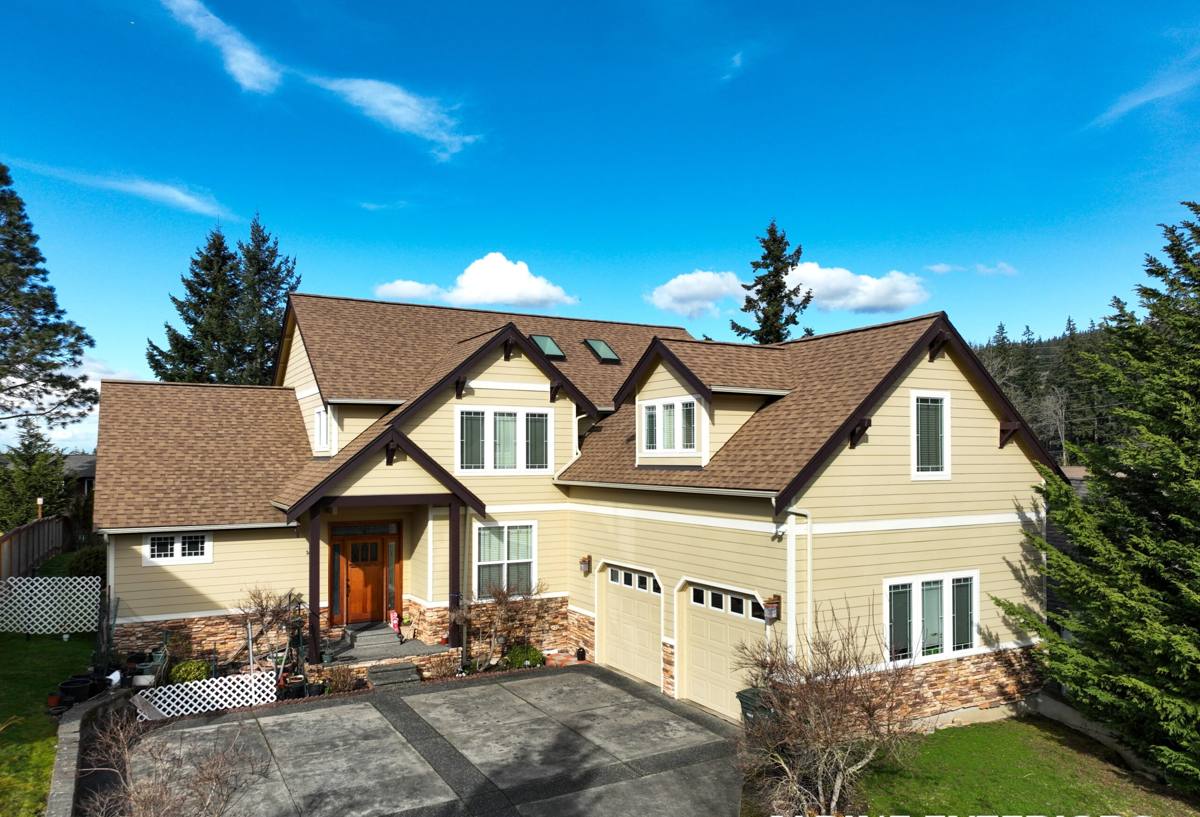
What Orcas Island Siding Is Actually Up Against
San Juan County doesn't get the wind-driven downpours of the Washington coast, but island homes take a slower, more persistent kind of punishment. Salt-laden air off Rosario Strait and the Strait of Juan de Fuca works into fasteners, trim joints, and any exposed wood fiber over time. Rain here isn't always heavy, but it's frequent and it lingers — combined with heavy tree cover on much of the island, that means long stretches where siding stays damp and shaded. That's exactly the environment where moss, algae, and mildew take hold, and where any siding material with a weak moisture tolerance starts to show it.
Ferry-dependent logistics also matter more here than people expect. If a product needs a specialty repair kit, a manufacturer rep, or a part that isn't stocked on the mainland, that's a longer wait and a bigger repair bill on an island than it would be in a mainland suburb. Whatever we put on a house here has to hold up on its own for a long time, because a quick fix isn't always quick.
What This Means for Material Choice
- Constant low-grade moisture exposure, not just occasional storms
- Shade from mature trees on many lots, slowing dry-out after rain
- Salt air that accelerates corrosion on fasteners and metal trim
- Longer lead times for specialty repairs or replacement parts
- Wide swings between damp winters and dry, sun-exposed summers on south-facing walls
Why We Don't Install Vinyl Siding
Vinyl siding is affordable and low-maintenance in the sense that it doesn't need painting. That's a real advantage and we won't pretend otherwise. But vinyl is a thin, flexible plastic panel, and its performance is tied directly to how well it's installed — it has to be hung loose enough to expand and contract with temperature swings, which on the shoulder seasons here can be significant between a cold morning and a sunny afternoon.
The bigger issue for island homes is impact and UV resistance. Vinyl gets brittle with age and sun exposure, and it cracks under impact in ways fiber cement doesn't. It also can't be painted a dark color in direct southern exposure without risking warping from heat absorption, which limits color choices on the sunnier lots around the island. And because it's a floating panel system, not a fastened, monolithic surface, it's more vulnerable to wind uplift in the exposed, waterfront-adjacent locations common here.
Why We Don't Install LP SmartSide
LP SmartSide is an engineered wood product — strand-based, resin-treated, and genuinely improved over the OSB siding failures of the 1990s that gave engineered wood a bad name. We're not relitigating that history. LP has made real strides in moisture resistance.
Our concern is simpler: it's still wood at its core. Wood-based products are dimensionally sensitive to moisture in a way fiber cement is not, and in an environment with the kind of sustained dampness and shade Orcas Island delivers, any breach in the factory coating or field-cut edge sealing becomes an entry point for swelling and eventual rot. We've seen this play out on homes where the coating was compromised at a cut edge, a nail hole, or a seam that wasn't caulked exactly to spec. Fiber cement doesn't have that failure mode — it's cement and cellulose fiber, not organic wood strand, so it doesn't swell, delaminate, or feed rot fungus the way an engineered wood panel can.
Why We Don't Install Cedar or Primed Spruce
Real wood siding has a look that some homeowners genuinely prefer, and we understand the appeal, especially on a property that's leaning into a rustic Pacific Northwest aesthetic. But cedar and primed spruce require an ongoing maintenance commitment that most homeowners underestimate going in: re-staining or repainting every few years, regular caulk inspection, and active moisture management, especially on north-facing or heavily shaded walls where the wood never fully dries out between rains.
On an island where a contractor visit means scheduling around a ferry, that maintenance burden compounds. A missed re-coat cycle on the mainland might mean a cosmetic issue. Missed on a shaded Orcas Island wall for a couple of extra years, it can mean active rot before anyone notices, because moss growth on the surface can mask what's happening to the wood underneath.
Why We Don't Install Other Fiber Cement Brands (Cemplank, Allura, etc.)
This one surprises people. Fiber cement as a category is sound, and other manufacturers make a legitimate product. Our decision to standardize on James Hardie specifically comes down to three things: the factory finish system, the climate-specific product engineering, and the warranty structure — all of which are covered in detail below. We'd rather install one product line extremely well, know its installation requirements cold, and stand behind a single warranty and finish system, than juggle multiple fiber cement brands with different specs, fastening requirements, and finish warranties.
What James Hardie Gets Right
Non-Combustible Material
James Hardie siding is fiber cement — sand, cement, and cellulose fiber — which is non-combustible. That's a real, tangible difference from vinyl (which melts and can contribute fuel to a fire) and wood-based products. It won't be the deciding factor for every homeowner, but it's a meaningful difference in wildfire-adjacent regions and one more reason we're comfortable standing behind it.
ColorPlus Factory Finish
Most Hardie products are available with the ColorPlus finish, a baked-on, factory-applied coating that's far more consistent and durable than a field-applied paint job. It resists fading and chipping better than site-applied paint, and because it's cured under controlled factory conditions rather than applied on a ladder in variable weather, the finish quality doesn't depend on what the weather did the week your house was painted.
Climate-Engineered HZ Product Lines
Hardie manufactures regional formulations — HZ5 and HZ10 lines — engineered for specific climate zones, including the wet, moderate Pacific Northwest. That's not a marketing label; the fiber cement formulation itself is adjusted for the moisture and freeze-thaw patterns of the region it's sold into, which matters directly for a marine climate like the San Juan Islands.
Warranty Backing
Hardie's product warranty is transferable to a new owner within the coverage period, which matters on an island where second homes and vacation properties change hands more often than a typical mainland neighborhood. A siding warranty that dies with the sale isn't worth much to a buyer weighing the property's condition.
Cost and Trade-Off Comparison
| Material | Upfront Cost | Maintenance | Moisture Tolerance | Typical Lifespan |
|---|---|---|---|---|
| Vinyl | Low | Low, but brittle/cracks over time | Fair — seams and fasteners vulnerable | 15-25 years |
| LP SmartSide | Low-Moderate | Moderate — coating and seam dependent | Good if intact, fails if breached | 20-30 years |
| Cedar / Primed Spruce | Moderate-High | High — recoat every 3-7 years | Poor without diligent upkeep | Highly variable, maintenance-dependent |
| James Hardie Fiber Cement | Moderate-High | Low — factory finish, occasional wash | Excellent — cement-based, doesn't rot or swell | 30-50+ years installed to spec |
These are general industry ranges, not quotes — actual cost and lifespan depend on your home's design, exposure, and how the installation is executed. Material choice only accounts for part of the outcome; installation quality accounts for the rest.
Why Installation Quality Matters as Much as the Product
Fiber cement is only as good as the details around it: proper flashing at windows and rooflines, correct fastener spacing and depth, rain-screen or drainage gap where the wall assembly calls for it, and caulking at the right joints and not at others. A poorly installed Hardie job can still trap moisture behind the siding. A well-installed vinyl or wood job will still outperform its lesser installed equivalent. We install Hardie specifically because we've built our process around its spec sheet — not because any siding installs itself.
What to Check Before Hiring for a Siding Job
- Ask whether the installer is a certified Hardie installer, not just someone who's handled the boards before
- Ask specifically about flashing details at windows, doors, and rooflines — this is where most moisture failures start
- Ask whether a rain-screen or drainage gap is used behind the siding on your wall assembly
- Get the fastener schedule in writing — spacing and nail type affect both warranty coverage and wind performance
- Confirm what's covered by the manufacturer warranty versus the installer's workmanship warranty, and for how long
Where This Leaves You as a Homeowner
You don't have to agree with our standard. Plenty of good homes on Orcas Island are sided in cedar, vinyl, or engineered wood, and plenty of them are holding up fine because someone maintained them properly. What we're telling you here is why we, as a company that has to stand behind our work on this island specifically, chose to build our entire process around one product system instead of stocking five different materials and hoping each installation crew gets the details right on all of them.
If you're planning a re-side and want to talk through what James Hardie would look like on your specific home — colors, product line, and a straightforward look at what it would cost — we're happy to come take a look. The estimate is free, there's no pressure, and we'll tell you honestly what your house needs.