 Orcas Island Siding
 Building Exteriors for the Mountain Lake Area
Homes around Mountain Lake sit in one of the quieter, more forested corners of Orcas Island, tucked near Moran State Park's timber and elevation rather than right on the shoreline. That inland, wooded setting changes the maintenance picture compared to a waterfront cottage, but it doesn't spare a home from San Juan County's core problem: this is a wet, marine climate with a long shoulder season of damp, low-light weather that gives moss, algae, and moisture plenty of time to work on an exterior every single year.
We work across Orcas Island and San Juan County, and the homes we see near Mountain Lake share a common thread with homes across the island — wood siding, trim, and fascia that looked fine for a decade and then started failing all at once, usually starting on the north side or under tree cover where things never fully dry out. Siding, roofing, windows, and decks all take the same beating out here, and we treat them as one system rather than four separate jobs.
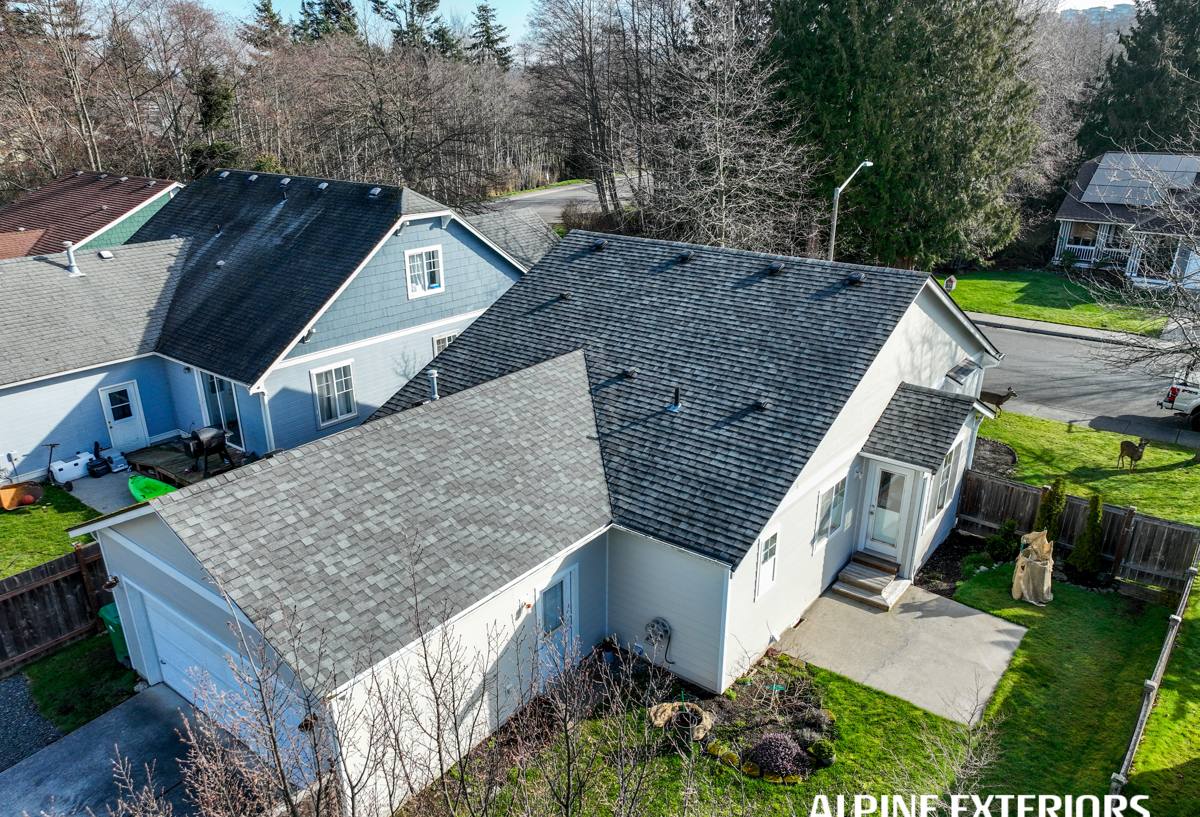
What the Climate Actually Does to a Home Near Mountain Lake
Three things define exterior wear in this part of Orcas Island, and they compound each other:
- Salt-laden air that moves inland off the surrounding waters of the San Juans and settles into wood grain, fasteners, and paint film even away from the immediate shoreline.
- Driving, wind-blown rain that hits siding at an angle instead of falling straight down, forcing water behind trim, into end-grain cuts, and up under lap joints that were only ever designed to shed water moving downward.
- A long moss season — the tree cover and shade around Mountain Lake keep roofs, north-facing walls, and shaded siding runs damp for months at a time, which is exactly the environment moss and algae need to take hold.
None of these are dramatic events. There's no single storm that destroys a wall. It's the slow, repeated cycle of wetting, drying, and biological growth, year after year, that eventually opens up paint film, swells wood fiber, and lets rot start in places you can't see from the ground.
Why Wood and Composite Products Struggle Here
Traditional wood siding, and even engineered wood products, depend entirely on an intact paint or coating layer to keep moisture out. Once that layer is compromised — by a hairline crack, a fastener that backed out, or years of moss holding water against the surface — the substrate underneath starts absorbing water. On a shaded, tree-covered lot like much of the Mountain Lake area, that coating gets tested constantly and dries out slowly, which is precisely the condition where wood-based products lose the fight over time.
Common Problems We Find on Orcas Island Homes
| What Homeowners Notice | What's Usually Happening |
|---|---|
| Green or black staining on north walls | Moss and algae growth from prolonged shade and moisture, especially under trees |
| Paint peeling or bubbling at seams | Water trapped behind lap joints or trim, pushing the coating off from underneath |
| Soft or spongy siding near the ground | Wood fiber saturation and early-stage rot, often worse where landscaping traps moisture |
| Corroded or streaking fasteners | Salt-air exposure attacking nail heads and metal trim over years |
| Warped or cupped boards | Repeated wet/dry cycling stressing wood fiber past its tolerance |
Why We Install Only James Hardie Fiber Cement Siding
We made a decision as a company to install one siding system: James Hardie fiber cement. We don't install vinyl, LP SmartSide, Cemplank, Allura, primed spruce, or cedar. That's not a marketing angle — it's a standard we hold because of what we've watched happen to exteriors across San Juan County's marine climate over time.
Vinyl siding is affordable and low-maintenance in the sense that it doesn't need painting, but it's a thin plastic product that expands and contracts with temperature swings, can crack in cold snaps, and offers essentially no fire resistance. Wood-based composites like LP SmartSide use engineered wood strand cores that perform reasonably well when detailing and maintenance are perfect, but any breach in the coating exposes a wood-fiber substrate to the same moisture problems as traditional wood — and on a shaded, damp lot, that breach is a matter of when, not if. Primed spruce and cedar are honest, attractive materials, but they're natural wood: they need repainting on a real schedule, they're vulnerable to the rot and moss cycle we described above, and in wildfire-adjacent forested settings they carry no inherent fire resistance.
James Hardie fiber cement is cement, sand, and cellulose fiber — not wood, not plastic. It doesn't absorb water the way wood does, it doesn't expand and contract the way vinyl does, and it's non-combustible, which matters on a heavily wooded island where wildfire risk is a real planning consideration for homeowners. The factory-applied ColorPlus finish is baked on under controlled conditions, which holds up to UV and salt air far longer than field-applied paint, and it comes with a strong transferable warranty when installed to Hardie's specifications.
The Hardie Product Lines We Use
James Hardie makes climate-engineered product lines, and we specify the one that fits the Pacific Northwest:
- HZ10 (HardieZone 5) — engineered for cold, wet, marine climates like San Juan County; this is our default recommendation for Mountain Lake area homes.
- Lap siding — the most common profile for full re-sides, available in multiple exposures and textures.
- Panel and shingle siding — used for accent gables, dormers, and architectural detail work.
- Trim boards — matched fiber cement trim so the entire exterior envelope, not just the field siding, resists the same moisture and moss cycle.
ColorPlus finishes come in a range of factory colors designed to hold their tone in UV and salt exposure, which matters more here than in a drier inland climate where paint fade is a slower problem.
How We Approach a Siding Job Near Mountain Lake
1. Assessment
We start by walking the exterior and identifying where moisture has already gotten in — soft spots, staining patterns, trim condition, and how water is currently being shed (or not) around windows, doors, and roof-to-wall transitions. On a wooded lot, we also look at how much shade and standing moisture different walls get, since that changes where problems will show up first.
2. Water Management First
Siding is only as good as what's behind it. We address flashing, house wrap, and drainage details before a single piece of Hardie goes up. This is the step that gets skipped most often on lower-quality re-sides, and it's the reason otherwise-good siding fails early.
3. Installation to Manufacturer Spec
Correct fastener placement, proper clearances from grade and roofing, and correct joint treatment all affect whether the warranty holds and whether the siding performs the way it's engineered to. We install to Hardie's published specifications, not shortcuts.
4. Final Detailing
Caulking, trim, and paint touch-up at seams are finished with attention to the same driving-rain exposure that causes problems in the first place — details matter more here than in a milder climate.
Beyond Siding: Roofing, Windows, and Decks
Siding rarely fails in isolation. A roof shedding water improperly, a window that's no longer sealed, or a deck ledger trapping moisture against the wall all feed the same rot and moss cycle that damages siding. We handle roofing, windows, and decks alongside siding work so the whole exterior envelope is addressed as one system rather than patched piecemeal. On a shaded property, a roof with moss problems is often an early warning sign that siding on the same side of the house is fighting the same battle.
Cost Factors for Mountain Lake Homeowners
| Factor | Why It Matters Here |
|---|---|
| Access and site conditions | Wooded, sloped, or ferry-dependent properties can affect material delivery and staging |
| Existing damage extent | Hidden rot behind old siding adds sheathing repair before new siding can go on |
| Siding profile and trim complexity | Multiple gables, dormers, and trim details take more labor than a simple rectangular wall |
| Water management upgrades | Flashing and drainage improvements are worth the added cost given this climate |
| Color and finish selection | Factory ColorPlus finishes cost more upfront than field-painted materials but need repainting far less often |
We give honest, itemized estimates rather than vague per-square-foot numbers, because the condition behind the old siding — which we can't always see until it's opened up — is usually the biggest variable on an Orcas Island re-side.
What to Look for in a Local Exterior Contractor
- Experience specifically with marine/island climates, not just general residential siding
- Willingness to explain why they use the products they use, not just quote a price
- A clear plan for water management and flashing, not just the visible siding layer
- Manufacturer-aligned installation practices that keep warranties intact
- Straight answers about site access, timeline, and what ferry or barge logistics mean for scheduling on Orcas Island
A contractor unfamiliar with island logistics can underestimate timelines and material handling in ways that show up later as delays or corners cut on-site. Local experience isn't a nicety here — it changes how the job actually gets done.
Why a Local Crew Matters
San Juan County's building conditions aren't the same as the mainland's. Material deliveries depend on ferry schedules, weather windows are shorter and less predictable, and every property has its own combination of shade, wind exposure, and moisture pattern. A crew that works this island regularly plans around those realities instead of being surprised by them mid-project.
If your home near Mountain Lake is showing signs of moss buildup, peeling paint, or soft trim, we're happy to take a look and give you a straightforward, no-pressure estimate — including what we'd recommend and why, with no obligation.