 Orcas Island Siding
 Building Exteriors for San Juan Island's Marine Climate
San Juan Island sits out in the archipelago, surrounded by the same salt water and weather patterns that shape every home in San Juan County. Being an island community changes how you have to think about exterior work. Materials, crews, and equipment don't just show up from around the corner — everything has to be planned around ferry schedules, weather windows, and the reality that a callback isn't a quick fifteen-minute trip. That's part of why we standardize on one siding system instead of juggling five different products: consistency matters more out here, not less.
The climate itself is the other half of the equation. Homes on San Juan Island deal with salt-laden air coming off the water, driving rain that gets pushed sideways by wind funneling through the channels, and a moss season that can stretch for much of the year on shaded north- and west-facing walls. None of that is exotic — it's just persistent, and persistent is what wears out the wrong siding choice faster than homeowners expect.
What Salt Air Actually Does to a House
Salt air isn't just a coastal cliché. Airborne salt accelerates corrosion on fasteners, flashing, and any exposed metal trim, and it can degrade certain paint and coating systems faster than the same product would wear inland. Siding that isn't engineered with a factory-applied, baked-on finish tends to chalk, fade, or lose adhesion sooner near open water. That's a real factor in material selection here, not a marketing talking point.
Driving Rain and Wind-Driven Moisture
Wind off the water doesn't just bring rain straight down — it pushes it sideways into wall assemblies, especially around windows, corners, and anywhere the siding meets a roofline or deck ledger. Over years, that kind of exposure finds every weak seam in a house's water management. Good siding is only half the job; correct flashing, house wrap integration, and gap details around penetrations matter just as much, and we treat them that way on every install.
The Long Moss Season
Shaded, moisture-retaining surfaces on San Juan Island can stay damp for long stretches of the year, which is exactly the environment moss and algae need to take hold. On some siding materials that means ongoing scrubbing, pressure washing, or chemical treatment to keep growth from staining or degrading the surface. It's a maintenance burden that's worth factoring into any siding decision before installation, not after.
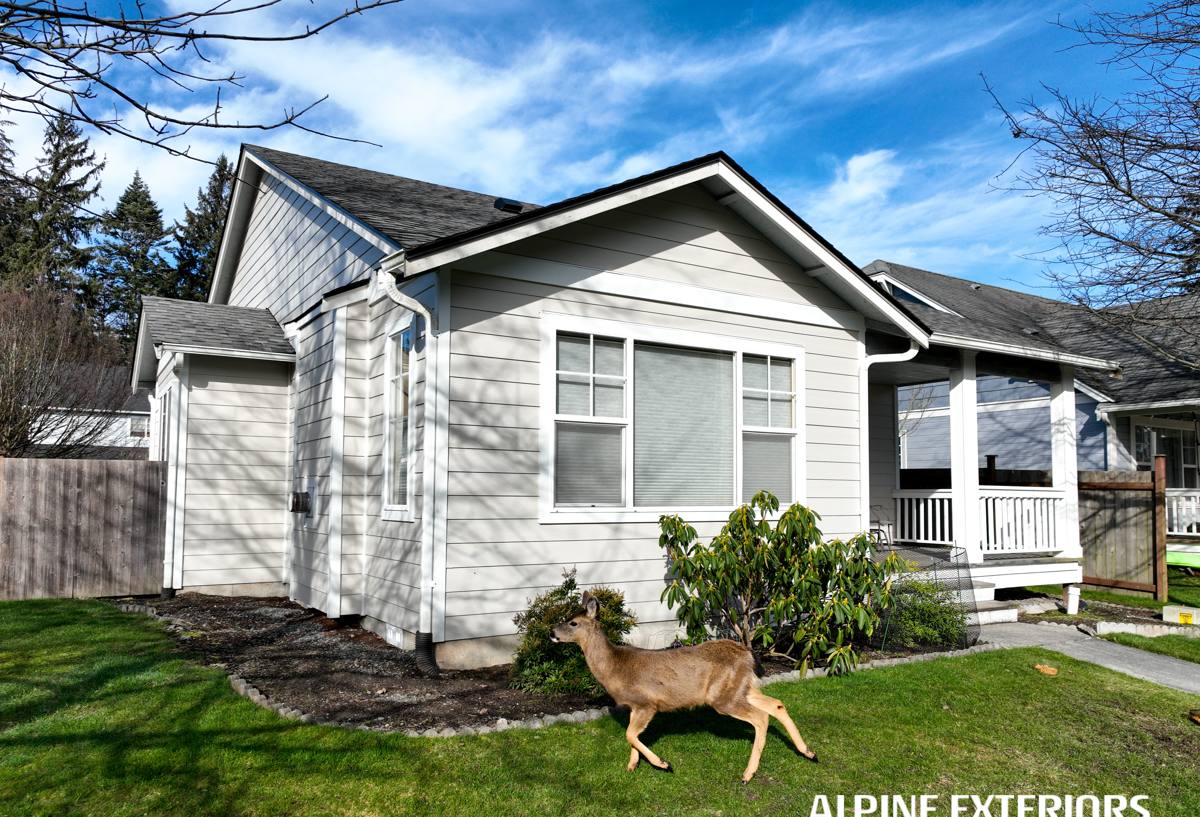
Why This Crew Installs Only James Hardie Fiber Cement
We made a deliberate call years ago to install one siding system — James Hardie fiber cement — instead of offering a menu of products. That's not about limiting options for the sake of it. It's because on a marine, moss-prone island climate, the material differences between siding types stop being theoretical and start showing up as callbacks, premature repainting, and moisture problems.
James Hardie fiber cement is non-combustible, which matters increasingly to insurers and homeowners alike, and it's manufactured with regional HZ formulations engineered for climates like the Pacific Northwest's — wetter, cooler, and salt-exposed. The ColorPlus factory finish is baked on under controlled conditions rather than field-applied, which gives it better fade and wear resistance than a typical site-painted surface, and it carries a long transferable warranty when installed to Hardie's specifications. That warranty language matters: it protects the material system, but only if the installation itself is done correctly, which is why installer training and detailing discipline are part of what you're actually paying for.
What We Turn Down, and Why
We don't install LP SmartSide, vinyl siding, Cemplank, Allura, primed spruce, or cedar. Each of those has legitimate uses and loyal fans elsewhere, and we're not going to tell you any of them are junk. But for this climate, each comes with a trade-off we've decided isn't worth building a business around:
- Vinyl siding is affordable and low-maintenance in mild climates, but it can become brittle in cold snaps, expand and contract with temperature swings, and doesn't offer the same fire performance as fiber cement.
- LP SmartSide is an engineered wood product — solid when detailed and maintained correctly, but wood-based siding is inherently more moisture-sensitive than fiber cement, which matters in a driving-rain, high-humidity environment.
- Cemplank and Allura are also fiber cement, and reasonable products, but we've standardized our crews, warranty process, and finish system around one manufacturer so every job gets the same level of expertise and accountability.
- Primed spruce and cedar are beautiful natural materials, but they demand a repainting and sealing cycle that's hard to keep up with in a moss-heavy, salt-air environment, and they're combustible in a region where wildfire risk is a growing concern.
Siding Product Comparison for Island Homes
| Material | Moisture Behavior | Maintenance Load | Fire Rating | Typical Finish Life |
|---|---|---|---|---|
| James Hardie Fiber Cement | Dimensionally stable, engineered for wet climates | Low — occasional wash | Non-combustible | Long-life factory finish |
| Vinyl | Doesn't absorb water, but seams and expansion can trap moisture | Low, but can crack/fade over time | Combustible | Fades, not repaintable easily |
| LP SmartSide | Wood-based, moisture-sensitive at cut edges | Moderate — caulk and paint upkeep | Combustible (treated) | Depends on maintenance |
| Cedar / Primed Spruce | Absorbs moisture, prone to swelling and rot if unmaintained | High — regular sealing/painting | Combustible | Short without upkeep |
More Than Siding: The Full Exterior Envelope
Siding doesn't work in isolation. On San Juan Island homes, the roof, windows, and any exterior decking all interact with the same wind and moisture the siding is fighting. We handle all four — roofing, windows, siding, and decks — because a weak point in any one of them undermines the rest. A roof that's shedding water improperly onto a wall, or a window that isn't flashed to shed water outward, will eventually show up as a siding problem even if the siding itself is installed correctly.
Roofing
Roof condition directly affects how much water your siding has to deal with at the eaves and around penetrations. When we're on site for siding work, we look at roof flashing, gutter function, and drainage paths as part of the same conversation — not a separate, disconnected service.
Windows
Window flashing and integration with the siding system is one of the most common places water intrusion starts. Whether you're replacing windows alongside a siding project or just having siding installed around existing windows, proper head flashing and drainage planes are non-negotiable in a wind-driven-rain climate.
Decks
Deck ledger connections against the house are another frequent trouble spot, especially where a deck meets siding below grade or near ground level. We build and re-flash these connections to keep water moving away from the wall assembly, not trapped behind it.
Why a Local Crew Matters on an Island
Working on San Juan Island means factoring in ferry logistics, weather-dependent scheduling, and material delivery timing in a way that mainland jobs don't require. A crew that's used to island work plans deliveries and labor around those realities instead of treating them as surprises that blow up a timeline. It also means being realistic with homeowners about scheduling — we'd rather set an honest timeline that accounts for a ferry delay or a weather window than promise something we can't hit.
Familiarity with San Juan County's building department and permitting expectations also speeds things along. Local experience means fewer surprises during inspection and a smoother path from estimate to finished exterior.
How the Process Works
- Free on-site evaluation of your current siding, roofing, windows, and decking, with honest notes on what's failing versus what's still sound.
- A written estimate specifying James Hardie products, colors, and installation scope — no vague allowances.
- Material and crew scheduling built around ferry logistics and realistic weather windows.
- Installation following Hardie's fastening, clearance, and flashing specifications to keep the manufacturer warranty intact.
- Final walkthrough covering care and what to expect from the finish over time.
What Affects Your Project's Cost
| Factor | Why It Matters |
|---|---|
| Home size and wall complexity | More corners, dormers, and trim details mean more labor and cut waste |
| Existing siding removal | Tear-off and disposal add time versus installing over prepared sheathing |
| Moisture damage found underneath | Rot repair or sheathing replacement is common once old siding comes off |
| Hardie product line and finish | Plank profiles, panel systems, and ColorPlus color selections vary in price |
| Site access and logistics | Island delivery and scheduling can affect project timing more than cost directly |
| Bundled roofing, window, or deck work | Combining projects can reduce redundant setup and staging costs |
Signs Your Siding Needs Attention
- Persistent moss or algae staining on north- or west-facing walls that keeps returning after cleaning
- Soft or spongy spots when pressing on wood-based siding, especially near the ground or under windows
- Paint that's peeling, chalking heavily, or failing to hold a new coat
- Visible gaps, warping, or cupping in individual boards or panels
- Rust streaks near fasteners or metal trim, a sign of ongoing corrosion
- Rising energy bills that may point to compromised insulation behind failing siding
If your San Juan Island home is showing any of these signs, or you're simply planning ahead for a siding, roofing, window, or deck project, we're glad to come take a look. The estimate is free, there's no pressure to commit on the spot, and you'll get a straight answer about what your home actually needs.