 Orcas Island Siding
 Exterior Work Built for Lopez Island's Climate
Lopez Island sits out in San Juan County where the weather does its own thing compared to the mainland. Homes here get a steady diet of salt-laden air off the water, long stretches of driving rain through fall and winter, and a moss season that seems to start earlier and last longer every year. None of that is dramatic on any single day, but it adds up on a house year after year. The exteriors that hold up best on Lopez are the ones chosen and installed with that slow, steady exposure in mind — not the ones that simply look good on the day they go up.
We work on siding, roofing, windows, and decks across the island, and we approach all four the same way: figure out what the local climate is actually doing to the building, then use materials and installation details that are built to take it.
What Salt Air and Moisture Do to a House Over Time
Salt Air
Being surrounded by water means airborne salt settles on everything — siding, trim, fasteners, roofing. Salt accelerates corrosion in metal components and can slowly break down paint films and less durable siding materials, especially on the sides of a house that face open water or prevailing wind. Fastener choice and flashing details matter more here than they would twenty miles inland.
Driving Rain
San Juan County doesn't get the heaviest rainfall totals in the state, but wind-driven rain off the Sound finds every gap, seam, and undersized flashing detail on a house. Water doesn't need to fall straight down to get into a wall assembly — it gets pushed sideways and upward into laps and joints that were never designed to shed water from that angle. Over the years, a house with sloppy flashing or the wrong siding product for the exposure will show it first at the seams.
Moss and Constant Dampness
The extended damp season on Lopez means moss and algae get a real head start on roofs, decks, and the north-facing sides of siding that don't dry out quickly. Materials that hold moisture against the substrate, or that develop a rough, porous surface over time, give moss more to grab onto. Materials that shed water and dry out fast give it less.
Siding: Why We Only Install James Hardie
We install James Hardie fiber cement siding exclusively. We don't install vinyl, LP SmartSide, Cemplank, Allura, primed spruce, or cedar, and that's a deliberate standard, not an accident of what we happen to stock.
The Honest Trade-Offs of the Alternatives
- Vinyl siding is inexpensive and low-maintenance in mild climates, but it can become brittle over time, and its seams and J-channels give wind-driven rain more opportunities to get behind the cladding on an exposed island lot.
- Wood-based products (LP SmartSide, primed spruce, cedar) can look great and many homeowners genuinely love the appearance, but they depend on an intact factory or field-applied coating to keep moisture out. In a climate with a long damp season, any nick, gap, or missed maintenance cycle gives water and moss an entry point.
- Other fiber cement brands (Cemplank, Allura) are legitimate products in the same category as Hardie, but we've standardized on one manufacturer so our crews install to one spec, our warranty conversations are simple, and we know exactly how the product behaves over decades rather than years.
What Hardie Gets Right for This Exposure
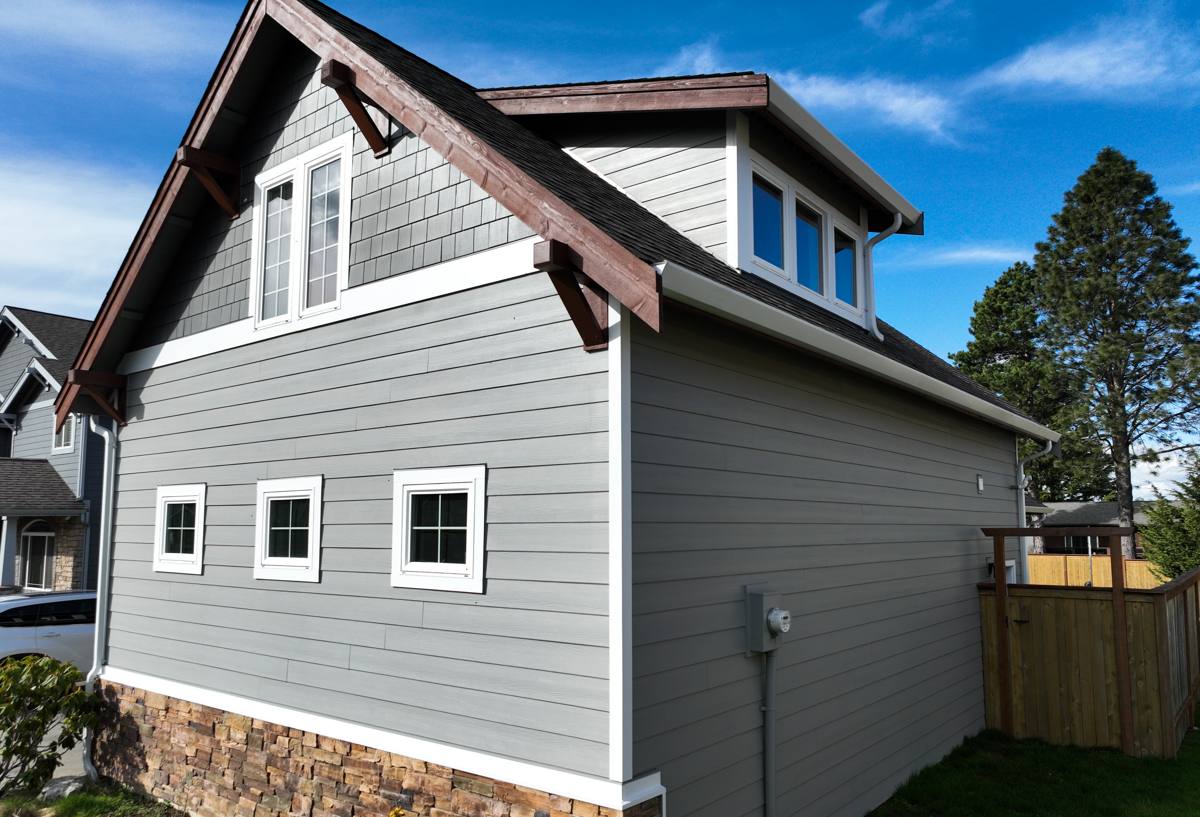
James Hardie fiber cement is non-combustible, dimensionally stable, and holds its factory-applied ColorPlus finish far longer than field-painted alternatives — which matters when a repaint means scheduling around Lopez's ferry-dependent access and a shorter dry-weather window. Hardie's HZ product lines are engineered for specific climate zones, including wetter coastal conditions, and the company backs it with a strong transferable warranty. Installed correctly — proper clearances, correct fasteners, flashing detailed for wind-driven rain — it's a siding system built for exactly the conditions Lopez Island throws at a house.
Roofing for a Long Damp Season
A roof on Lopez Island earns its keep by shedding water fast and resisting the moss and algae growth that a long wet season encourages. That comes down to a few unglamorous details: proper underlayment, flashing at every valley and penetration, adequate ventilation so the underside of the roof deck isn't fighting condensation on top of exterior moisture, and materials chosen for how they perform wet, not just how they look dry. We size every roofing recommendation to the specific exposure of the house — a roof tucked into trees on the island's interior faces a different moss risk than one open to wind off the water.
Windows: Sealing Out Wind-Driven Rain
Windows are one of the most common places water actually gets into a wall on a coastal property. It's rarely the glass — it's the flashing and sealant details around the frame. On Lopez Island homes, we pay particular attention to head flashing and sill pan details on walls that face open water or prevailing wind, since that's where driving rain tests a window installation hardest. Replacement windows also give homeowners a chance to improve energy performance, which matters through a Pacific Northwest winter with a lot of gray, damp days in a row.
Decks: Built to Handle Salt Air and Standing Moisture
Outdoor decks on Lopez face their own version of the same problems — salt air accelerating fastener corrosion, and dampness sitting in ledger connections, joist hangers, and anywhere water can pool instead of draining. We use fasteners and hardware rated for coastal exposure and pay close attention to ledger flashing, since that's the single most common source of hidden rot on a deck attached to a house in a wet climate.
What Homeowners on Lopez Island Should Watch For
- Moss buildup on the north or shaded side of the roof or siding, which signals slow drying and a good place for moisture to linger
- Soft or discolored trim around windows and doors, often the first visible sign of a flashing failure
- Peeling or bubbling paint on wood siding or trim, which usually means moisture is already trapped underneath
- Rust streaks below fasteners or metal flashing, a sign that salt air is working on hardware faster than expected
- Any siding seam or corner that looks like it's pulling away or gapping, since that's an open door for wind-driven rain
- Deck ledger boards or joist hangers with visible rust or dark, damp-looking wood around fasteners
Comparing Common Siding Options for a Lopez Island Home
| Material | Maintenance Burden | Moisture Behavior in a Wet Climate | Our Position |
|---|---|---|---|
| Vinyl | Low, but limited repair options if damaged | Seams can allow wind-driven rain behind cladding | Not installed by our crews |
| Cedar / primed spruce | High — regular refinishing needed | Depends entirely on an intact coating to resist moisture and moss | Not installed by our crews |
| LP SmartSide | Moderate — coating and edge sealing matter | Engineered wood strand product; performance depends on installation and maintenance | Not installed by our crews |
| Other fiber cement (Cemplank, Allura) | Low | Comparable category to Hardie, but we standardize on one manufacturer | Not installed by our crews |
| James Hardie fiber cement | Low — factory finish holds up for years | Non-combustible, dimensionally stable, engineered HZ lines for wetter climates | What we install exclusively |
Why a Local Crew Matters on Lopez Island
Working on Lopez Island isn't the same as working on the mainland — ferry schedules affect how a job gets staged and how quickly a crew can get back out for a follow-up, and every house's exposure to wind and salt varies depending on where it sits on the island. A crew that regularly works San Juan County properties understands those logistics and knows to look closely at flashing, fastener choice, and drainage details rather than assuming a mainland-standard installation will hold up the same way out here.
Our Process for Lopez Island Projects
- An on-site walkthrough to assess the house's specific exposure — wind direction, sun and shade patterns, existing moisture or moss issues
- A written estimate that spells out materials, scope, and timeline, with ferry logistics factored into scheduling
- Correct installation details for a marine climate: proper clearances, coastal-rated fasteners, and flashing sized for wind-driven rain rather than straight-down rain
- A final walkthrough so you understand what was done and what to watch for going forward
If your Lopez Island home is due for new siding, a roof, replacement windows, or deck work, we're happy to take a look and give you a straightforward, no-pressure estimate — no obligation, just an honest read on what your house actually needs.