 Orcas Island Siding
 Why San Juan Island's Climate Is Hard on Siding
San Juan Island sits in the same marine weather system as the rest of San Juan County, but island living adds its own wear pattern to a home's exterior. Salt-laden air off the water works into fastener heads, seams, and any exposed wood or edge grain. Driving rain off the water finds every gap in flashing and caulk. And the long stretch of wet, shaded months each year gives moss, algae, and mildew plenty of time to take hold on north-facing walls, under eaves, and anywhere siding stays damp longer than it should.
None of that damage happens overnight. It shows up as small, easy-to-miss problems first — a soft spot near a downspout, a hairline crack that's widened, a patch of green film that keeps coming back. By the time it's obvious from the street, moisture has usually been working behind the siding for a while. That's the pattern we see most often on repair calls out here, and it's why we look past the visible damage to what's happening underneath before we recommend a fix.
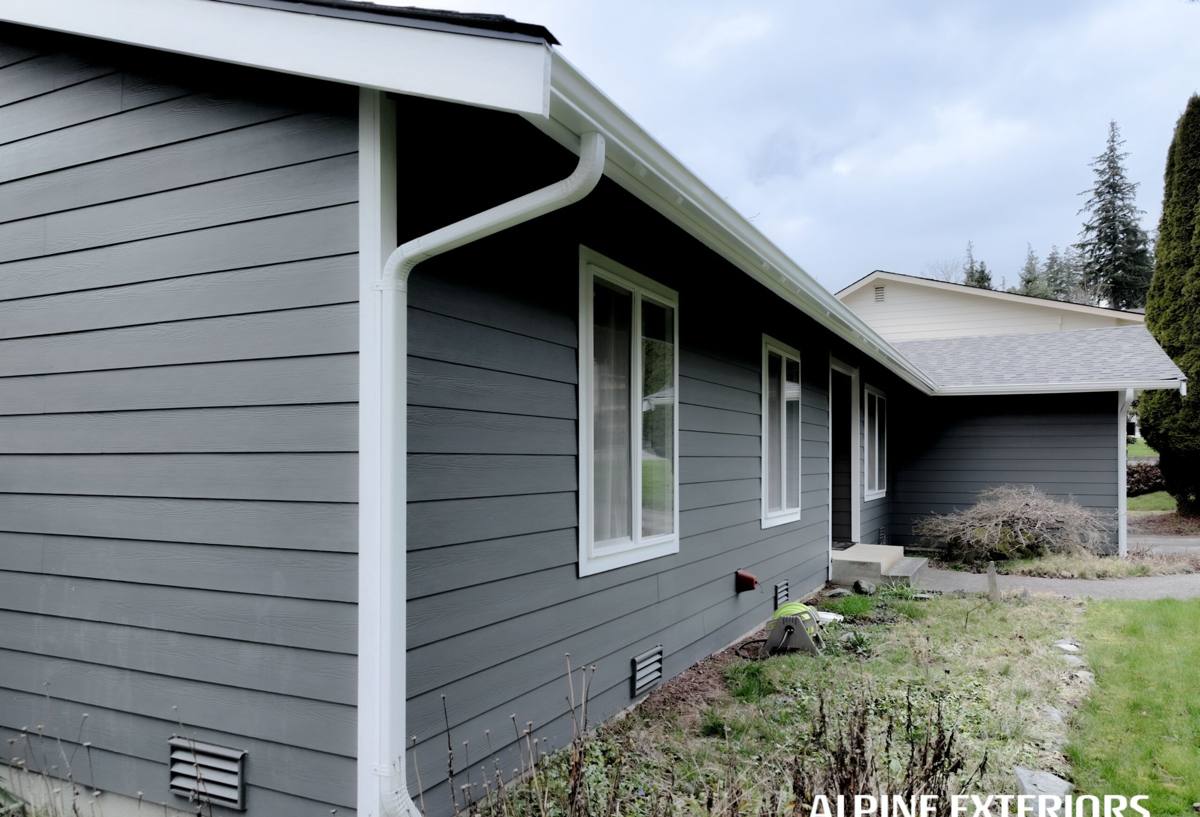
Signs Your Siding Needs Repair, Not Just a Repaint
A lot of San Juan Island homeowners reach for paint or caulk first, and sometimes that's the right call. But some symptoms mean the siding itself — or what's behind it — needs attention, not just a fresh coat:
- Soft, spongy, or crumbling siding when you press on it, especially near the bottom edge or around windows
- Cracks or splits that keep reappearing after being caulked or painted over
- Persistent moss or dark staining that returns within a season of cleaning
- Paint that's bubbling, peeling, or failing faster than it should on one side of the house — usually the side facing prevailing wind and rain
- Warped, buckled, or bowed panels, which usually mean moisture is trapped behind the siding
- Visible gaps at seams, corners, or trim where caulking has shrunk or pulled away
- Soft trim boards or rot at inside corners and butt joints, where water tends to collect
Any one of these on its own might be a small repair. Several at once, especially clustered on one wall, usually points to a moisture problem that's bigger than the siding itself — often a flashing or drainage issue that needs to be corrected as part of the repair, not just patched over.
What a Correct Siding Repair Actually Involves
It Starts Underneath the Siding, Not on Top of It
A repair that only addresses what's visible tends to fail again within a year or two, especially in this climate. Before we touch the siding, we check the water-resistive barrier, flashing at windows, doors, and penetrations, and the condition of any sheathing that's been exposed to moisture. If the underlying assembly is compromised, replacing siding over it just hides the problem again.
Matching, Fastening, and Sealing Matter
If the existing siding is James Hardie fiber cement, a proper repair means matching the correct profile and ColorPlus finish, using corrosion-resistant fasteners driven to the manufacturer's specified pattern and depth, and following Hardie's guidance on where caulk belongs — and where it doesn't. Over-caulking joints that are designed to allow drainage is a common mistake that traps moisture instead of shedding it.
Moss and Mildew Removal Has to Be Done Without Damaging the Surface
Pressure washing siding the wrong way — too close, too much pressure, or at the wrong angle — can drive water behind panels and force seams open, which creates the exact problem you're trying to prevent. Cleaning moss and mildew off siding correctly is a low-pressure, appropriate-cleaner job, not a power-wash-and-hope approach.
Repair vs. Replace: How We Help You Decide
Not every damaged section needs a full re-side, and we don't push for one when a targeted repair will hold up. The honest factors we weigh with homeowners:
| Situation | Usually Repair | Usually Replace |
|---|---|---|
| Damage limited to a few panels or one wall section | Yes, if the material underneath is sound | No |
| Existing siding is James Hardie fiber cement | Yes — matching material is straightforward | Only if damage is extensive |
| Existing siding is old cedar, LP, or vinyl showing widespread wear | Only as a short-term stopgap | Often the better long-term value |
| Moisture damage found behind multiple areas of siding | Rarely — underlying issue needs full access | Usually, to properly address the water barrier |
| Cosmetic wear (fading, chalking) with no structural issues | Not a repair issue — cleaning or repainting may suffice | No |
When the existing siding isn't James Hardie, we'll still tell you honestly whether a repair is worth doing or whether you're better off putting that money toward a proper re-side. Patching failing wood or vinyl siding on a home that's already showing widespread wear is sometimes just delaying a bigger job — we'd rather say that upfront than sell you a repair that won't hold.
Why We Repair — and Recommend — James Hardie Fiber Cement
We only install James Hardie fiber cement siding, and that standard shapes how we approach repairs too. Hardie's HZ5 product line is engineered for climates like this one — cold, wet, and humid for long stretches — and it doesn't absorb and swell with moisture the way wood-based products can. It's non-combustible, holds its ColorPlus factory finish far longer than field-applied paint on wood or composite siding, and comes with a strong transferable warranty when installed to spec.
That matters directly for repair work. When we replace a damaged section of Hardie siding, we're matching into a system that was engineered for this climate from the start, with a finish that ages consistently across the wall. Patching failing wood, LP SmartSide, or vinyl siding, by contrast, often means matching into a product that's already reached the point where the whole wall is due for replacement — the patch looks fine for a season and then stands out as everything around it continues to fade or wear.
Working on an Island: Scheduling and Logistics
Repair work on San Juan Island runs on a different clock than a mainland job. Materials, matching panel stock, and trim have to be brought over on a schedule that respects ferry sailings, and weather windows for exterior work can close fast this far out on the water. A crew that already works this island plans around that instead of treating it as a surprise — right-sizing material orders so a repair doesn't stall waiting for a second ferry trip, and scheduling work for stretches of weather that actually hold.
That local familiarity also means knowing which sides of a house on San Juan Island typically take the worst of the wind-driven rain and salt exposure, and checking those areas first even if that's not where the visible damage is.
Our Siding Repair Process, Step by Step
- On-site assessment — we inspect the damaged area and the surrounding siding, checking for moisture behind panels, not just visible cracks or gaps
- Diagnosis — we identify whether the cause is a flashing failure, a caulking issue, fastener corrosion, or trapped moisture, since the fix depends on the cause
- Honest repair-or-replace recommendation — we tell you plainly whether a targeted repair will hold up or whether the underlying siding is past the point of patching
- Material matching — for Hardie siding, we match profile, plank width, and ColorPlus color as closely as the existing product allows
- Repair work — damaged sections are removed, the water-resistive barrier and flashing are corrected if needed, and new material is installed to manufacturer fastening and sealing specs
- Final check — we walk the repaired area with you before considering the job done
Checklist: Is It Time to Call for a Repair Estimate?
- Siding feels soft or spongy when pressed
- Cracks or gaps keep reopening after caulking
- Moss or dark staining returns quickly after cleaning
- Paint or finish is failing unevenly across the house
- You can see daylight or gaps at trim and corner joints
- A section of siding looks warped, bowed, or separated from the wall
- It's been years since anyone inspected the siding up close, not just from the street
If two or more of these sound familiar, it's worth having someone look before the next wet season adds to the damage. If you're anywhere on San Juan Island and want a straight answer on whether your siding needs a repair or something more, we're happy to take a look. Fill out the form below for a free, no-pressure estimate.