 Orcas Island Siding
 Decks Built for West Sound, Not Just Any Backyard
West Sound sits close enough to the water that every deck we build there has to answer to conditions a lot of mainland decks never see. Salt-laden air moves off the water and settles into fasteners, framing, and finishes. Rain doesn't just fall here — it drives sideways for days at a stretch during the wet months. And the shade and moisture that make this part of Orcas Island so green also make it a near-perfect environment for moss and algae to take hold on any horizontal surface that doesn't drain and dry properly. A deck built without those specifics in mind will look fine for a season or two and then start showing problems: soft spots, black streaking, rusted fastener heads, railings that wobble because a post base corroded from the inside out.
This page is about what a correctly built custom deck looks like specifically for homes in the West Sound area — the material choices, the structural details, and the maintenance realities that matter here. It's not a generic "how to build a deck" rundown. It's what we've learned building and repairing decks in this exact microclimate.
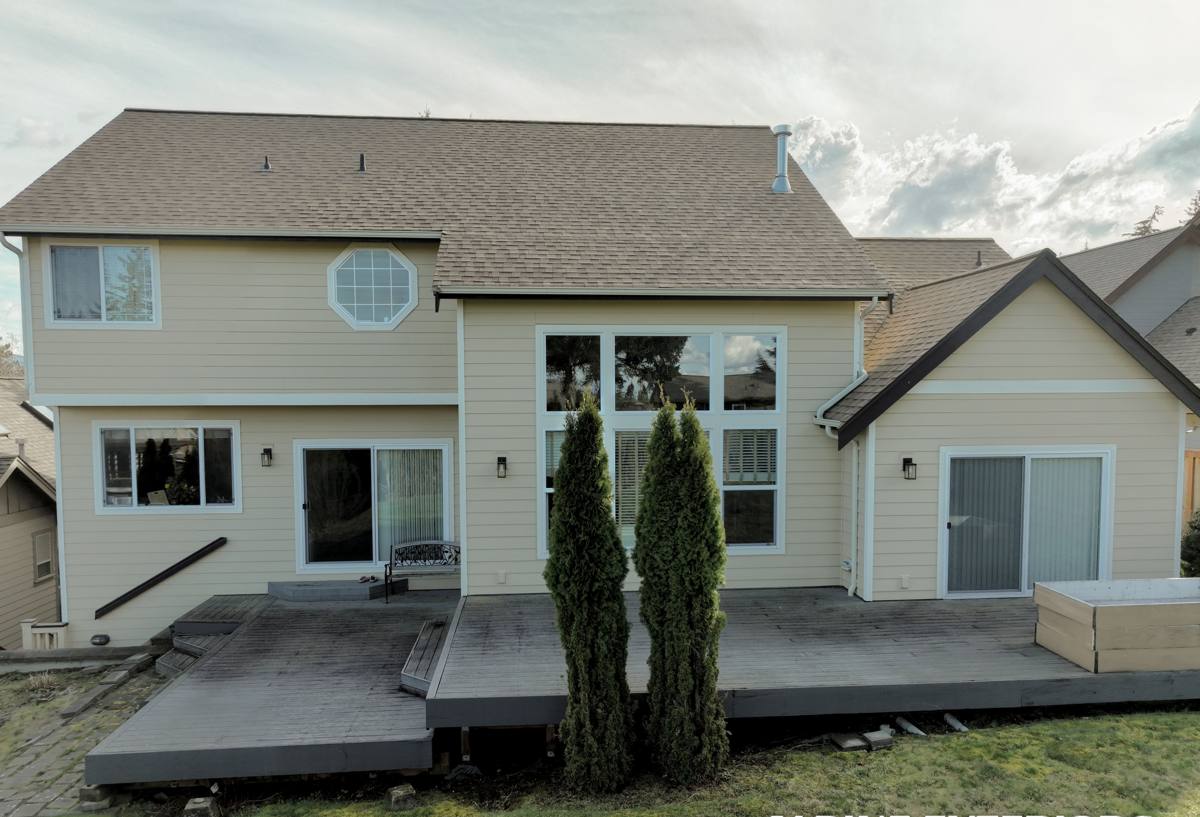
What Salt Air, Driving Rain, and Moss Actually Do to a Deck
Salt Air and Metal
Proximity to saltwater accelerates corrosion on anything metal — screws, joist hangers, post bases, railing brackets. Standard electro-galvanized hardware that would last decades inland can start rusting within a few years this close to the water. Once a fastener starts to corrode, it loses holding strength long before the rust is visible from the surface, which is exactly why deck hardware failures near the water tend to show up as sudden, not gradual, problems.
Driving Rain and Water Intrusion
Wind-driven rain doesn't behave like a gentle vertical shower. It gets pushed sideways into ledger connections, under railing posts, and into any gap where flashing was skipped or done poorly. The single most common failure point we see on older decks in this area is the ledger board — where the deck attaches to the house — because that connection was never properly flashed to shed water away from the house framing.
Moss, Algae, and Shade
Orcas Island's tree cover and marine humidity create ideal conditions for moss and algae growth on any deck surface that stays damp. Beyond looking bad, a mossy deck surface is a slip hazard, and moss that's allowed to establish itself on wood decking holds moisture against the boards, which speeds up rot in softwoods and can even stain and etch composite surfaces over time.
Choosing the Right Decking Material for This Site
There's no single "best" decking material — there's a best material for a given site, budget, and maintenance appetite. For West Sound properties, we weigh moisture behavior and corrosion resistance more heavily than we would for a drier, more sheltered lot.
| Material | How It Handles This Climate | Maintenance Reality |
|---|---|---|
| Cedar | Naturally rot- and insect-resistant, ages to a silver-gray patina, breathes well | Needs periodic cleaning and refinishing to control moss and keep color; softer surface |
| Pressure-Treated Fir/Pine | Budget-friendly, structurally solid when properly installed and sealed | Most prone to moss growth and surface checking if not maintained; needs regular sealing |
| Composite/PVC Decking | Doesn't rot, resists moisture absorption, consistent performance in wet shade | Low maintenance but still needs regular washing to prevent surface algae film; higher upfront cost |
| Tropical Hardwoods (e.g., Ipe) | Extremely dense and rot-resistant, handles wet conditions very well | Requires oiling to maintain color; hardware and fastening require extra care |
We don't push any single product line as the automatic answer. Composite decking has become popular near the water because it removes rot risk almost entirely, but it's not maintenance-free — it still needs to be washed to stay ahead of algae film, and lower-quality composite products can trap moisture at fastener points if they're not installed with the right ventilation gaps. Real wood, done right, can perform beautifully here too — it just asks more of the homeowner in terms of periodic cleaning and refinishing. We'll walk through the honest trade-offs for your specific site and sun exposure rather than defaulting to whatever's easiest to install.
The Structural Work Nobody Sees
A deck's surface material gets all the attention, but the framing underneath is what determines whether it's still solid in fifteen years. This is where corner-cutting shows up as expensive problems later, and it's where the West Sound climate matters most.
Ledger Flashing
Where the deck meets the house, we install proper flashing — typically a combination of metal flashing and a self-adhering waterproof membrane — to make sure water is directed away from the house rim joist rather than pooling against it. This single detail is responsible for more deck-related structural rot than almost anything else when it's missing or done wrong.
Joist Protection
Every joist top gets a protective tape barrier before decking goes on. In a climate with this much sustained rain, an unprotected joist top will absorb water through every screw hole over time, even when the joist itself is pressure-treated lumber.
Footings and Post Bases
Footings need to be sized and set below frost depth per code, and post bases should hold the post above the concrete and decking surface so wood never sits in standing water. We use corrosion-resistant post bases and hardware rated for the coastal exposure this area sees, not standard interior-grade connectors.
Fasteners and Hardware
This is the detail most likely to get skipped by a crew not used to building near saltwater. We use stainless steel or high-grade coated fasteners and connectors rated for coastal/corrosive exposure throughout the structure — not just on the visible decking screws. A deck is only as strong as its weakest hardware, and near the water that weak point shows up fast if the wrong grade of hardware was used.
Railings, Stairs, and Wind Off the Water
Many West Sound properties are built to take advantage of water views, which means railings need to be both code-compliant and able to handle real wind loading without feeling flimsy. Cable railing and glass panel systems are popular for view-oriented decks because they preserve sightlines, but they also demand corrosion-resistant hardware and correct post spacing to stay tight over time — a cable railing with the wrong-grade fittings will start showing rust streaks within a couple of seasons this close to the water.
Stairs on sloped lots — common throughout the island's terrain — need adequate stringer support and non-slip tread surfaces, which matters even more here given how often the surface stays damp from rain or morning moisture.
Our Process, Start to Finish
- On-site assessment: we look at sun exposure, drainage, existing structure (if replacing a deck), and how exposed the site is to weather off the water.
- Material and design conversation: honest trade-offs on decking material, railing style, and layout based on your budget and how much maintenance you want to take on.
- Permitting: we handle the San Juan County permit application and required inspections for the scope of work.
- Demolition and structural work: footings, framing, ledger flashing, and joist protection — the parts that determine whether the deck lasts.
- Decking, railing, and stairs installed with corrosion-resistant fastening throughout.
- Final walkthrough: we go over the finished deck with you and explain what maintenance it needs and roughly when.
Permits and Island Logistics
Most new deck construction and many deck replacements on Orcas Island require a permit through San Juan County, particularly for decks attached to the house, decks above a certain height, or any work that involves new footings. We handle that process as part of the job rather than leaving it to the homeowner to sort out.
Material logistics are also a real part of building on an island. Lumber, composite decking, and hardware all have to come over by ferry, which means lead times need to be planned for rather than assumed. A crew that regularly works West Sound and the surrounding areas already has these logistics built into how they schedule a job — it's one less thing that turns into a delay or a surprise mid-project.
Maintenance Checklist for a West Sound Deck
Whatever material you choose, a little seasonal attention goes a long way in this climate. Here's what we recommend homeowners stay on top of:
- Sweep debris and standing water off the deck surface regularly, especially under overhangs and near the house where drainage is slower
- Wash the surface at least once or twice a year to remove early moss and algae growth before it establishes
- Check railing posts and hardware annually for any sign of rust bleed or looseness
- Keep gutters and downspouts near the deck clear so runoff isn't concentrating extra water onto the deck or ledger area
- Reseal or refinish wood decking on the schedule appropriate to the species — don't wait until it's visibly gray and worn
- Trim back overhanging branches where possible to reduce shade and speed up drying time after rain
Why Hire a Crew That Already Works West Sound
A deck built by a crew unfamiliar with this specific climate tends to look correct on the day it's finished — the framing is square, the boards are tight — but the details that actually matter over time get missed: the wrong hardware grade, a ledger flashed the way it would be in a drier inland climate, decking installed without enough thought to drainage and drying. Those aren't obvious on day one. They show up in year three or four as rust, soft spots, and moss that won't go away no matter how often it's scrubbed.
Working regularly in San Juan County and specifically around West Sound means we already know which details matter here, what the county permitting process requires, and how to plan material delivery around ferry schedules so a project doesn't stall out waiting on lumber. That local familiarity isn't a marketing line — it's the difference between a deck that's still solid in fifteen years and one that needs major repair in five.
Getting Started
If you're planning a new deck or need to replace one that's showing its age, we're happy to come take a look and give you a straightforward, no-pressure estimate. Use the form below to get in touch and we'll set up a time to walk the site with you.