 Orcas Island Siding
 Roofing on an Island That Doesn't Forgive a Bad Roof
Shaw Island is one of the quieter, more wooded corners of San Juan County — reached only by ferry, tucked in among tall firs, and surrounded on all sides by salt water. That setting is a big part of why people love it, and it's also exactly why roofs here take more punishment than roofs a few miles inland. Homes sit under heavy tree cover that keeps roofs shaded and damp for long stretches, while open water exposure means salt-laden air and wind-driven storms move through on a regular basis. A roof that would hold up fine in a drier, more sheltered location can fail early out here if it wasn't built with this specific combination of conditions in mind.
A new roof installation on Shaw Island isn't just a bigger version of a repair. It's a chance to correct whatever the old roof got wrong — usually ventilation, flashing, or underlayment choices that weren't suited to a marine, shaded climate — and put something in place that's actually built for this environment for the next few decades.
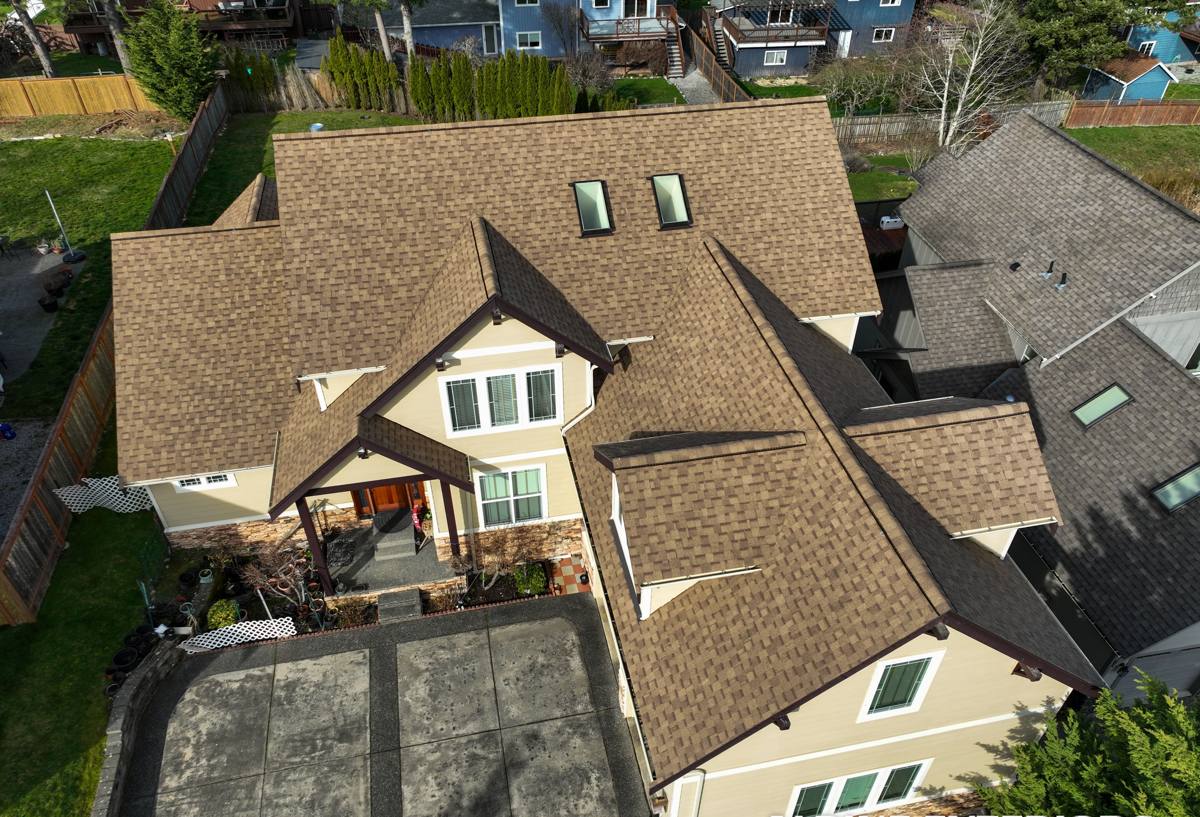
What Salt Air, Driving Rain, and Moss Actually Do to a Roof
These three factors don't just make a roof look worse over time — they shorten its working life if the installation doesn't account for them.
Salt Air and Metal Fatigue
Airborne salt accelerates corrosion on any exposed metal — flashing, fasteners, vents, gutters, and drip edge. Standard galvanized fasteners and bargain-grade flashing corrode faster near the water than the same materials would inland. Once flashing starts to pit and thin, it stops shedding water properly long before the shingles or panels around it are worn out, and that's usually where leaks start.
Wind-Driven Rain
Storms coming off the water don't just drop rain straight down — they push it sideways, up under shingle edges, and into any gap in flashing or trim. A roof here needs details built for rain that's actively trying to get underneath the roofing material, not just fall on top of it.
Moss and Shade
Heavy tree cover means less direct sun and slower drying after every rain. Moss and algae take hold fastest on roof sections that stay shaded and damp, and once moss gets a foothold it holds moisture against the roofing material and can lift shingle edges over time. Roofs on wooded island lots need both the right surface material and a design that lets water and air move off the roof quickly.
Choosing a Roofing System Built for This Climate
There's no single "best" roofing material for every home — it depends on the roof's shape, how much shade it sits under, and what the homeowner wants to maintain long-term. Here's how the main options typically compare for a shaded, salt-exposed island property.
| Material | Moss & Algae Resistance | Salt Air Handling | Wind/Rain Performance | Relative Cost |
|---|---|---|---|---|
| Algae-resistant architectural asphalt shingle | Good, with copper or zinc strips at ridges for extra protection | Good when paired with corrosion-resistant flashing and fasteners | Strong when properly nailed and sealed | Moderate |
| Standing seam metal | Very good — sheds moss and debris more easily due to slope and slick surface | Depends heavily on coating and fastener quality; needs marine-grade specification | Excellent for wind uplift resistance | Higher |
| Cedar shake / synthetic shake | Poor to moderate for real cedar in shaded, damp settings; better for synthetic composites | Fair; real wood needs more upkeep near salt air | Good, but real cedar requires diligent maintenance | Higher (real cedar) / Moderate (synthetic) |
For most shaded Shaw Island lots, we lean toward algae-resistant architectural shingles or standing seam metal, both installed with corrosion-resistant flashing and fasteners rated for coastal exposure. Real cedar shake can look great, but in a heavily shaded, damp setting it demands a maintenance commitment that not every homeowner wants to take on — that's a trade-off worth discussing honestly before you commit, not something we'll talk you out of if it's genuinely what you want.
What a Correct Installation Actually Involves
A new roof is only as good as what's underneath the visible surface. The parts nobody sees are usually what determines whether a roof lasts 15 years or 30 in this climate.
- Full tear-off: old material and old flashing removed so the decking can actually be inspected, not just re-covered.
- Decking repair: any soft, rotted, or delaminated sheathing replaced — common on older roofs that have held moisture under moss for years.
- Ice-and-water shield at vulnerable points: eaves, valleys, and around every penetration, to back up the main roofing material where wind-driven rain is most likely to get in.
- Corrosion-resistant flashing and fasteners: at chimneys, skylights, sidewalls, and vents — the details salt air attacks first.
- Balanced attic ventilation: intake at the eaves and exhaust at the ridge, so the roof deck dries out between storms instead of staying damp.
- Proper drip edge and starter course: so water is directed off the roof edge and into the gutters, not back under the first course of shingles.
Skipping any one of these doesn't necessarily show up as a problem right away — it shows up as a leak or premature moss growth two or three years later, which is exactly the kind of "surprise" a new roof is supposed to prevent.
Our Process for a Shaw Island Roof Replacement
Working on the islands takes more planning than a mainland job, and we build that into the schedule rather than treating it as an inconvenience.
- On-site evaluation: we walk the roof, check the attic for existing moisture or ventilation issues, and take real measurements rather than estimating from photos.
- Material selection and staging: once material is chosen, we coordinate ferry logistics and delivery timing so everything needed for the job arrives together — running short on materials mid-job on an island isn't a quick fix.
- Weather-window scheduling: a full tear-off leaves a home exposed until dried-in, so we schedule around the most reliable weather stretch we can find and keep the open-roof period as short as possible.
- Permitting: San Juan County permitting requirements are handled before work starts, not worked around after the fact.
- Installation and daily cleanup: tear-off, deck repair, underlayment, and roofing material installed in sequence, with the site cleaned and secured at the end of each day.
- Final walk-through: flashing, vents, and edges reviewed with the homeowner before we consider the job finished.
Ventilation and Moisture Control: The Half of the Job You Don't See
A shaded island roof lives or dies by how well it manages moisture it can't avoid getting exposed to. Balanced ventilation — enough intake at the soffits to match exhaust at the ridge — keeps the underside of the roof deck closer to outdoor temperature and humidity, which slows both moss growth on top and condensation problems underneath. On older Shaw Island homes we often find ventilation that was undersized or blocked entirely, sometimes by insulation stuffed too far into the eaves. Correcting that during a full roof replacement is far easier and cheaper than trying to retrofit it later.
Why It Matters to Hire a Crew That Already Works the Islands
A roofing crew that only occasionally takes island jobs has to relearn the logistics every time: ferry schedules, material staging, what happens if a delivery is missed, and how San Juan County permitting works. A crew that already works Shaw Island and the surrounding islands regularly has that figured out, which usually means fewer surprise delays and fewer trips back to fix something that wasn't accounted for the first time.
It's also worth asking any contractor you're considering a few direct questions before you sign anything:
- Have you completed roofing projects on Shaw Island or nearby San Juan County islands before?
- How do you handle material delivery and staging around ferry schedules?
- What flashing and fastener grade do you use for salt-air exposure, and why?
- How is attic ventilation assessed and addressed as part of the installation?
- What's included in writing — warranty terms, cleanup, and what happens if weather delays the job?
A contractor who answers these clearly, without hedging, is usually one who's done this kind of job before.
Keeping a New Roof Performing After Installation
A properly installed roof still benefits from a little seasonal attention in this climate, especially with heavy tree cover nearby:
- Clear gutters and downspouts of needles and debris before the fall rains pick up.
- Have moss or algae growth addressed early with appropriate, roof-safe treatment rather than left to spread.
- Trim back overhanging branches that keep sections of the roof shaded and slow to dry.
- Have flashing and fasteners visually checked every year or two, since salt-air corrosion is gradual and easy to miss until it isn't.
If your Shaw Island home needs a new roof, we're glad to take a look and talk through what actually makes sense for your property's exposure, shade, and budget — no pressure, no hard sell. Use the form below to request a free estimate.