 Orcas Island Siding
 Windows Built for the Cascade Lake Microclimate
Homes around Cascade Lake sit in one of the more demanding microclimates on Orcas Island. The lake and the surrounding forest canopy of Moran State Park hold moisture close to the ground long after a storm has passed, and the tree cover means many homes get less direct sun and more shade-driven dampness than properties along the open shoreline. Add in the salt-laden air that moves across San Juan County off the Salish Sea, driving rain that comes in sideways during winter storms, and a moss season that can run eight months or more, and you have a set of conditions that will find every weak point in a window assembly — the frame, the glazing, and especially the seal around it.
Energy-efficient windows are marketed everywhere, but "efficient" only means something if the unit actually keeps water out and holds its seal in this specific environment. A window rated well in a lab test in a dry climate can still underperform on Orcas Island if it isn't installed with the right flashing and drainage details for a wet, shaded, salt-exposed site like Cascade Lake.
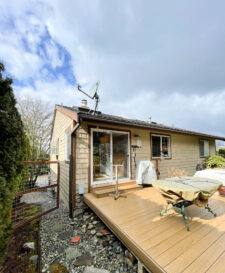
How to Tell Your Windows Are Working Against You
Most homeowners don't replace windows because they woke up thinking about U-factors. They replace them because something is visibly or financially wrong. Around Cascade Lake, the tells are pretty consistent:
- Cold drafts near the sash or frame even when the window is latched shut
- Condensation or fogging between double-pane glass, meaning the seal has failed
- Wood sashes that have swollen, stuck, or gone soft at the bottom corners
- Visible moss or black streaking building up on the sill or lower frame
- A noticeable jump in heating costs during the shoulder seasons
- Paint or finish peeling faster on window trim than on the rest of the siding
Any one of these is worth a look. Several at once usually means the window's original seal or flashing has already failed and moisture has been getting behind the frame for a while — which is a siding and framing problem, not just a window problem, if it goes unaddressed.
What "Energy-Efficient" Actually Means
The term gets used loosely, so it's worth being specific about what actually matters in a window's performance, and why each factor carries different weight here than it might in a drier inland climate.
U-Factor
This measures how well the window resists heat transfer — lower is better. It matters year-round here because Orcas Island winters are long and damp, and most homes are heated with electricity, heat pumps, or propane rather than cheap piped-in gas. A poor U-factor shows up directly on the power bill.
Solar Heat Gain Coefficient (SHGC)
This measures how much solar heat passes through the glass. For a shaded, tree-covered property near the lake, you're generally not fighting excess solar heat gain the way a south-facing waterfront home might be — so the priority shifts toward insulating value and moisture performance over glare and heat control.
Low-E Coatings and Gas Fills
Low-emissivity coatings and argon or krypton gas fills between panes both improve insulating performance without adding bulk. These are standard on any window worth installing today, but the coating type and fill matter less than whether the unit's seal will hold up to years of damp, salt-bearing air — a poorly sealed high-spec window will underperform a well-sealed simpler one within a few seasons.
Frame Material
This is where climate exposure matters most. The table below compares how common frame materials actually hold up in a marine, moss-prone environment like Cascade Lake, not just in a showroom.
| Frame Material | Moisture & Salt Air Resistance | Maintenance | Typical Lifespan |
|---|---|---|---|
| Vinyl | Good — won't rot or corrode, but can warp under heat/cold swings if low quality | Low — occasional cleaning | 20–30 years |
| Fiberglass | Excellent — dimensionally stable, doesn't absorb moisture | Low | 30–40+ years |
| Aluminum | Fair — corrosion-resistant coatings needed near salt air; conducts cold | Low to moderate | 20–30 years |
| Wood | Poor to fair without diligent upkeep — attractive but vulnerable to rot and moss | High — regular painting/sealing | 15–25 years without upkeep |
| Wood-clad (wood interior, vinyl/aluminum exterior) | Good — exterior shell protects the wood | Moderate | 25–35 years |
None of these are wrong choices in every case — a lot depends on the home's style and the owner's tolerance for upkeep. But on a shaded, damp lot near the lake, we steer most homeowners away from bare wood exteriors unless they're committed to a real maintenance schedule, simply because moss and standing moisture are harder to keep off wood than off a clad or fiberglass surface.
Matching the Window to the Site, Not Just the House
Two homes on the same street around Cascade Lake can need different window specs depending on how much tree cover they sit under, which direction they face, and how exposed they are to wind-driven rain coming off the water. A window on the shaded, forest-facing side of a home deals mostly with sustained dampness and moss — the priority there is drainage and rot resistance at the sill. A window on the more open, wind-exposed side deals more with driving rain and pressure — the priority there is a tight, well-flashed seal that won't let water past the frame during a real storm. We look at each elevation of the house separately rather than speccing every window the same way.
Our Installation Process
Most window failures we get called out to fix trace back to the installation, not the product. A quality window installed with sloppy flashing will leak; a mid-range window installed correctly will outperform it. Our process is built around getting the water management right, every time:
- On-site assessment — we check each opening for existing rot, soft framing, or prior water intrusion before quoting anything
- Precise measurement — old openings on Orcas Island homes are rarely perfectly square, especially in older cabin-style construction
- Removal and inspection — once the old unit is out, we check the sheathing and framing behind it for hidden moisture damage
- Flashing and drainage plane integration — the new window is tied into the house's water barrier so any moisture that reaches the frame drains out and down, not into the wall
- Air sealing and insulation — the gap between the frame and rough opening is properly insulated and sealed, not just caulked over
- Interior and exterior finish work — trim is reset and sealed to match the home
- Final water test where conditions warrant it — particularly on wind-exposed elevations
That flashing step is the one most often skipped by crews unfamiliar with this climate, and it's the one that matters most here. A window can have a great warranty on the glass and still leak at the frame if it wasn't tied properly into the wall's drainage plane.
Why Flashing and Sealing Carry More Weight Here
In a dry climate, a mediocre flashing job might go unnoticed for years. Around Cascade Lake, with driving rain, dense shade, and near-constant ambient moisture for much of the year, a gap in the flashing shows up fast — as rot in the framing, staining on interior sills, or moss finding a foothold in a spot that never fully dries out. Moss itself isn't just cosmetic: once it establishes on a sill or lower frame, it holds moisture against the wood or siding continuously, accelerating decay in exactly the spots where a window seal is most vulnerable. Correct flashing, a proper drainage gap, and quality sealant rated for exterior, marine-climate exposure aren't upgrades — they're the baseline for a window that's actually going to perform on this property.
Working Around Island Logistics
Ordering windows for a Cascade Lake home isn't quite the same as ordering for a mainland job. Materials generally have to come over by ferry, which means lead times need to be planned around the schedule rather than assumed to be next-day. We build that into the timeline up front — measuring and ordering early, and sequencing the job so your home isn't sitting with open rough openings waiting on a delayed shipment. It also means we plan weather windows carefully; driving rain and a delayed ferry run are a bad combination if an opening is exposed, so we don't start tear-out until materials are confirmed on-island.
Maintaining Your Investment After Installation
A correctly installed energy-efficient window should need very little from you, but a little seasonal attention goes a long way in this climate:
- Clear moss and debris from sills and tracks before it gets a foothold, especially on shaded elevations
- Check exterior caulking annually and touch up anywhere it's cracked or pulled away
- Keep gutters and downspouts clear so runoff isn't sheeting directly across upper windows
- Operate hardware a few times through the off-season so latches and hinges don't seize
- Watch for soft spots in exterior trim, which usually show up before an actual leak does
Why Hire a Crew That Already Works Cascade Lake
Window installation isn't one-size-fits-all, and a crew that mostly works drier, inland climates can miss details that matter here — how much drainage gap a shaded sill actually needs, how to flash correctly against Orcas Island's rain patterns, or how to sequence a job around ferry-dependent material deliveries. Working regularly in San Juan County means we're not guessing at any of that. We know which frame materials hold up under sustained shade and moisture, which installation details actually stop water on a wind-exposed elevation, and how to plan a project so it isn't derailed by a missed ferry or an early winter storm. That familiarity is the difference between a window that looks right on install day and one that's still performing correctly five wet seasons later.
If your windows are drafty, fogged, or just due for an honest look, we're happy to come out and take a look at no cost and with no pressure to sign anything. We'll tell you straight whether repair, resealing, or replacement makes sense for your home — use the form below to request a free estimate.