 Orcas Island Siding
 Why Cascade Lake Roofs Age Differently
Homes around Cascade Lake sit under heavier tree cover than most of Orcas Island — tall firs and cedars ring the lake and the surrounding parkland, which means shade for most of the day and a steady rain of needles, cones, and organic debris onto every roof plane. That shade keeps roofs damp longer after storms, and damp plus organic debris is exactly what moss and moisture-loving lichen need to take hold. Add San Juan County's long wet season and the salt-laden air that moves across the whole island, and you get a roofing environment that's tougher on materials than a typical inland home faces.
None of this means a roof here is doomed early. It means the roof has to be built and maintained with those specific stresses in mind — the right underlayment, the right ventilation, and material choices that don't trap moisture under a canopy that rarely lets a roof fully dry out.
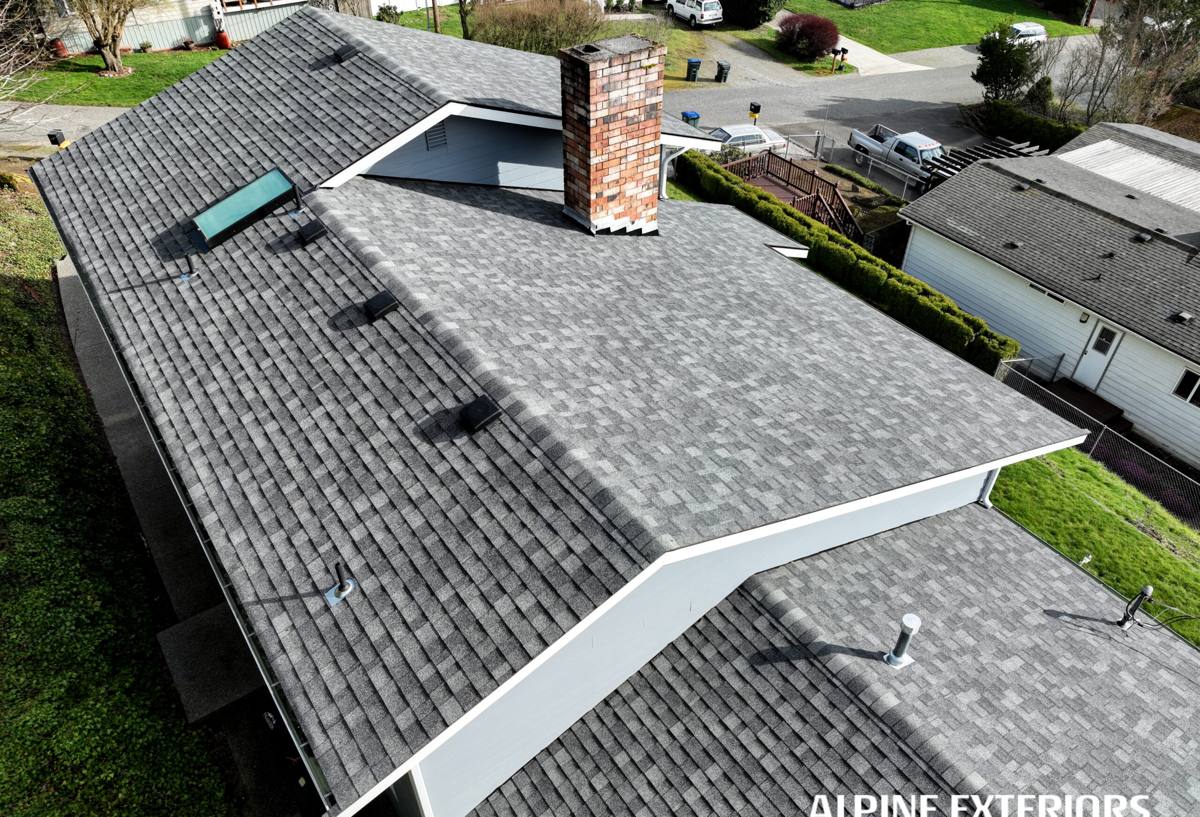
What Actually Wears Out a Roof Near Cascade Lake
- Moss and lichen growth — takes root in shaded valleys, north-facing slopes, and anywhere debris collects, lifting shingle edges and holding water against the roof deck.
- Needle and debris buildup — clogs valleys and gutters, backing water up under shingles or shakes instead of letting it run off.
- Driving rain — wind-driven storms push water sideways under flashing and up under shingle tabs that aren't properly sealed or lapped.
- Salt air corrosion — accelerates rust on exposed fasteners, flashing, and metal roofing that isn't rated or coated for a marine environment.
- Prolonged dampness — shade from the surrounding trees slows drying time after every rain, which shortens the working life of algae-resistant shingle granules and encourages rot in older wood decking.
Signs a Cascade Lake Roof Needs Replacing, Not Patching
Repairs make sense when the damage is isolated — a cracked pipe boot, a section lifted by wind, a small flashing leak. Replacement becomes the honest recommendation when the problems are spread across the whole roof rather than one spot. Here's how we tell the difference on a site visit:
| What we see | Usually means |
|---|---|
| Moss confined to one shaded valley | Cleaning and targeted repair may be enough |
| Moss and granule loss across multiple slopes | Shingles are past their protective life — replacement territory |
| Soft or spongy decking in one small area | Localized repair with deck replacement at that spot |
| Soft decking found in more than one area during inspection | Sign of long-term moisture intrusion — full replacement warranted |
| Curling or cracked shingles concentrated near the edges | Often flashing or ventilation related — repair possible |
| Curling, cracking, and granule loss uniformly with roof age | Material has simply reached end of service life |
We won't recommend a full replacement when a repair will genuinely hold up. But we also won't patch a roof that's failing broadly just to avoid a harder conversation — that costs a homeowner more in the long run, especially with a wet season this long.
What a Correct Roof Replacement Involves Here
Tear-off and deck inspection
Every existing layer comes off down to the deck, which is the only way to actually see what's underneath. In a shaded, moisture-prone spot like Cascade Lake, we specifically check for soft or delaminated sheathing, especially around valleys, chimneys, and skylights where water has had the most opportunity to sit.
Underlayment built for wind-driven rain
A synthetic underlayment with a self-adhered ice-and-water membrane at eaves, valleys, and penetrations gives a second line of defense when wind pushes rain sideways up under the roof covering — a real occurrence during winter storms on the island.
Flashing sized for the site
Chimneys, skylights, dormers, and roof-to-wall intersections get new step and counter-flashing, not caulk over old metal. Under tree cover, flashing seams are one of the first places a slow leak starts, because water has more time to find a way in before the roof dries out.
Ventilation that matches the roof
Balanced intake and exhaust ventilation keeps the underside of the deck dry and regulates attic temperature, which matters more under a shaded canopy where the roof surface itself dries slowly. We size and place vents to the specific roof, not a one-size-fits-all count.
Material installed to spec
Fastener placement, nail count, exposure, and sealing all follow manufacturer installation requirements — not shortcuts. This is what keeps a warranty valid and what actually determines how the roof performs in wind and driving rain.
Material Choices for a Shaded, Salt-Air Site
There's no single "right" material for every home — it depends on the roof's pitch, sun exposure, HOA or neighborhood expectations, and budget. What matters near Cascade Lake specifically is how a material handles sustained shade and moisture, and how its metal components hold up to salt air.
| Material | How it handles shade & moss | Salt-air consideration |
|---|---|---|
| Architectural asphalt shingle | Algae-resistant granule options slow moss/lichen growth; still needs periodic cleaning under heavy tree cover | Standard fasteners and flashing should be corrosion-resistant near the coast |
| Standing seam metal | Sheds debris and dries faster than shingle roofs; moss has a harder time gripping smooth metal | Requires marine-grade coatings and fasteners; lesser-grade metal corrodes faster in salt air |
| Synthetic/composite shingle | Resists moisture absorption better than wood; holds up well in shaded, damp conditions | Minimal metal components reduces corrosion exposure |
| Wood shake | Highest maintenance burden in shade — retains moisture, more prone to moss and rot without diligent upkeep | Not a corrosion issue, but shortened lifespan under a wet tree canopy |
We'll walk through these trade-offs honestly for your specific roof rather than pushing one product — a full-sun roof and a lake-shaded, tree-covered roof can reasonably end up with different recommendations even on the same street.
Our Process, Start to Finish
- On-site inspection — we walk the roof and attic, check for soft decking, ventilation gaps, and the extent of moss or moisture damage.
- Written estimate — a clear scope covering tear-off, decking repair allowance, underlayment, flashing, ventilation, and material, with no vague line items.
- Material selection — we go over the trade-offs above against your roof's actual sun exposure and budget.
- Scheduling around the weather — we plan tear-off days around dry stretches to keep the deck exposed for the shortest time possible.
- Tear-off and deck repair — old material removed, deck inspected and repaired as needed before anything new goes down.
- Installation to spec — underlayment, flashing, ventilation, and roofing material installed per manufacturer requirements.
- Final walkthrough — we review the finished roof with you, including care and maintenance specific to your site.
Timing, Access, and the Realities of an Island Job
Roofing on Orcas Island comes with logistics a mainland job doesn't: material and equipment often travel by ferry, and driveways around the lake and park land can be narrower or steeper than a typical suburban lot, which affects staging and dumpster placement. We plan deliveries and crew scheduling around ferry timing so a job doesn't stall waiting on material, and we scope access needs during the initial walk so there are no surprises on tear-off day.
Weather windows matter too. San Juan County's wet season runs long, and a tear-off left exposed overnight in the rain is a real risk to the deck below. We watch the forecast and sequence work so the roof isn't open to weather longer than necessary — this is standard practice for us, not an upsell.
Why Local Experience on This Specific Roof Type Matters
A crew that mostly works sunny, open-lot roofs will treat a Cascade Lake home the same way they'd treat any other job — and that's where moss comes back within a year or ventilation gets under-sized for a shaded deck that never fully dries. Working this area regularly means we already know which slopes hold moisture longest, where debris collects fastest under this kind of tree cover, and how driving winter rain off the water behaves against different roof lines. That's the difference between a roof that looks right on installation day and one that actually performs through a full wet season, year after year.
After the Roof Goes On: Keeping It Performing
A correctly installed roof still benefits from basic upkeep, especially under tree cover this heavy:
- Clear needles and debris from valleys and gutters at least twice a year, more often if the canopy is dense overhead.
- Have moss or lichen treated at first sign rather than letting it spread across a slope.
- Check flashing around chimneys and skylights annually for gaps or lifted edges.
- Trim overhanging limbs where practical to cut down on debris and let more light and air reach the roof surface.
- Watch for granule buildup in gutters, which can signal a shingle roof nearing the end of its service life.
If you're weighing repair versus replacement, or just want an honest read on where your roof stands, we're glad to take a look. The estimate is free, there's no pressure attached to it, and you'll get a straight answer either way — you can request one using the form below.