 Orcas Island Siding
 What San Juan Island Homes Are Actually Up Against
San Juan Island sits in the rain shadow of the Olympics, which means less annual rainfall than mainland Puget Sound — but that statistic hides more than it reveals. What the island actually delivers is a steady combination of salt-laden marine air, driving horizontal rain during winter storms, and long stretches of damp, shaded conditions that keep moss and algae active on north-facing walls for most of the year. Add ferry-dependent logistics, older housing stock built before modern moisture standards, and homes perched close to the water on exposed bluffs, and you get a siding environment that punishes shortcuts fast.
Siding on San Juan Island isn't just decorative. It's the first line of defense against a climate that combines coastal exposure with the kind of prolonged, low-grade dampness that Western Washington is known for. A siding system that isn't built for salt air, sustained moisture, and biological growth will show its weaknesses within a few seasons — not decades.
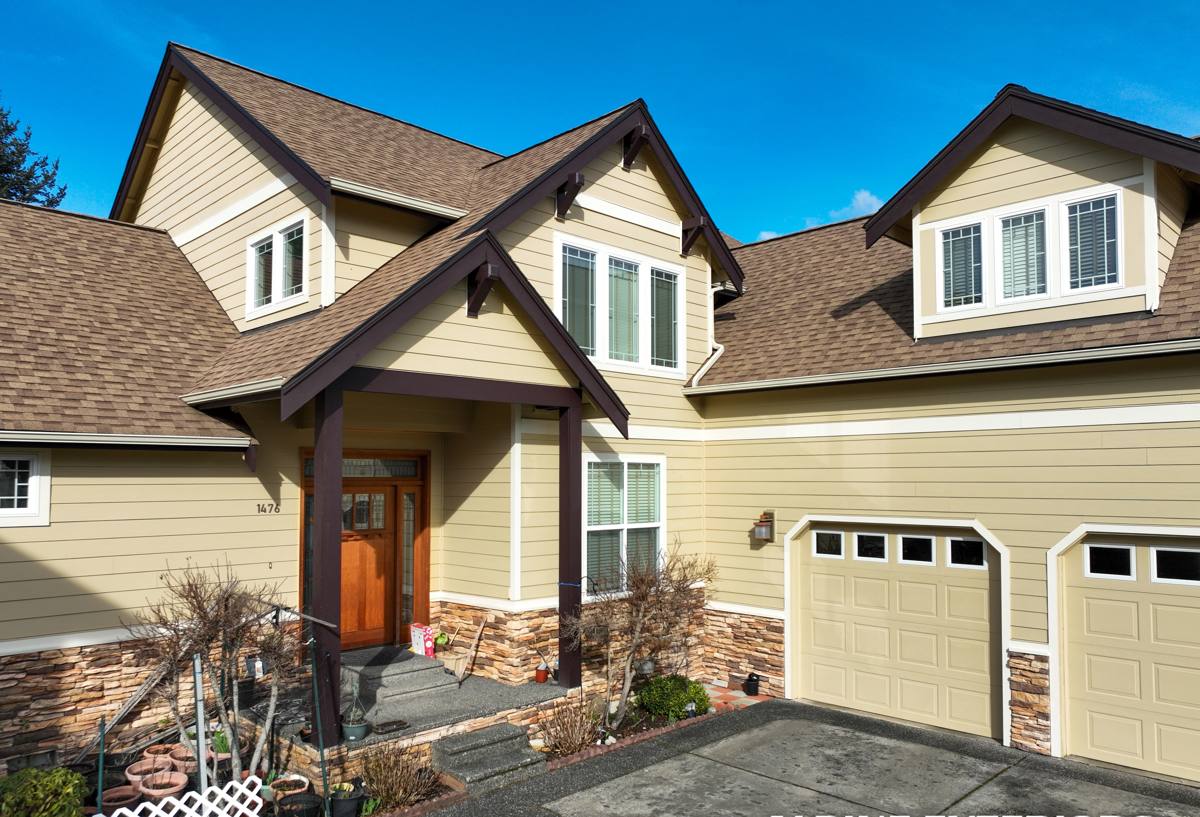
How Salt Air, Rain, and Moss Actually Damage Siding
Salt Air
Homes near the shoreline take on airborne salt that settles on exterior surfaces and accelerates corrosion of fasteners, flashing, and any metal trim. Salt also draws moisture out of the air and holds it against the wall surface longer than it would sit in an inland location, which matters enormously for any siding material that isn't dimensionally stable when wet.
Driving Rain
Winter storms off the Strait of Juan de Fuca and the Salish Sea don't always fall straight down — wind-driven rain gets pushed sideways into walls, corners, and anywhere flashing and caulking are doing the real work. Poorly lapped siding, gapped joints, or missing kick-out flashing at roof-to-wall intersections turn into slow, hidden water intrusion long before anything shows on the surface.
Moss and Algae
Shaded, north- and west-facing walls on tree-covered lots stay damp for extended periods, which is exactly what moss and algae need to establish. Left unaddressed, biological growth holds moisture against the siding surface, degrades paint and finish coatings, and — on materials that swell or absorb water — accelerates rot from the outside in.
Why Material Choice Matters More Here Than Almost Anywhere
On a lot in a low-humidity inland climate, a mediocre siding product might perform fine for years. On San Juan Island, the margin for error is much smaller. We install James Hardie fiber cement siding exclusively, and on island properties specifically, the reasons come down to three things:
- Non-combustible composition — fiber cement doesn't burn, which matters on properties where wildfire risk and limited fire department response times are real considerations.
- Dimensional stability when wet — Hardie's fiber cement doesn't swell, cup, or delaminate the way wood-based and some engineered wood products can when exposed to sustained moisture.
- Factory-applied ColorPlus finish — a baked-on finish applied under controlled conditions holds up to salt air and UV exposure far better than field-applied paint, and it doesn't need repainting on the same cycle wood siding does.
We don't install vinyl, LP SmartSide, primed wood, or cedar. That's not a knock on every use case for those products — it's a standard we hold because we've seen how island conditions specifically expose their weak points: vinyl becomes brittle and can crack in cold snaps and flex in wind, wood-based products are vulnerable to prolonged moisture exposure, and cedar demands a maintenance schedule that most owners of a second home or a busy full-time residence simply can't keep up with. Fiber cement, installed correctly, is built for exactly this kind of exposure.
What a Correct Siding Installation Involves Here
The siding material is only half the equation. On San Juan Island, the installation details are what actually determine whether a home stays dry for the next 30 years or develops hidden rot in year five. A correct job includes:
- Water-resistive barrier — a continuous, properly lapped weather barrier behind the siding, installed shingle-style so water is always directed outward and down, never trapped.
- Rainscreen or drainage gap — a small air gap between the siding and the water-resistive barrier lets any moisture that does get past the cladding drain and dry out instead of sitting against the wall sheathing.
- Flashing at every penetration — windows, doors, vents, and roof-to-wall intersections all need properly integrated flashing, not just caulk. Caulk fails; flashing sheds water by design.
- Correct fastener spec — corrosion-resistant fasteners, installed per manufacturer specification, matter enormously in a salt-air environment where standard fasteners will corrode and stain the siding face over time.
- Manufacturer-spec clearances — proper gaps at grade, roofline, and decking so siding never sits in standing water or gets buried under mulch, soil, or hardscape.
- Sealed and caulked joints — factory-cut and field-cut edges primed and sealed per Hardie's installation guidelines, especially at butt joints and inside corners.
Skip any one of these steps and the siding material's quality stops mattering — water will find the gap.
Common Installation Mistakes We Correct
- Face-nailing through overlaps instead of blind-nailing per spec, which traps moisture at the fastener point.
- Missing or undersized rainscreen gap, especially on the shaded, moisture-prone sides of a home.
- Caulk used as a substitute for flashing at window and door penetrations.
- Siding installed tight to grade or decking with no clearance, wicking moisture up from below.
- Untreated cut edges left exposed to the weather.
Our Process for San Juan Island Projects
Because San Juan Island is ferry-access only, project logistics are part of doing this work correctly — materials, crew scheduling, and disposal all have to be planned around ferry timing rather than treated as an afterthought. Our process:
| Step | What Happens |
|---|---|
| Site Assessment | On-site evaluation of existing siding, moisture damage, exposure direction, and any rot or flashing issues found during tear-off |
| Material Planning | James Hardie product line, profile, and ColorPlus finish selected for the home's exposure and style; materials ordered and staged ahead of the crew's arrival on-island |
| Tear-Off & Sheathing Check | Old siding removed, sheathing inspected for hidden rot or water damage before anything new goes on |
| Weather Barrier & Rainscreen | Continuous water-resistive barrier and drainage gap installed per manufacturer spec |
| Flashing & Installation | Flashing integrated at every penetration, siding installed to Hardie's fastening and clearance specifications |
| Final Inspection | Walkthrough covering joints, caulking, clearances, and finish before the crew leaves the property |
Why It Matters That We Already Work This Island
A crew that treats San Juan Island as a one-off job will plan around mainland assumptions — mainland moisture exposure, mainland scheduling, mainland material lead times. A crew that already works San Juan County knows to plan material orders and ferry logistics well ahead of the install date, knows which orientations on the island tend to hold moss the longest, and doesn't treat corrosion-resistant fastener specs as optional upgrades. That familiarity shows up in fewer surprises mid-project and a finished install that's actually built for what the island throws at it, not just what a standard spec sheet assumes.
What to Expect for Cost Factors
Every home is different, but the main variables that affect a San Juan Island siding project are consistent:
| Factor | Why It Matters |
|---|---|
| Home size and wall complexity | More corners, dormers, and roof-to-wall intersections mean more flashing detail and labor time |
| Existing damage | Rotten sheathing or framing discovered during tear-off adds repair scope before new siding can go on |
| Siding profile and finish | Lap width, shake-style panels, and trim details vary in material and labor cost |
| Site access and logistics | Ferry scheduling, staging space, and property access on the island affect project timeline more than cost, but both are worth planning for |
| Tear-off scope | Full removal of old siding versus a smaller repair-and-replace section changes labor significantly |
We'll walk your property, look at what's actually driving the scope on your specific home, and give you honest numbers before any work starts — not a generic per-square-foot estimate that ignores your home's real condition.
Maintenance After Installation
One of the practical advantages of James Hardie fiber cement on an island property is how little ongoing maintenance it demands compared to wood-based alternatives. That said, no siding is maintenance-free:
- Rinse siding periodically to remove salt residue and organic buildup, especially on shaded or shoreline-facing walls.
- Keep gutters and downspouts clear so water isn't cascading down the wall face during storms.
- Trim back vegetation that keeps a wall section shaded and damp longer than necessary.
- Inspect caulking at trim and penetrations every year or two and touch up as needed — caulk is a maintenance item even on a low-maintenance siding system.
- Address any impact damage or cracked panels promptly rather than letting a small gap become a water entry point.
If you're planning a siding project on San Juan Island, we'd rather walk the property and give you a straight answer than talk you into more than you need. Request a free, no-pressure estimate below and we'll take it from there.