 Orcas Island Siding
 Why San Juan Island Windows Wear Out Faster Than the Mainland
Windows on San Juan Island live a harder life than windows almost anywhere inland. The same marine air that makes the San Juans beautiful also carries salt that settles into vinyl gaskets, aluminum tracks, and exposed fasteners, working corrosion in slowly over years. Add the region's driving, wind-blown rain — the kind that comes in sideways off the water rather than straight down — and you get moisture pressure-tested against every seal, sill, and joint a window has. Then there's the long, damp shoulder season that keeps north- and west-facing walls shaded and slow to dry, which is exactly the environment moss and mildew prefer. None of this means island homes need exotic materials. It means the windows, the flashing behind them, and the caulking around them all have to be chosen and installed with this specific climate in mind, not a generic one.
We've been doing exterior work in San Juan County long enough to see the pattern repeat: windows that were installed correctly for a drier climate, or installed in a hurry without proper flashing, start failing at the corners and sills first. Fogged glass, soft trim, and drafts around San Juan Island homes almost always trace back to water finding a path in — not to the glass itself.
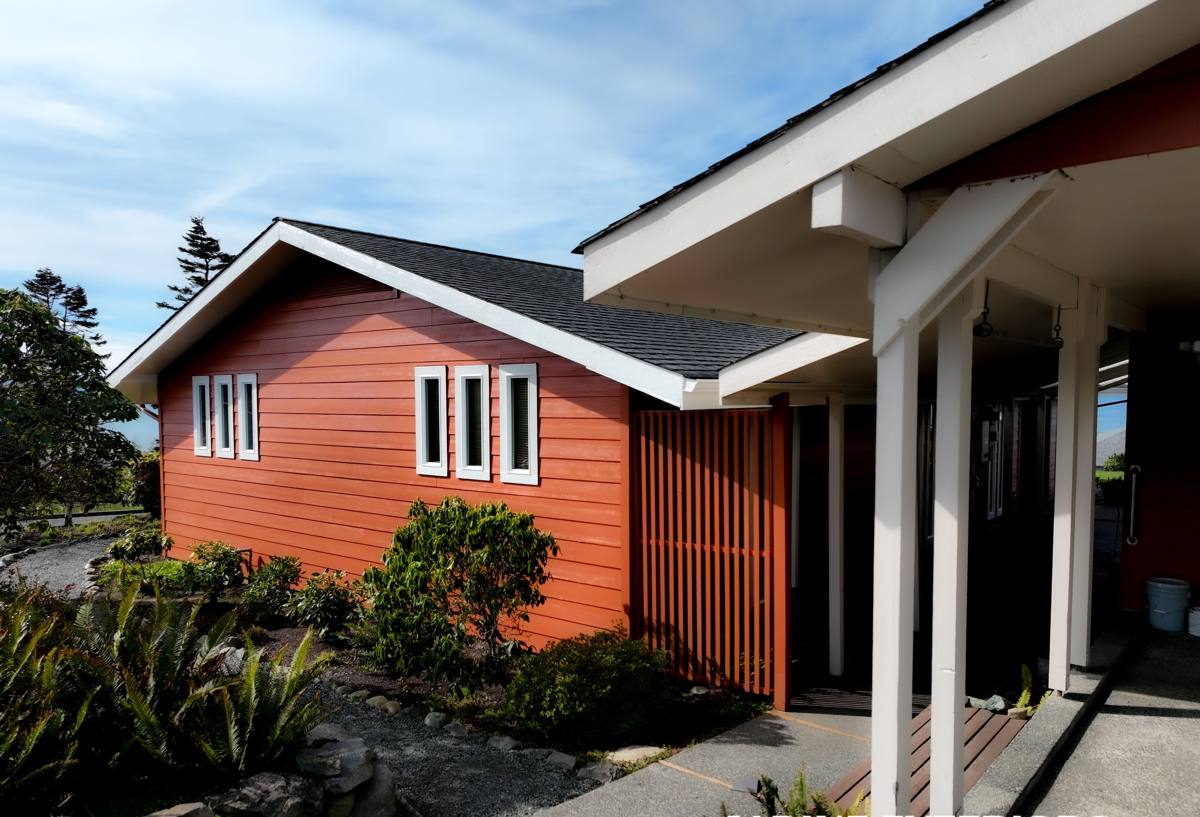
What "Custom" Actually Means Here
"Custom windows" doesn't have to mean unusual shapes or high-end architectural glass, though we do that too. On San Juan Island it more often means windows sized and detailed to fit an older or irregular home correctly, rather than forcing a stock size into an opening that doesn't quite match. A lot of the housing stock here includes additions, cabins upgraded over decades, and post-and-beam or timber-frame construction where openings were never perfectly standard to begin with.
Custom, done right, covers:
- Exact measurement of each opening rather than assuming uniformity across a wall
- Frame material and finish matched to sun exposure and wind/rain direction on that specific elevation
- Glass package chosen for the room's orientation, not a single spec used everywhere
- Flashing and sill pan details built for the openings as they actually exist, including out-of-square or settled framing
- Trim and casing that match the home's existing lines instead of a generic factory profile
The goal is a window that performs like it was built for that exact wall, because it was.
Material and Glass Choices for a Salt-Air, High-Moisture Climate
There's no single "best" window material — there's a best fit for a given elevation, budget, and exposure. Here's how the common options actually behave on an island exposed to salt air and steady rain:
| Material | How It Handles Salt Air & Moisture | Maintenance | Best Use on San Juan Island |
|---|---|---|---|
| Vinyl | Won't rust or rot; UV can fade darker colors over time | Low — occasional cleaning | Budget-friendly replacements, rentals, secondary structures |
| Fiberglass | Very stable in temperature swings and damp conditions; resists warping | Low | Exposed west/south walls, larger openings |
| Aluminum-clad wood | Exterior handles weather well if clad seams are sealed correctly; wood interior needs protection from any leak | Moderate | Homes wanting a wood interior look with exterior durability |
| Solid wood | Attractive but vulnerable if finish isn't maintained; rot risk highest in shaded, damp locations | High — regular refinishing | Sheltered elevations, historic-style homes where owners commit to upkeep |
We're honest about trade-offs rather than pushing one brand or material for every job. A solid wood window on a shaded, moss-prone north wall is a maintenance commitment; the same window on a sheltered, sun-exposed wall can last decades with normal care. Our job is to tell you which is which before you buy, not after.
Glass Packages Worth Discussing
Double-pane, low-E glass is the standard baseline and performs well for most San Juan Island homes. Triple-pane adds meaningful benefit on north- and west-facing rooms that catch the worst of the wind and rain, and on homes near open water where wind-driven cold is more of a factor. It's not automatically worth the added cost on every elevation — we'll walk your home wall by wall rather than quote one glass spec across the board.
Signs Your Current Windows Are Already Losing the Battle
Because moisture problems build slowly, a lot of homeowners don't realize a window has failed until the damage has spread into the wall. Watch for:
- Fogging or a hazy film between panes (seal failure — the argon or air gap has been compromised)
- Soft, spongy, or discolored trim and sill wood
- Persistent moss or dark staining at the corners of a window, even after cleaning
- A draft you can feel even with the window fully latched
- Paint or finish that's bubbling or peeling specifically around the frame, not the surrounding wall
- Difficulty opening or closing that's new in the last year or two
Any one of these on its own might just mean the window needs attention. Two or three together, especially on a west- or north-facing wall, usually means water has already gotten behind the frame.
Our Installation Process
The window itself is only part of the job. Most failures we're called out to fix started with the flashing and sealing, not the unit. Here's how we handle a San Juan Island installation:
- On-site assessment. We look at the existing opening, the condition of the sheathing and trim behind it, and the specific exposure of that wall to wind and rain.
- Precise measurement. Every opening is measured individually — we don't assume matching windows on the same wall are identical, especially in older homes.
- Removal and inspection. Once the old window is out, we check the framing and sheathing for hidden rot or moisture damage before anything new goes in. This is often where we catch a problem the homeowner didn't know existed.
- Sill pan and flashing. A properly sloped sill pan and correctly layered flashing (integrated with your home's weather-resistive barrier) are what actually keep water out over the long run — this step matters more than the window brand.
- Setting and shimming. The window is set level, plumb, and square, then shimmed and fastened per manufacturer specs so it operates correctly and doesn't stress the frame.
- Sealing. Interior and exterior sealant is applied at the right points — not everywhere, since over-sealing can trap moisture instead of shedding it.
- Trim and finish. Casing and trim are matched to the home and finished to hold up to the local climate.
- Final check. We test operation, look for gaps, and walk the job with you before we call it done.
Logistics: Getting It Right on an Island Job
Working on San Juan Island means factoring in things a mainland contractor doesn't have to think about. Materials, custom-sized units, and crews often depend on ferry schedules, so lead times need to be planned with that in mind rather than assumed. Weather windows for exterior sealant work are also tighter — driving rain can roll in with less warning than inland areas get, so we plan installation days around forecasts that actually hold, and we don't rush a flashing or sealing step just to beat a schedule. A crew that already works this island knows to build that buffer into the plan from the start, instead of discovering it mid-project.
What Custom Window Work Costs — and What Drives the Price
Every home and opening is different, so we won't quote a number without seeing the job, but the main cost drivers are consistent:
| Factor | Why It Affects Price |
|---|---|
| Frame material | Vinyl and fiberglass generally cost less than clad-wood or solid wood units |
| Opening condition | Hidden rot or damaged framing found during removal adds repair work before the new window goes in |
| Glass package | Triple-pane and specialty coatings cost more than standard double-pane low-E |
| Size and shape | Custom or non-standard shapes require more fabrication time than stock sizes |
| Wall exposure | Highly exposed walls may call for more robust flashing and sealing details |
| Access and logistics | Island scheduling and material delivery timing can factor into overall project cost |
Broadly, straightforward vinyl replacements in existing openings sit at the lower end of the range, while custom-sized fiberglass or clad-wood units with full flashing repair sit higher. We'll break down exactly where your project falls once we've seen the openings.
Maintaining Custom Windows in a Marine Climate
A correctly installed window still needs some upkeep in this climate. A short routine goes a long way:
- Rinse salt residue off frames and glass a few times a year, especially on wind-exposed sides
- Clear moss and debris from sills and tracks before it holds moisture against the frame
- Check exterior caulking annually for cracking or separation, particularly after a hard winter
- Test operation each season — a window that's suddenly hard to open or close is worth a look before it's forced
- Keep gutters and downspouts clear so runoff isn't sheeting directly across upper windows
Why It Matters to Hire a Crew That Already Works San Juan Island
Window installation isn't unique to islands, but the details that make it last here are. A crew that mostly works inland climates may not default to the flashing and sealing choices that matter most against driving rain and salt air, simply because they don't see those conditions daily. Working across San Juan County, including San Juan Island and the surrounding communities, means we plan for ferry-dependent lead times, build in realistic weather windows for sealant work, and choose materials with this specific exposure in mind as a starting point, not an afterthought.
We'll also tell you plainly when a window isn't your real problem — sometimes what looks like a failing window is actually a siding or flashing issue elsewhere on the wall, and fixing the window alone won't solve it. That's the advantage of working with an exterior contractor who looks at the whole wall assembly, not just the window opening.
If you're weighing window replacement or a custom install on San Juan Island, we're glad to walk the property with you, look at each opening, and give you a straight answer on what it needs and why. Reach out for a free, no-pressure estimate using the form below.