 Orcas Island Siding
 Why Mountain Lake's Microclimate Is Tougher on Siding Than It Looks
Homes around Mountain Lake sit under heavy evergreen canopy, set back from open water, and it's easy to assume that distance from the shoreline means less weather exposure. In practice, San Juan County's marine climate doesn't stop at the beach. Salt-laden air still moves through the trees, driving rain still finds its way sideways into wall assemblies during winter storms, and the shade that makes these lots so pleasant in July is the same shade that keeps siding damp for days after a storm passes. Combine that with limited direct sun for much of the year and you get a long moss season — moss, algae, and lichen don't need standing water, just consistent moisture and something to hold onto.
That's a different stress profile than a wide-open bluff home gets, but it's not a lighter one. Wood-based and moisture-sensitive siding products age faster under filtered, damp shade than they do in full sun, because they simply don't get the drying cycles they were designed around.
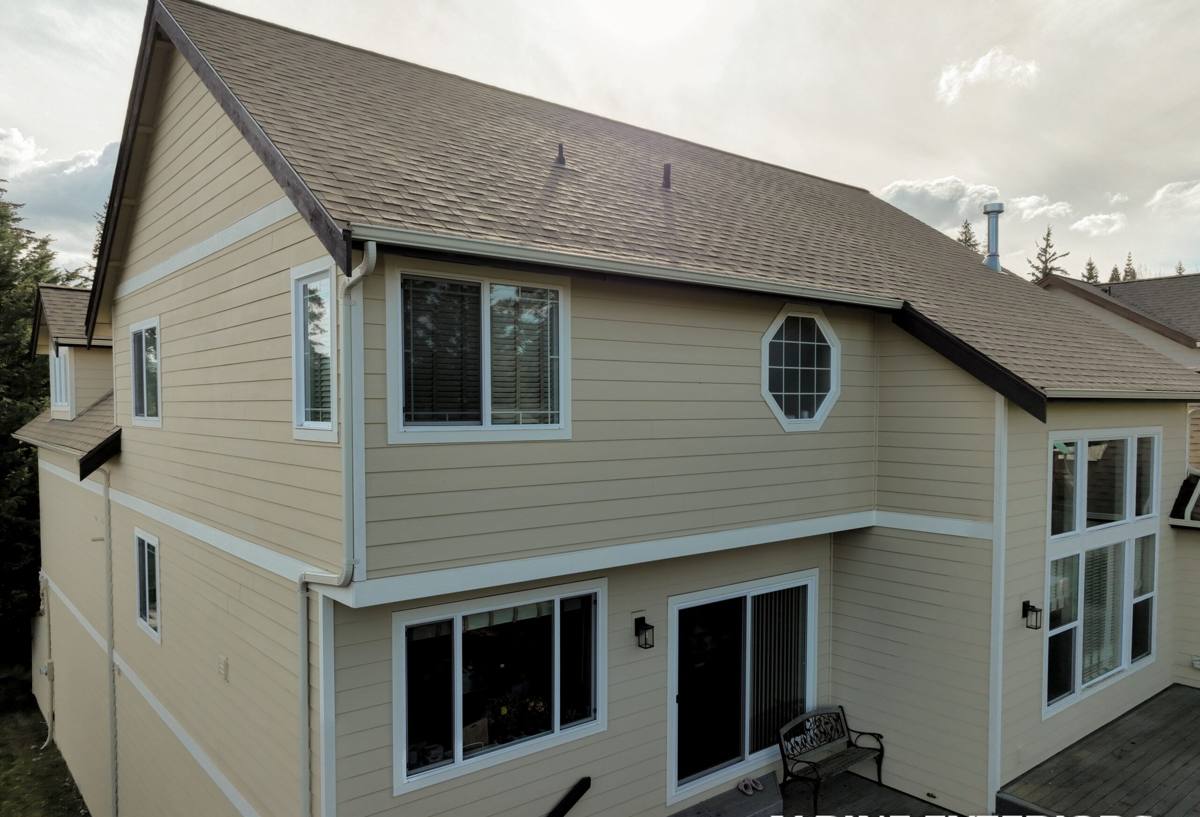
How the Wrong Siding Shows Its Age Here
Vinyl
Vinyl siding handles moisture fine on its own, but it depends on tight, consistent panel fit to look good — and shaded, damp conditions accelerate the growth of algae and moss in the panel laps and J-channels, where a pressure wash alone won't fully reach without risking water intrusion behind the panels.
LP SmartSide and other engineered wood products
These products rely on factory sealants and field-applied caulking to keep water out of the wood strand core. In a spot like Mountain Lake, where surfaces stay damp longer between rain events, any gap in that seal — a missed caulk joint, a cut edge left unsealed — gives moisture more time to work into the substrate before the next dry stretch. Once swelling starts at an edge or fastener, it doesn't reverse.
Primed spruce and cedar
Solid wood siding needs a maintenance rhythm — recoating, caulking, spot repairs — that has to happen on schedule, not when convenient. In a long moss season, missed years compound fast: trapped moisture under failing paint invites rot from the inside out, and by the time it's visible on the surface, the damage is usually already behind it.
Why We Install Only James Hardie Fiber Cement
We standardized on James Hardie fiber cement for every siding job we take on, including here around Mountain Lake, for a few concrete reasons rather than brand loyalty for its own sake:
- Non-combustible core. Fiber cement doesn't feed a fire the way wood-based products can — relevant on a heavily forested island where defensible space matters.
- Engineered for regional climate zones. Hardie's HZ product system is formulated by climate zone rather than sold as one universal product, which matters in a marine, moisture-heavy environment like this one.
- ColorPlus factory finish. The color is baked on in a controlled factory process rather than field-applied, which holds up better against the UV and moisture cycling this area sees and reduces how often repainting comes up.
- A warranty structure built around the product staying on the house, not around annual maintenance keeping it alive.
None of that means fiber cement is maintenance-free. It means the maintenance it does need is mostly cosmetic — washing off moss and grime — rather than structural repair of a substrate that's slowly failing underneath.
What a Correct Installation Actually Involves
Fiber cement performs the way it's rated to perform only when it's installed to spec. In a damp, shaded environment like Mountain Lake, the installation details matter more than they would on a dry, sun-exposed lot, because there's less margin for a mistake to dry out before it causes a problem.
| Detail | Done correctly | Common shortcut that causes problems |
|---|---|---|
| Water-resistive barrier and rainscreen gap | Drainable gap behind the siding so any moisture that gets past the cladding can drain and dry | Siding installed tight to the sheathing with no drainage path |
| Flashing at windows, doors, and penetrations | Integrated flashing that sheds water down and out, lapped correctly with the barrier | Caulk used as a substitute for proper flashing |
| Fastening pattern | Hardie-specified fastener type, spacing, and placement per board | Generic nailing that can split boards or cause fastener-line staining over time |
| Board and panel gaps | Manufacturer-specified clearance at butt joints and trim, sealed appropriately | Boards butted too tight, trapping moisture at the joint |
| Ground and roof clearance | Minimum clearance maintained from grade, decks, and roof lines | Siding installed too close to grade or a roof plane, wicking moisture |
Every one of these details is inspectable, and every one of them is something we walk a homeowner through before we close up a wall.
Choosing Colors and Textures for a Wooded, Shaded Lot
Under heavy tree cover, color and texture choices behave a little differently than they would on an open, sunny elevation. A few practical points worth weighing:
Lighter vs. darker ColorPlus finishes
Very light colors tend to show moss and organic staining sooner, simply because the contrast is higher. Mid-tone and darker ColorPlus colors can mask early-stage growth longer between washings — worth factoring in if you'd rather not think about the exterior every season.
Smooth vs. textured profiles
A cedarmill or wood-grain texture hides minor surface debris and shadowing from tree cover better than a smooth panel finish, which shows every streak and drip line more plainly in flat, filtered light.
Trim and accent contrast
Because direct sun is limited for much of the year, high-contrast trim tends to read better here than it would in full, bright sun, where contrast can look harsh instead of crisp.
Our Process, Start to Finish
- Walkthrough and estimate. We look at your existing siding, wall assembly, and problem areas, and give you a straightforward written estimate — no pressure, no inflated scope.
- Material selection. We go through Hardie lines, colors, and textures against your home's exposure and your own preferences.
- Prep and tear-off. Old siding comes off, sheathing gets inspected for hidden rot or moisture damage before anything new goes on.
- Barrier and rainscreen installation. The drainage plane goes in correctly before a single piece of Hardie board is hung.
- Siding installation. Boards, panels, and trim installed to Hardie's fastening and clearance specifications.
- Caulking, touch-up, and cleanup. Joints sealed, factory finish touched up where needed, site cleaned of debris and cutoffs.
- Final walkthrough. We go over the finished job with you before we consider it done.
Living With a Long Moss Season: Maintenance That Actually Matters
Correctly installed fiber cement doesn't need much, but "not much" isn't "nothing." Here's what we tell Mountain Lake homeowners to actually stay on top of:
- Rinse siding with a garden hose or low-pressure wash once or twice a year, focusing on shaded north-facing walls where moss establishes first
- Keep tree branches and shrubs trimmed back a few inches from the siding so airflow can help surfaces dry between storms
- Clear gutters before the fall rains so overflow doesn't run directly down a wall section
- Check caulking at trim and joints every year or two and re-caulk if it's cracked or pulling away
- Avoid high-pressure washing directly into panel seams — it can force water where it doesn't belong
What Affects Cost for a Mountain Lake Job
Every job is different, but the same handful of factors tend to move the number most:
| Factor | Why it matters |
|---|---|
| Tear-off vs. new construction | Removing and disposing of old siding adds labor and dump fees compared to siding on new framing |
| Hidden sheathing or framing damage | Damp, shaded walls sometimes reveal rot once old siding comes off, which has to be repaired before new siding goes on |
| Home size and wall complexity | More corners, dormers, and trim details mean more cutting, fitting, and labor time |
| Product line and finish | Panel vs. lap profile, and standard vs. premium ColorPlus finishes, carry different material costs |
| Site access and material logistics | Island delivery scheduling and driveway/lot access can affect staging and timeline |
We'll walk through which of these apply to your specific home before giving you a number, not after.
Why Hiring a Crew That Already Works Orcas Island Matters
Siding materials for island jobs move on a ferry schedule, not a same-day delivery truck. A crew that already plans around that reality orders and stages materials so a delay on the mainland side doesn't leave your house half-sided in the rain. Beyond logistics, a crew that's done this work on Orcas Island understands how the marine climate and the local moss season actually behave on a home over years, not just how a product looks on installation day. That's the difference between a siding job that still looks right in year eight and one that's already showing streaking and soft spots.
If you're weighing a siding replacement or new construction siding for a home near Mountain Lake, we're happy to walk the property, look at what's really going on with your current siding, and put together a straightforward, no-pressure estimate using the form below.