 Orcas Island Siding
 Cascade Lake sits in one of the more demanding pockets of Orcas Island for exterior materials. Homes here deal with marine-influenced moisture off the surrounding waters, long stretches of shaded, tree-covered lots that stay damp well after a storm passes, and a moss season that can run most of the year on north-facing walls. Board and batten siding — with its clean vertical lines and strong shadow lines — is a popular choice for cabins and homes in this area, but it only performs as well as the material and installation behind it. This page covers what board and batten siding needs to hold up around Cascade Lake, what we install and why, and what a correct job actually looks like.
Why Cascade Lake's Climate Is Tough on Siding
San Juan County's marine climate is generally mild, but "mild" doesn't mean gentle on building materials. Around Cascade Lake specifically, three conditions do most of the damage over time.
Salt Air and Marine Moisture
Orcas Island's proximity to saltwater means airborne salt travels further inland than most homeowners expect, especially during winter storms with sustained onshore wind. Salt-laden moisture accelerates corrosion on fasteners, flashing, and hardware, and it interacts poorly with unsealed or poorly primed wood edges. Any siding system installed here needs corrosion-resistant fasteners and trim details that don't leave raw material exposed.
Driving Rain and Wind-Driven Wetting
Vertical board and batten profiles are more exposed to wind-driven rain than horizontal lap siding, because water can be pushed sideways along the battens instead of simply running down a shingled overlap. On an open or partially exposed Cascade Lake lot, that means flashing details at the top of each panel and at window and door heads matter more than they would on a fully sheltered wall.
Moss, Shade, and Slow-Drying Wood
Many Cascade Lake properties sit under mature evergreen canopy, which is part of the area's appeal but also means north- and east-facing walls can stay damp for days after a rain event. Wood-based siding products are especially vulnerable here — moss and mildew take hold fastest on surfaces that don't dry quickly, and once established, they hold moisture against the wall even longer. Any siding choice for a shaded Cascade Lake lot needs to tolerate extended damp exposure without swelling, cupping, or feeding organic growth.
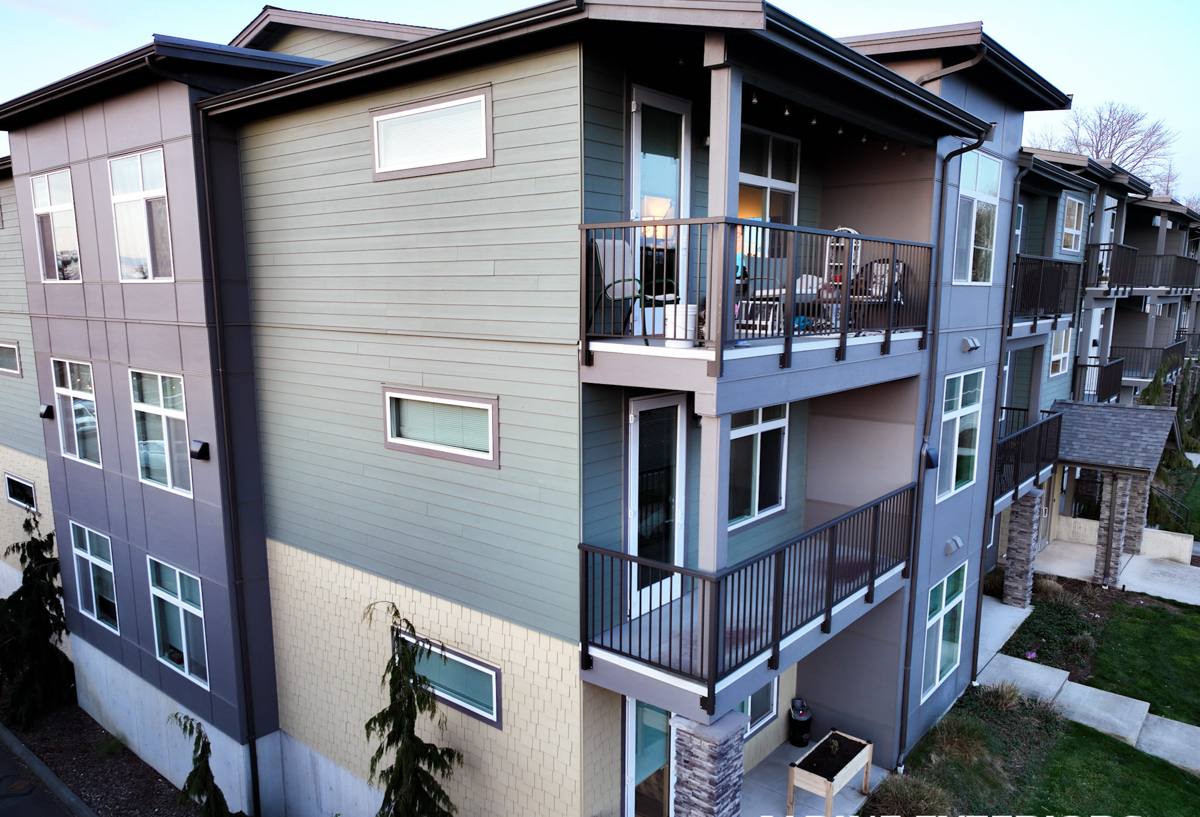
What Board and Batten Siding Is — and Why It Fits This Area
Board and batten is a vertical siding system: wide flat panels or boards installed side by side, with narrower strips (battens) covering the seams between them. It reads as a more modern or cabin-style look than traditional lap siding, and it's a natural fit for the mix of rustic and contemporary homes found around Orcas Island. Beyond appearance, the vertical profile sheds water differently than horizontal siding and can be used as a full exterior or paired with lap siding as an accent on gables, dormers, or entry features — a common combination we see requested on Cascade Lake projects.
The look only holds up long-term if the material underneath resists the moisture cycle described above. That's the deciding factor in what we install.
Why We Install Board and Batten Only in James Hardie Fiber Cement
We do not install board and batten in cedar, primed spruce, engineered wood (LP SmartSide), vinyl, or other fiber cement brands. That's a standard we hold across every job, not just Cascade Lake work, but it matters even more here because of the shade and moisture conditions above. Wood-based battens and boards are the pieces most likely to trap water at the seams — exactly where board and batten siding concentrates its joints.
The Panel-and-Batten System
James Hardie's fiber cement board and batten system uses HardiePanel (or a comparable vertical panel product) as the field material with HardieTrim battens fastened over the seams. Fiber cement doesn't absorb water the way wood or wood-composite products do, so it doesn't swell, cup, or delaminate at the batten joints the way organic materials can after repeated wet-dry cycles. It's also non-combustible, which matters on a wooded island lot where wildfire risk is a real, if lower-probability, consideration.
Factory-Applied ColorPlus Finish
Hardie's ColorPlus finish is baked on at the factory under controlled conditions, rather than field-painted on site. That matters directly for a shaded, damp lot: field-applied paint needs a dry, temperature-controlled window to cure properly, which is harder to guarantee on a Cascade Lake job site much of the year. A factory finish arrives fully cured, with a longer finish warranty than most site-applied paint jobs can offer, and it holds color and sheen more consistently in a climate that's hard on painted wood.
What a Correct Board and Batten Installation Involves
Board and batten looks simple from the street, but it has more seams and fastening points than lap siding, and every one of them is a potential water entry point if it's done wrong. A correct install on a Cascade Lake home includes:
- A properly lapped weather-resistant barrier (WRB) behind the panels, with all seams taped and integrated with window and door flashing — not just stapled house wrap
- A drainage gap or rain screen furring behind the siding so any moisture that gets past the panel face can drain and dry instead of sitting against the wall sheathing
- Corrosion-resistant fasteners rated for the salt-air exposure common around Orcas Island, not standard interior-grade hardware
- Z-flashing at horizontal panel joints and at the top of window and door trim to break the path of wind-driven rain
- Battens fastened per manufacturer spacing and fastener-pattern specifications, not "eyeballed" for looks
- Proper clearance between the bottom of the siding and grade, decks, or roof lines to keep splash-back and standing moisture away from the panel edge
- Factory-cut panel edges sealed or primed per Hardie's installation instructions before they're closed up against trim or battens
Skipping any one of these doesn't usually cause a visible problem in year one. It shows up two, five, or eight years later as a soft spot, a stain, or moss creeping in at a seam — by which point the fix is more than a caulk touch-up.
Board and Batten Material Options: A Cost and Durability Comparison
Homeowners comparing quotes on Orcas Island often see different materials proposed for the same board and batten look. Here's how the common options generally compare on the factors that matter most in this climate:
| Material | Moisture/Rot Resistance | Maintenance Over Time | Typical Upfront Cost |
|---|---|---|---|
| James Hardie fiber cement | High — doesn't absorb water or swell at seams | Low — factory finish, no repainting cycle needed for years | Mid to upper range |
| Cedar boards and battens | Moderate — resists rot naturally but absorbs moisture; needs sealing | High — periodic staining/sealing, more exposure to moss in shade | Mid to upper range |
| Engineered wood (e.g., LP SmartSide) | Moderate — resin-treated but still wood-based; edge sealing is critical | Moderate — field-painted finish needs repainting eventually | Lower to mid range |
| Vinyl board and batten | High resistance to rot, but panels can warp or crack in temperature swings and impacts | Low, but panels aren't repairable in sections — full replacement if damaged | Lower range |
We install the first row. The others aren't defective products, but each carries a trade-off — ongoing maintenance, edge-sealing sensitivity, or limited repairability — that we're not willing to put our name behind on a job that has to survive Cascade Lake's moisture cycle for decades.
Our Process for Cascade Lake Projects
Every board and batten job starts with a walk-around assessment of the specific wall exposures on your property — which sides get direct wind-driven rain, which stay shaded and slow to dry, and where existing moisture or moss damage is already showing. From there we handle removal of the old siding where applicable, correction of the WRB and flashing details underneath (this is where most of the long-term performance is actually decided), panel and batten installation to manufacturer spec, and a final walk-through before we consider the job finished. We also flag any underlying sheathing or framing issues we find during removal before covering them back up — better to deal with it once than to seal a problem behind new siding.
Why Hiring a Crew That Already Works Orcas Island Matters
Island jobs come with logistics that don't apply on the mainland: material has to be staged and timed around ferry schedules, weather windows are less forgiving when a load can't just be rescheduled for the next morning, and access to some Cascade Lake properties involves narrower roads and driveways than a typical mainland job site. A crew that regularly works Orcas Island has already worked out how to plan deliveries, schedule around ferry availability, and sequence a job so it isn't sitting exposed to weather longer than it needs to be. That planning is part of what protects the installation quality described above — a rushed or improvised sequence is where shortcuts creep in.
Maintenance and What to Expect Over Time
A correctly installed Hardie board and batten system on a Cascade Lake home is a low-maintenance exterior, not a no-maintenance one. Plan on an annual rinse-down to knock back moss and pollen buildup, especially on shaded walls, and a periodic look at caulking around window and door trim, since sealant is the one component that wears out faster than the siding itself. Watch drainage at grade level after any major storm — keeping gutters clear and grading water away from the foundation protects the bottom courses of siding as much as the material choice does. Beyond that, the ColorPlus finish is designed to go a long stretch without repainting, which is one less maintenance cycle to manage on a property you may not be checking on every week.
If you're weighing board and batten siding for a home near Cascade Lake, we're happy to take a look and give you a straightforward, no-pressure estimate — including an honest read on what your specific wall exposures actually need. Use the form below to get started.