 Orcas Island Siding
 West Sound Homes Face a Specific Kind of Weather Punishment
West Sound sits on the sheltered west side of Orcas Island, and "sheltered" is relative out here. Homes in this part of San Juan County still take on salty marine air rolling off the water, long stretches of driving rain through the fall and winter, and shaded, damp conditions that keep moss and algae established on north-facing walls almost year-round. None of that is dramatic on any given day. It's the accumulation over years that wears siding down — and it's why the siding choice matters more in West Sound than it would in a dry inland climate.
Salt-laden air is corrosive to fasteners and trim metal, and it accelerates the breakdown of coatings that aren't built to take it. Driving rain, especially wind-driven rain off the water, finds every gap in flashing and every underlapped seam. And moss doesn't just look bad — it holds moisture against the siding surface far longer than open air would, which is exactly the condition that rots wood-based products and stains lesser coatings. Any siding installed on a West Sound home needs to be chosen and installed with all three of these factors in mind, not just picked for looks.
Why We Install James Hardie and Nothing Else Here
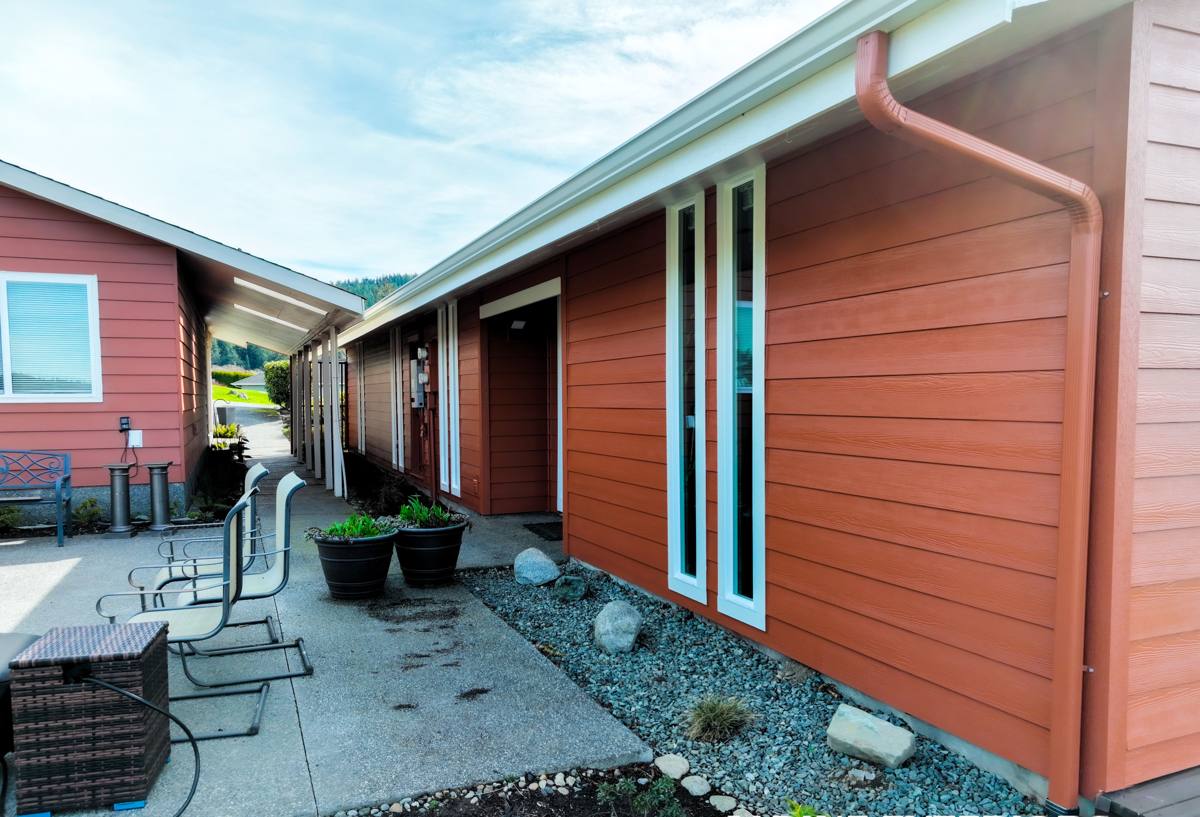
We standardized on James Hardie fiber cement siding for every job we do, including West Sound, and we don't install LP SmartSide, vinyl, Cemplank, Allura, primed spruce, or raw cedar. That's not a marketing position — it's a practical one based on what holds up in this climate without turning into a maintenance project for the homeowner.
Non-Combustible and Dimensionally Stable
Fiber cement doesn't expand and contract with humidity swings the way wood-based siding does, and it doesn't provide fuel the way wood siding can. In a marine climate where moisture is constant and wildfire risk is a real regional concern in dry summer stretches, both of those properties matter.
Engineered for the Region
James Hardie makes climate-specific product formulations, and the HZ5 line is engineered for wetter, harsher climates like the Pacific Northwest coast. That's the line we spec for West Sound projects rather than a generic formulation meant for a drier part of the country.
Factory-Applied ColorPlus Finish
ColorPlus finish is baked on at the factory under controlled conditions, which gives it better fade and moisture resistance than a field-applied paint job. In salt air, a factory finish holds its color and its seal significantly longer than site-applied paint on wood or on some other cement board products.
What a Correct Installation Actually Involves
Hardie siding is only as good as the installation underneath it. We see plenty of fiber cement job sites around the islands where the board is right but the install skipped the details that make it perform — and those are the houses that end up with problems in five to eight years instead of holding up for decades.
Moisture Management Comes First
Before a single board goes up, the wall needs a proper water-resistive barrier, correctly lapped and taped, with flashing at every window, door, and horizontal penetration. In a driving-rain climate, house wrap that's poorly lapped or flashing that's missing at a window head is where water gets behind the siding — and once it's behind the siding, the siding itself doesn't matter anymore.
Clearances and Fastening
James Hardie's installation instructions call for specific clearances above rooflines, decks, and grade, and for specific gaps at butt joints and around trim, caulked with a quality sealant rated for the exposure. Fasteners need to be corrosion-resistant and driven to the manufacturer's spec — not overdriven, not underdriven — because in salty air, the wrong fastener corrodes and stains the siding face long before the board itself would ever fail.
Starter Strips and Trim Details
A proper starter strip at the base of the wall, correct trim at inside and outside corners, and consistent reveal lines aren't cosmetic extras — they control how water sheds off the wall assembly. Skipping them is one of the most common shortcuts we see on rushed jobs.
What Goes Wrong When Corners Are Cut
We get called out to look at siding installed by other crews more often than you'd think, and in West Sound the failure patterns are consistent:
- Missing or poorly lapped flashing at windows, leading to staining or rot in the wall sheathing behind otherwise intact siding
- Caulked joints instead of properly gapped and flashed butt joints, which fail within a few seasons of freeze-thaw and UV exposure
- Fasteners that weren't corrosion-resistant, leaving rust streaks bleeding down the face of the siding
- Siding installed too close to grade, decks, or roof lines, wicking moisture up into the board over time
- North-facing walls with heavy moss buildup that was never addressed at install, holding damp against the surface year-round
Every one of these is preventable at the install stage. None of them are things the siding material itself can fix on its own.
Our Process for a West Sound Siding Project
On-Site Assessment
We start by walking the exterior with the homeowner, looking at exposure on each side of the house — which walls take the most wind-driven rain, which stay shaded and hold moss, where existing trim or flashing is already showing wear.
Prep and Moisture Barrier
Existing siding comes off down to the sheathing where needed, damaged sheathing gets addressed, and a new water-resistive barrier goes on with flashing detailed at every opening before any Hardie board is hung.
Installation to Manufacturer Spec
Boards, trim, and fasteners go in following James Hardie's published installation guidelines for clearances, fastening patterns, and joint treatment — the details covered above, applied consistently across the whole house rather than just the visible street-facing side.
Final Walkthrough
We go over the finished exterior with the homeowner, point out anything to keep an eye on seasonally, and answer questions about care before we consider the job done.
Why It Matters That We Already Work West Sound
Getting materials and crews to the west side of Orcas Island takes planning — ferry schedules, weather windows, and logistics that a mainland contractor unfamiliar with island work will underestimate. A crew that already works West Sound has that logistics figured out, knows which exposures on the island take the worst weather, and isn't learning island scheduling on the homeowner's timeline. It also means we're not disappearing after the invoice — if a warranty question or a trim detail needs a second look, we're already working in the area.
Living With Hardie Siding in a Salt Air, Moss-Prone Climate
Fiber cement is low-maintenance compared to wood, but "low-maintenance" doesn't mean "no maintenance," especially in this climate. A little seasonal attention keeps a Hardie exterior looking and performing the way it should for decades:
- Rinse siding annually, and more often on shaded, moss-prone walls, using a garden hose and soft brush rather than an aggressive pressure washer
- Check caulked joints at trim and penetrations every year or two, and re-caulk before a small gap becomes a water path
- Trim back vegetation and tree cover that keeps walls shaded and damp, especially on the north side
- Inspect fastener heads and trim metal periodically for corrosion staining, particularly on walls with direct water exposure
- Address moss buildup promptly rather than letting it establish — it's easier to remove early than after it's taken hold
What Affects the Cost of a West Sound Hardie Project
Every house is different, but the same factors tend to drive cost up or down on island siding projects. This isn't a quote — it's what to expect the estimate to weigh:
| Factor | Why It Matters |
|---|---|
| Condition of existing sheathing | Rot or moisture damage found during tear-off adds repair scope before new siding can go on |
| Home size and wall complexity | More corners, gables, and trim detail means more labor and material waste |
| Product line and profile | HZ5 panels, plank widths, and trim styles vary in material cost |
| Access and logistics | Island delivery, staging, and site access affect scheduling and labor time |
| Existing moisture barrier | Whether the current water-resistive barrier can be reused or needs full replacement |
We walk through these factors on-site with every homeowner so the estimate reflects the actual house, not a generic per-square-foot number.
If your West Sound home's siding is showing wear from salt air, moss, or years of driving rain, we're happy to take a look and put together a straightforward, no-pressure estimate — just fill out the form below.