 Orcas Island Siding
 Why West Sound Homes Need a Different Approach to Siding
West Sound sits on the protected west side of Orcas Island, but "protected" doesn't mean "easy" when it comes to exterior building materials. Homes here still face a marine climate: salt-laden air moving off the water, long stretches of driving rain through the fall and winter, and deep shade in wooded lots that keeps north- and west-facing walls damp for days after a storm passes. Add San Juan County's short building season, its careful permitting around shoreline and view properties, and the logistics of getting crews and materials to an island, and you have a set of conditions that punishes the wrong siding choice faster than almost anywhere else in Western Washington.
This page is specifically about fiber cement siding for West Sound properties: what the climate demands, what a correct installation actually involves, and why the crew you hire matters as much as the product you choose.
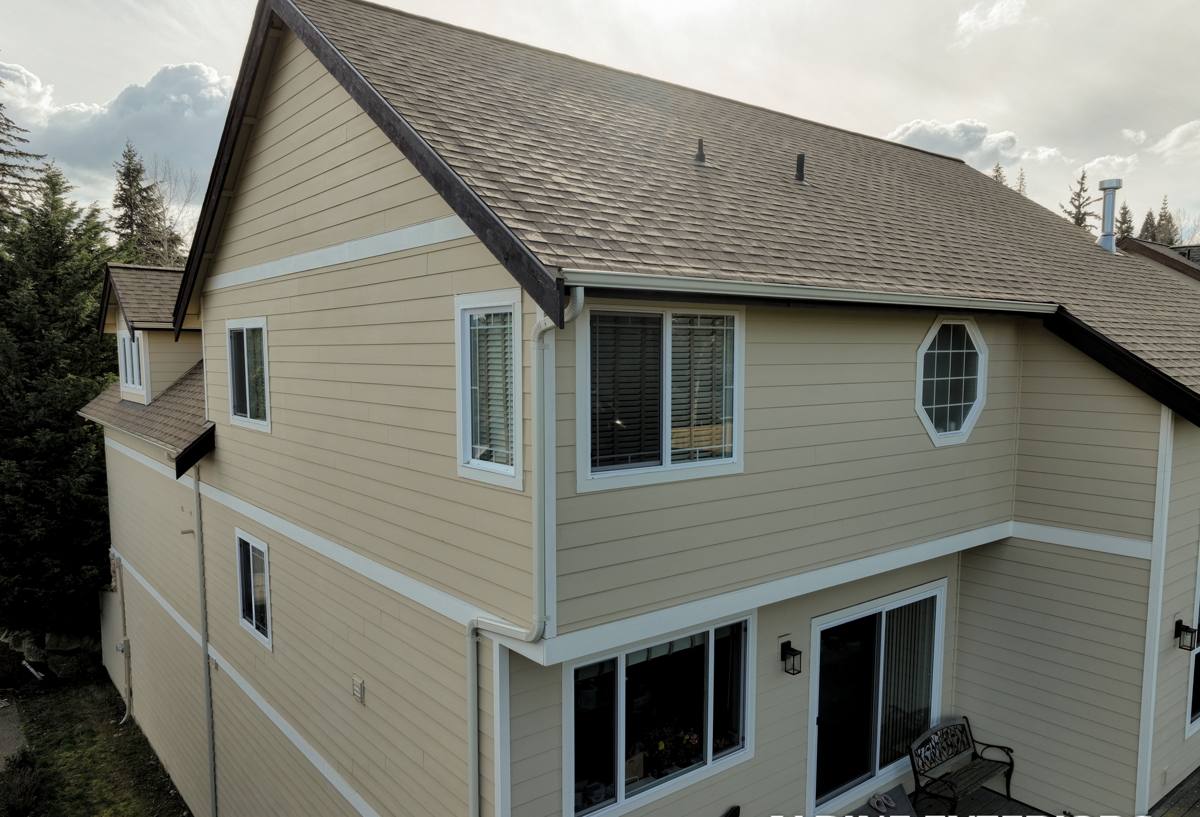
What Salt Air, Rain, and Moss Actually Do to Siding
Salt and Marine Air
Airborne salt is corrosive to fasteners, flashing, and any exposed metal trim on a home's exterior. It also accelerates the breakdown of lower-grade paints and coatings, leaving chalky, faded surfaces years before a homeowner expects to repaint. Siding materials that rely on site-applied paint are the first to show it — the coating fails at the surface long before the substrate underneath does.
Driving Rain and Wind-Driven Moisture
Storms moving across the Salish Sea don't just drop rain straight down — wind pushes it sideways, into laps, joints, and anywhere a siding system has a gap. Over years, that wind-driven moisture finds its way behind poorly flashed panels and sits there, which is how rot starts even on a wall that looks fine from the yard. Homes on more exposed points and bluffs take this harder than homes tucked into the trees, but no West Sound property is fully sheltered from it.
Moss, Algae, and Shade
Orcas Island's tree cover is part of its appeal, but shaded, damp walls are exactly where moss and algae take hold. On porous or absorbent siding materials, that growth can hold moisture against the surface for extended periods, which shortens the life of the material underneath. A siding product that doesn't absorb water in the first place has a real advantage here, and it's one of the clearest reasons material choice matters as much as workmanship.
Why We Install Only James Hardie Fiber Cement
We standardized on James Hardie fiber cement siding for every job we do, including West Sound, and we don't install vinyl, LP SmartSide, primed spruce, cedar, or other fiber cement brands. That's not a marketing position — it's a professional standard built around how these products actually perform in a marine climate over decades, not just in the first few years.
Fiber cement is a mix of cement, sand, and cellulose fiber, engineered to be non-combustible and dimensionally stable. It doesn't expand and contract with moisture the way wood-based products do, which matters directly in a climate with this much rain exposure. James Hardie's HZ5 product line is engineered specifically for wetter, harsher climates like the Pacific Northwest, and its ColorPlus factory-applied finish is baked on under controlled conditions rather than brushed or sprayed on site — a meaningful difference when salt air is working against whatever coating is on the wall.
James Hardie also backs its siding with a strong transferable limited warranty on both the substrate and the ColorPlus finish, which carries real value on an island where resale buyers and appraisers pay close attention to exterior condition and maintenance history. And because the product line offers a range of textures, from smooth to cedar-grain lap profiles, homeowners aren't giving up the look they want to get the performance they need.
What a Correct Fiber Cement Installation Involves
Fiber cement siding is only as good as the assembly behind it. A significant share of the siding problems we get called out to inspect on Orcas Island aren't failures of the siding material itself — they're the result of a rushed or incorrect installation underneath it. Fiber cement is also less forgiving of guesswork than some other materials; it requires specific blades, fasteners, and clearances, and skipping any of them shows up as a problem years later rather than immediately.
Drainage Plane and Rainscreen
A correctly built wall assembly gives water a way out. That means a weather-resistant barrier installed shingle-style, correctly lapped, with a drainage gap behind the siding so any moisture that does get past the surface can drain and dry rather than sitting against the sheathing. On a site with this much wind-driven rain, skipping or shortcutting this step is one of the most common causes of hidden rot.
Fastening and Flashing
Every penetration — windows, doors, hose bibs, light fixtures — needs proper flashing integrated with the water-resistive barrier, not just caulked over the top. Fasteners need to be the corrosion-resistant type and grade James Hardie specifies, driven to the correct depth; overdriven or underdriven fasteners are a common cause of premature panel damage.
Clearances and Joints
Fiber cement siding needs proper clearance from roofing, decks, and grade, along with correctly caulked or shiplap joints at butt seams. Panels installed tight to a deck or roofline trap water exactly where it can't dry out, which is a slow but serious problem on a shaded island lot.
Factory Finish Integrity
Cut edges and job-site touch-ups need to be sealed with the correct Hardie touch-up products to maintain the ColorPlus warranty and keep the factory finish's protection intact at every seam.
Our Process for West Sound Projects
- On-site assessment. We look at sun exposure, tree cover, wind exposure, and the condition of the existing wall assembly before recommending anything.
- Moisture and rot check. Any suspect areas around windows, trim, or lower wall sections get opened up or probed before we quote the job, not after.
- Product and color selection. We walk through James Hardie's HZ5 lines and ColorPlus palette options suited to this climate and to the home's existing roofline and trim.
- Written scope and schedule. Because getting crews and materials to Orcas Island takes planning, we build a realistic timeline around ferry logistics and weather windows up front, so there are no surprises mid-project.
- Installation to manufacturer spec. Drainage plane, flashing, fastening, and clearances are done to James Hardie's published installation requirements, not shortcuts.
- Final walkthrough. We review the finished work with the homeowner and cover basic care specific to a salt-air, high-moss environment.
Cost Factors for Fiber Cement Siding in West Sound
Every home is different, but these are the factors that most often move the price of a fiber cement siding project on Orcas Island, up or down:
| Factor | Why It Matters Here |
|---|---|
| Existing wall condition | Hidden rot from prior moisture intrusion adds repair scope before new siding goes on |
| Home access and site logistics | Ferry scheduling and site access on island properties affect crew and material staging |
| Wall complexity | Dormers, multiple gables, and trim detail add labor time beyond a simple flat wall |
| Siding profile and plank width | Lap width and texture choice affect material cost and installation time |
| Trim and accessory scope | Fascia, corner boards, and trim replaced at the same time affect total project cost |
| Tear-off vs. overlay | Full removal of old siding costs more up front but lets us inspect and correct the wall assembly underneath |
We don't quote from a distance for this reason — an accurate number requires seeing the actual wall condition and site access in person.
Maintenance Checklist for Salt-Air, High-Moss Climates
Fiber cement siding is low-maintenance compared to wood or vinyl, but "low-maintenance" isn't "no-maintenance" in this environment. A simple annual routine goes a long way:
- Rinse siding with a garden hose once or twice a year to clear salt residue and airborne debris, especially on walls facing open water
- Trim back tree branches and shrubs to improve airflow and sun exposure on shaded walls where moss tends to establish
- Check and clear gutters each fall so overflow doesn't run down the siding face during heavy storms
- Inspect caulking at trim, windows, and joints yearly and have any cracked or missing caulk replaced before the wet season
- Watch for moss or algae buildup at the base of walls and in shaded corners, and address it early with a gentle wash rather than pressure washing
- Have any impact damage or hairline cracks looked at promptly — small issues are far cheaper to address than water intrusion after the fact
Why Hiring a Crew That Already Works West Sound Matters
Island work is different from mainland work. Material deliveries, crew transport, and scheduling all have to account for the ferry system, and a contractor who hasn't planned for that will either pad the price to cover the uncertainty or run into delays that stretch the project out. A crew that already works on Orcas Island and throughout San Juan County has the logistics figured out, knows how to stage materials efficiently, and isn't learning the realities of island scheduling on the homeowner's dime.
Local experience also means we've seen how these specific conditions — salt exposure, wind-driven rain, and shaded, moss-prone walls — actually play out on real homes over time, not just on a manufacturer's climate chart. That shapes real decisions: where extra flashing attention matters most, which walls need the most drainage detail, and what maintenance routine actually keeps a home looking good here versus what works in a drier inland climate. It also means we're accountable to this community for the long run, not just for the length of one project.
If your West Sound home needs new siding, or you want a second opinion on a wall that's showing early signs of trouble, we're glad to take a look. Reach out for a free, no-pressure estimate using the form below.