 Orcas Island Siding
 West Beach Weather Doesn't Give Windows Much of a Break
Homes along West Beach face open water to the west, which means they take the brunt of whatever weather rolls across the Strait. Wind-driven rain in the fall and winter doesn't just fall on these windows — it hits them sideways, again and again, for months at a stretch. Add in the salt content carried on that air off the water, plus a wet season here on Orcas Island that runs long enough to grow moss on just about any surface that stays damp, and you've got three separate forces working against a window at the same time: water intrusion, corrosion, and organic growth. A window that would coast along fine in a sheltered inland yard can start showing real problems within a decade out here if it wasn't built or installed with this exposure in mind.
None of that means West Beach is a bad place to build or own a home — it's one of the more striking stretches of the island. It just means the windows need to be chosen and installed to match the site, not treated like any other job in San Juan County.
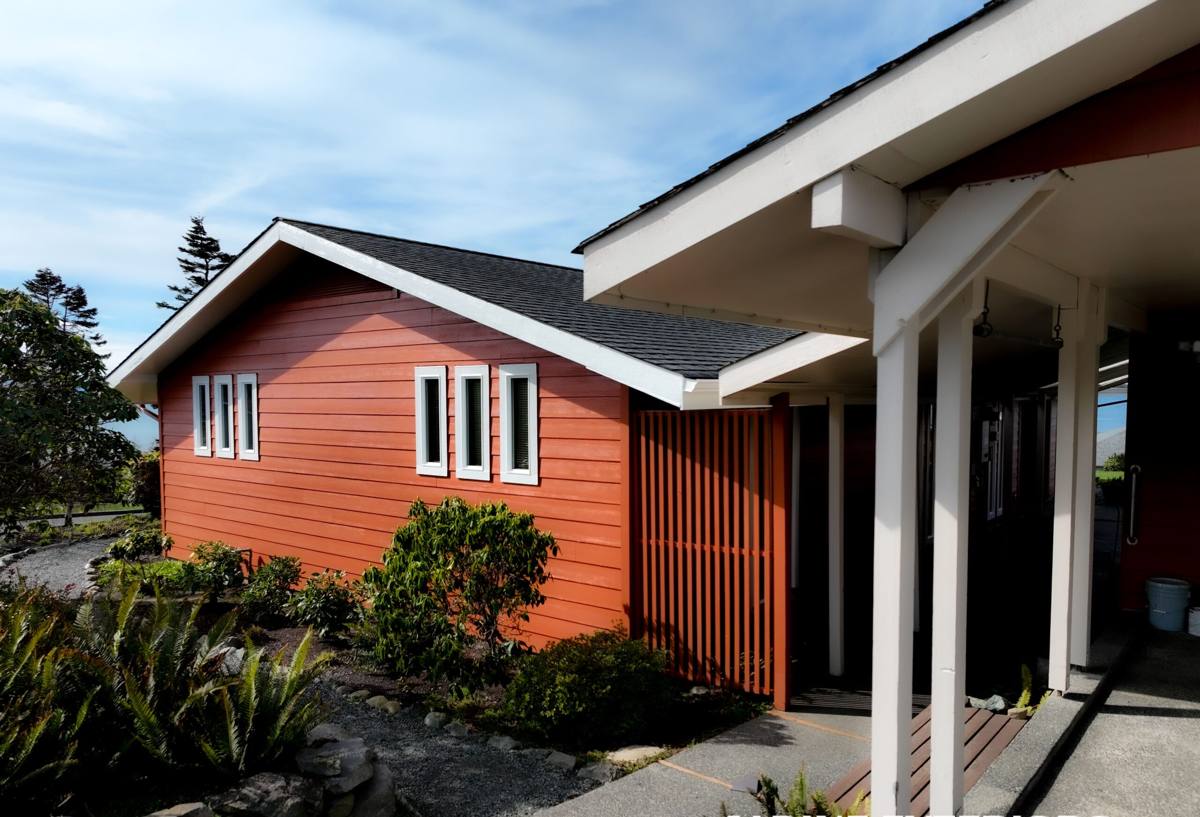
What Actually Fails First on West-Facing Windows Here
We see the same handful of failure patterns over and over on West Beach homes, and they're almost always tied to the same root causes:
- Fogged or hazy glass — the seal between panes has broken down and moisture has worked its way into the gap, usually faster here than inland because of the constant humidity swings.
- Soft or rotting wood at the sill and jambs — water that got behind old flashing or failed caulk had nowhere to go, so it sat against wood and slowly broke it down.
- Corroded hardware — cranks, hinges, and screws that weren't rated for coastal exposure pit and seize up well before the window itself is due for replacement.
- Sun-stressed frames on the west elevation — vinyl and painted wood facing the afternoon sun take more direct UV and heat cycling than any other side of the house, and it shows in fading, warping, or brittle gaskets.
- Moss and algae creeping into trim and drainage tracks — once that takes hold, it holds moisture against the frame and blocks the weep holes that are supposed to let water drain back out.
Most of these aren't "the window was bad" problems — they're installation and material-selection problems that show up years later.
What a Correct Installation Actually Involves
A window is only as good as the flashing and sealing details around it, and this is where a lot of shortcuts get taken on jobs that look fine at handoff but fail in three or four years. On a site like West Beach, we treat these steps as non-negotiable:
Sill Pan and Head Flashing
Every opening gets a sloped sill pan so any water that gets past the window has a built-in path back out, not a place to pool. Head flashing goes in above the window and laps correctly with the weather-resistive barrier, so water is always directed down and out, never trapped behind the trim.
Integration With the Wall, Not Just the Window
The window has to tie into the house's drainage plane correctly — housewrap or building paper lapped in the right order, sealant used only where it's supposed to carry a load (not as a substitute for proper flashing), and a drainage gap maintained where the siding meets the window trim.
Shimming and Squaring
A window that's out of square binds its own hardware and stresses its seals early. On custom sizes especially, this is where careful measuring and installation pay off over the life of the window, not just at install.
Choosing a Frame Material That Holds Up to Salt Air
There's no single "best" window material — there's the right material for this site and this budget. For West Beach specifically, salt exposure and moisture cycling move some options up the list and some down.
| Material | Salt Air / Corrosion | Moisture Behavior | Maintenance | Typical Cost Range |
|---|---|---|---|---|
| Vinyl | Good — won't corrode, but hardware inside still needs to be rated for coastal use | Handles moisture well; won't rot | Low | Lower |
| Fiberglass | Very good — stable in temperature swings and salt exposure | Excellent; very low expansion/contraction | Low | Mid to upper-mid |
| Wood-clad (exterior clad, wood interior) | Good on the clad exterior; interior wood needs protection from any water intrusion | Good if flashing details are correct; vulnerable if not | Moderate | Upper |
| Aluminum (uncoated or basic finish) | Poor in direct salt exposure unless properly finished | Conducts heat/cold and can condensate more | Higher | Varies |
We're not going to tell a homeowner a product is "bad" — plenty of aluminum and wood windows perform fine in the right setting. But for a west-facing, salt-exposed site, we lean toward vinyl or fiberglass frames with a marine-rated hardware package, or a well-detailed clad-wood option when the look calls for it, because they carry less ongoing maintenance risk in this specific exposure.
Glass That Makes Sense for a West-Facing View
West Beach homes usually want the glass — that's the whole point of being here. But a big west-facing window also takes a long, low afternoon sun straight on for months of the year, which means heat gain and glare are real considerations, not afterthoughts.
- Low-E coatings cut down on heat transfer without dulling the view — worth having on any west elevation.
- Double-pane with argon fill is the baseline we'd recommend for this climate; triple-pane is worth discussing for anyone prioritizing energy performance or noise reduction from wind.
- Tempered glass on large panes or anything near a walking surface, both for safety and because it holds up better to the physical stress of temperature swings.
- Condensation resistance matters more here than in a drier climate — the gap between a warm interior and cold, damp island air drives condensation on interior glass if the unit isn't performing well.
Hardware and Fasteners: The Detail Most Jobs Skip
This is the cheapest part of a window job to get right and one of the most common places corners get cut. Standard steel screws and basic hinges will pit and corrode in salt air faster than almost anything else on the window. We spec stainless steel or otherwise coastal-rated fasteners, hinges, and locking hardware on every West Beach installation — it's a small cost difference up front and it's the difference between hardware that still operates smoothly in ten years and hardware that seizes up in three.
Our Process for a Custom Window Project
- On-site assessment — we look at the actual exposure of each opening, not just the house as a whole. A window on the west wall gets treated differently than one tucked on the east side.
- Precise measurement and material selection — custom sizes are cut to the actual opening, not the nearest stock size, and material/glass package is matched to that opening's exposure.
- Ordering and lead time — custom windows take longer to arrive than stock sizes, and we build ferry and delivery logistics for island work into the schedule up front so there are no surprises.
- Removal and hidden-damage check — every old window comes out with an inspection of the framing behind it, since this is where rot from years of past water intrusion tends to hide.
- Correct flashing and installation — sill pans, head flashing, proper sealant placement, and squaring, every time, not just on request.
- Final walkthrough — we check operation, seal, and finish with the homeowner before calling the job done.
Signs It's Time to Replace Rather Than Patch
Not every window on a West Beach home needs full replacement — sometimes a resealing or hardware swap buys real years. Here's how we tell the difference:
- Glass that's permanently foggy or hazy between the panes (the seal is gone — this can't be fixed, only replaced)
- Soft, spongy, or visibly rotted wood at the sill or jambs
- Windows that are hard to open, close, or lock, especially after seasonal humidity shifts
- Visible daylight, drafts, or water staining around the frame after a storm
- Rust streaks or seized hardware on cranks, hinges, or locks
- Moss or algae established in the trim or tracks that keeps coming back after cleaning
Why Local Experience on Orcas Island Actually Matters Here
Working on West Beach isn't the same as working a sheltered inland lot, and it isn't the same as a typical mainland job either. Materials and custom orders have to come over by ferry, which changes how a project gets scheduled and staged. And a crew that's done this exposure before knows, before they ever pull a permit, which details on this stretch of Orcas Island are worth the extra attention — where the wind-driven rain actually hits hardest, which elevations take the worst of the salt air, and where moss tends to take hold first. That's the kind of judgment that only comes from doing this specific work, on this specific coastline, more than once.
If you're dealing with foggy glass, sticking hardware, or a window that just isn't holding up the way it should on a West Beach property, we're happy to take a look and give you an honest read on repair versus replacement. Reach out below for a free, no-pressure estimate — no obligation, just a straight answer about what your windows actually need.