 Orcas Island Siding
 Getting Windows Right the First Time on San Juan Island
New-construction window work is a different job than replacing an old window in an existing wall. On a new build, the window opening is still open framing, the weather-resistive barrier isn't installed yet, and the siding hasn't gone on. That's actually the good news: it's the one point in a home's life when the entire water-management system around a window can be built correctly, in the right order, with nothing hidden behind existing finishes. Get it right at this stage on a San Juan Island home and you avoid the slow, expensive moisture problems that show up five or ten years later. Get it wrong, and the mistake gets sealed behind siding and trim where it's invisible until there's a stain on the drywall or soft wood at the sill.
We work on new-construction homes and additions throughout San Juan County, and San Juan Island's building stock has its own set of demands. Windows here aren't just a design choice — they're part of the wall's defense against a genuinely tough marine climate.
Why San Juan Island's Climate Changes the Job
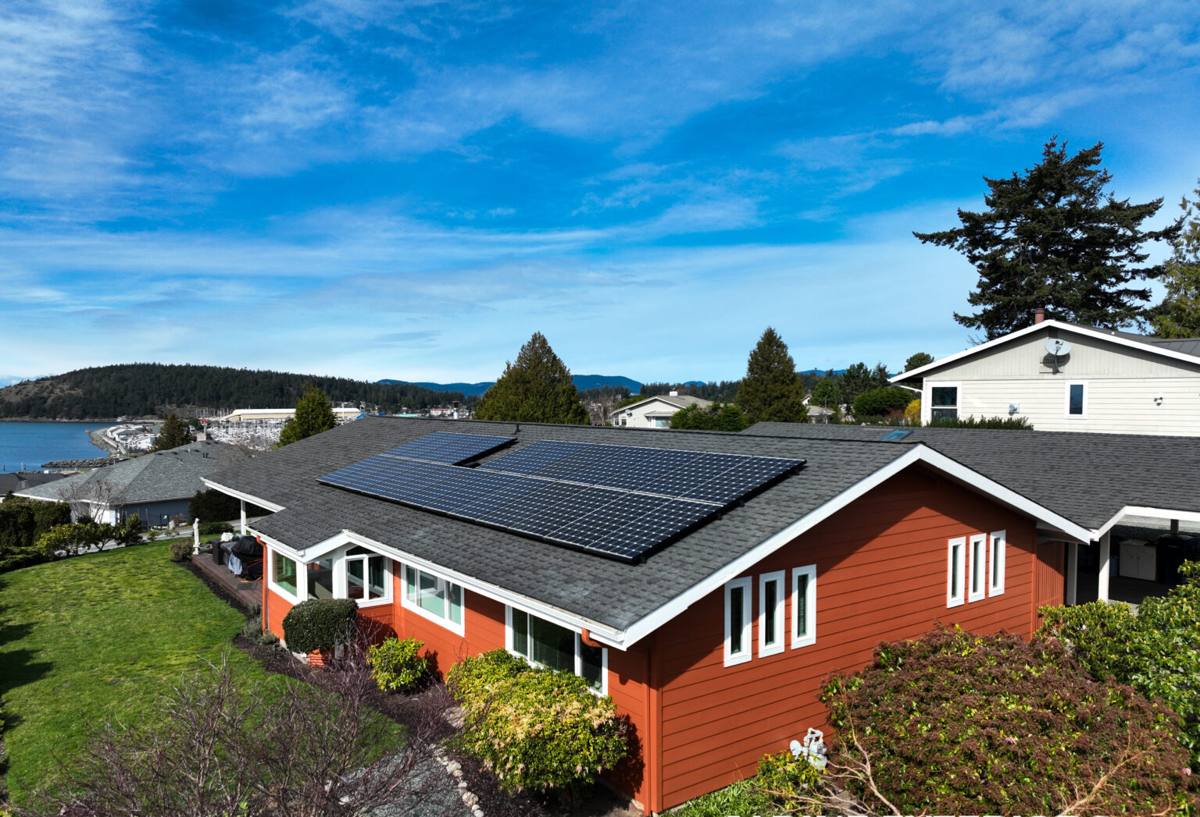
San Juan Island sits in the Salish Sea, which means every wall assembly on the island is dealing with conditions that inland Washington homes simply don't see to the same degree.
Salt air
Airborne salt from the surrounding water accelerates corrosion on unprotected metal — fasteners, hinges, cranks, and cheap flashing all degrade faster near the water than they would twenty miles inland. Window hardware and flashing materials that aren't rated for a marine environment can start showing rust or pitting well before they should.
Driving rain
Storms coming off the water bring wind-driven rain that hits window openings at an angle, not just straight down. That means water is actively pushed sideways and upward against trim, casings, and sills — a wall assembly that only manages vertical water flow isn't enough here. Flashing details have to account for wind pressure, not just gravity.
A long moss season
The extended wet, shaded season that lets moss take over roofs and north-facing siding on the island is the same moisture that finds its way into any gap around a poorly sealed window. Persistent dampness doesn't just grow moss — it's exactly the condition that lets rot start in framing and sheathing if a window opening isn't properly flashed and drained.
None of this means island homes need exotic materials or unusual designs. It means the ordinary best practices for window installation — sill pan flashing, correct WRB integration, proper fastening — aren't optional extras here. They're the difference between a window opening that sheds water for decades and one that quietly fails.
What a Correct New-Construction Window Install Actually Involves
A window installed during framing goes through several steps before the siding crew ever shows up. Skipping or rushing any one of them is where problems start.
Rough opening preparation
The opening has to be framed square, plumb, and sized correctly for the specific window unit — including the tolerances the manufacturer specifies. An opening that's out of square gets forced into place, which stresses the frame and can affect how the sash operates for years.
Sill pan flashing
Before the window ever goes in, the sill gets a flashing pan that slopes to the exterior and turns up at the sides and back. This is the single most important detail in the whole installation — it's the backstop that carries away any water that gets past the window itself, which on a windy island lot will happen eventually no matter how good the window is.
Weather-resistive barrier integration
The WRB (housewrap or equivalent) has to be sequenced in the correct shingle-lap order with the window's flashing tape — head flashing over the WRB, side and sill flashing under it — so water is always directed down and out, never trapped behind the barrier.
Setting the window
The unit is set level, plumb, and square, then fastened per the manufacturer's schedule. Shimming has to support the frame without distorting it, since an out-of-square window binds, leaks air, and wears its hardware unevenly.
Insulating and sealing
The gap between the frame and the rough opening gets filled with a low-expansion foam or backer rod and sealant rated for exterior use — never packed solid with standard can foam, which can bow the frame inward.
Exterior trim and flashing tie-in
Head flashing, trim, and any cladding details around the window need to be coordinated so water sheds away from the opening at every point, not just at the sill.
A quick checklist for a properly installed new-construction window
- Rough opening is square, plumb, and sized to the window manufacturer's tolerances
- Sill pan flashing is installed and sloped to drain outward, not just laid flat
- WRB and flashing tape are layered in correct shingle-lap order (no reverse laps)
- Window is shimmed and fastened without distorting the frame
- Gaps are sealed with appropriate foam or sealant — not overpacked or left open
- Head flashing directs water clear of the opening and over the cladding below
- Corrosion-resistant fasteners and hardware are used, appropriate for a marine environment
Choosing a Window Frame Material for an Island Build
Frame material matters more here than in a drier, inland climate, because it has to hold up to constant humidity, salt air, and UV exposure without becoming a maintenance burden. There's no single "correct" answer for every project — it depends on budget, design, and how much upkeep a homeowner wants to take on — but the trade-offs are worth understanding before you decide.
| Frame Material | Moisture Resistance | Salt Air Durability | Maintenance | Typical Cost Tier |
|---|---|---|---|---|
| Vinyl | Good — won't rot or corrode | Good, no corrosion risk | Low — no painting needed | Lower |
| Fiberglass | Very good — dimensionally stable | Very good, resists pitting | Low to moderate | Mid to higher |
| Wood-clad (exterior clad, wood interior) | Good if cladding and flashing are correct | Depends on cladding material and finish | Moderate — interior wood may need attention over time | Higher |
| Bare aluminum | Fair — prone to condensation | Weaker without marine-grade coatings and hardware | Higher near salt air | Varies |
Our standard for island new-construction work leans toward vinyl or fiberglass frames with corrosion-resistant hardware, simply because they hold up with the least upkeep in a marine environment. If a homeowner wants the look of wood-clad windows, that's a legitimate choice — it just means being honest up front about the extra attention the cladding and finish will need over time so it isn't a surprise later.
Coordinating Windows With Siding and Water Management
A window installed perfectly on its own can still leak if the trades around it don't tie into it correctly. The siding, trim, and flashing all have to work as one continuous system — each layer lapping over the one below it so water is always moving down and out, never getting channeled behind the window or trapping moisture against the sheathing.
This is one of the real advantages of having the same crew handle both the window installation and the siding: there's no handoff where one contractor assumes the other one covered a detail. On a new build, we sequence window installation with the siding plan from the start, so flashing laps, trim details, and drainage paths are planned together instead of improvised on site.
Working With Island Logistics
Building on San Juan Island comes with scheduling realities that don't exist on the mainland. Materials generally move by ferry, which means window orders need to be placed with enough lead time to account for sailing schedules, freight capacity, and the occasional weather delay. Rushing a window order to make up for late planning usually means settling for whatever's available rather than the right unit for the opening.
Weather windows matter too — a rough opening sits exposed to the elements until the window and flashing are in, so we plan installation around stretches of workable weather rather than fighting driving rain to get a unit set. Working regularly on the island means we already know how to build these lead times and weather contingencies into a schedule instead of discovering them mid-project.
Permitting and Code Considerations
New-construction windows on San Juan Island are subject to San Juan County's building permit process and the Washington State Energy Code, which sets minimum requirements for window U-factor and solar heat gain depending on the home's overall energy compliance path. Homes in higher-exposure locations may also need to meet specific wind load and water penetration requirements as part of the design. We coordinate with the project's builder or designer to confirm the window specifications called for meet code before ordering, so there are no surprises at inspection.
Our Process for New-Construction Window Installation
- Review the framing plan and window schedule with the builder or homeowner before units are ordered
- Confirm rough opening sizes and verify window specifications meet code and design intent
- Order windows with enough lead time to account for island shipping schedules
- Install sill pan flashing and integrate the WRB in correct sequence before setting any unit
- Set, shim, and fasten each window per manufacturer specifications
- Insulate and seal the perimeter, then install exterior flashing and trim tie-ins
- Coordinate directly with the siding installation so water management details connect cleanly
Every step gets done in the order that keeps the wall assembly working as a system, not a collection of separate trades hoping their work lines up.
Why Local Experience Matters for This Job
New-construction window installation isn't complicated in theory, but the details that matter most — sill pan flashing, flashing sequencing, hardware selection — are exactly the details that are easy to shortcut and hard to inspect once the wall is closed up. A crew that already works San Juan Island homes has seen how this climate treats a wall assembly over time, which informs the choices made at rough-in, long before the siding or trim ever goes on. That's the kind of judgment that's hard to get from a contractor who mostly works inland and treats every marine-climate build as a one-off.
If you're planning a new build or addition on San Juan Island and want windows installed correctly from the framing stage forward, we're glad to walk the plans with you and provide a free, no-pressure estimate — just fill out the form below.