 Orcas Island Siding
 Siding on an Island: Why San Juan Island's Climate Is Hard on the Wrong Product
Homes on San Juan Island sit in one of the more demanding exterior environments in Washington State. San Juan County is surrounded by the Salish Sea, which means every home here deals with a mix of salt-laden air, wind-driven rain off the water, and long, damp shoulder seasons where surfaces rarely get a chance to fully dry out. Add in the shade from mature evergreens on many lots, and you get a textbook environment for moss, algae, and mildew growth on anything with a porous or wood-based surface.
That combination — salt air, driving rain, and a long moss season — doesn't just make siding look tired faster. It actively works against materials that weren't engineered for it. Wood-based products absorb moisture, swell, and eventually rot at seams and butt joints. Vinyl can warp and fade under repeated wet-dry cycling and UV exposure off the water. Metal fasteners and trim that aren't rated for coastal exposure corrode faster than they would twenty miles inland. None of this is theoretical — it's the standard wear pattern we see on older siding jobs across the San Juan Islands.
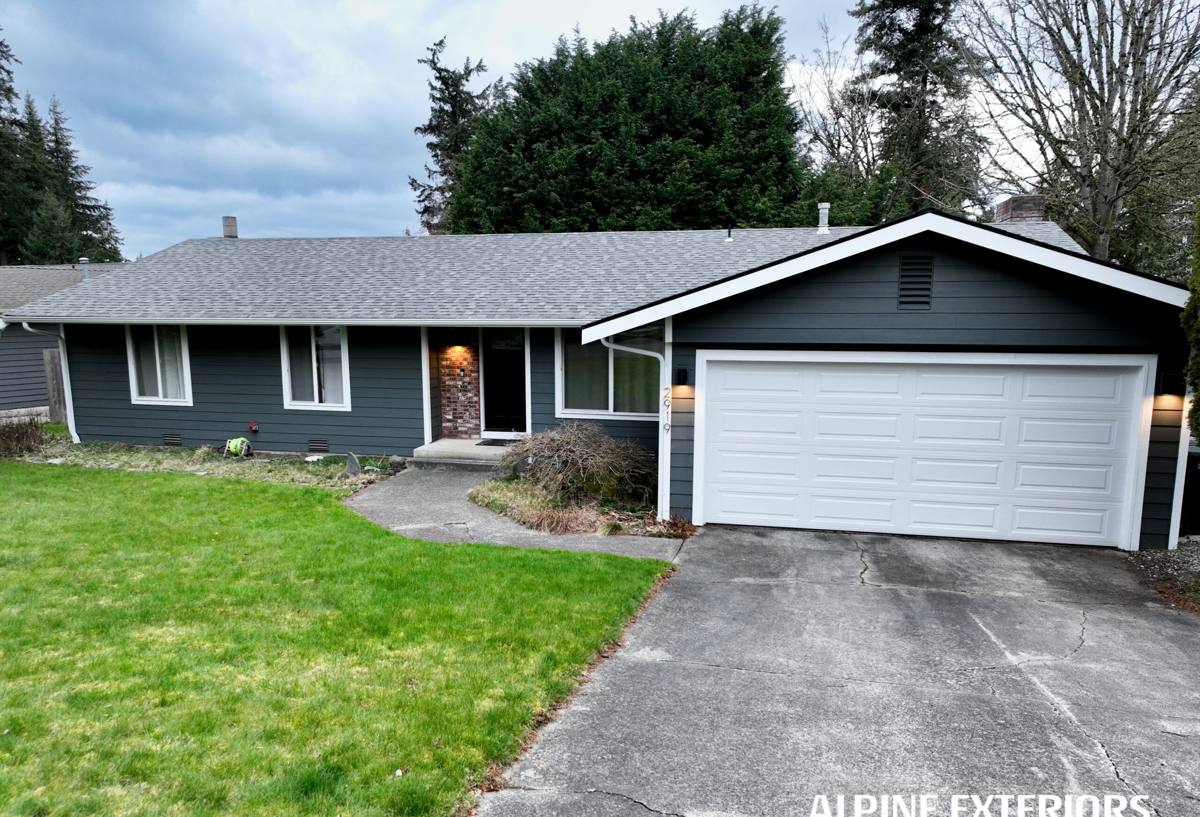
Why We Install Only James Hardie Fiber Cement Here
We made a deliberate call to install James Hardie fiber cement siding exclusively, and San Juan Island's climate is a big part of that decision. Fiber cement is made from cement, sand, and cellulose fiber — it doesn't have the organic wood content that feeds rot and moss growth, and it doesn't absorb water the way wood or wood-composite siding does. It's also non-combustible, which matters on an island where wildfire response times can be longer than what homeowners are used to on the mainland.
Just as important, James Hardie engineers its products by climate zone. The HZ5 formulation used throughout the Pacific Northwest is built specifically for cold, wet, high-moisture-cycling conditions like ours — it's a different product than what gets installed in Arizona or Florida. Combined with the factory-applied ColorPlus finish, which is baked on under controlled conditions rather than field-painted, you get a finish that holds its color and resists the chalking and fading that salt air and UV exposure accelerate on site-painted surfaces.
What "Correct" Actually Means Once the Siding Is on the Wall
Fiber cement performs the way it's supposed to only when it's installed to manufacturer spec. A rushed or careless install can undo most of the material's advantages, which is why the installation details below matter as much as the product choice itself.
What a Correct Installation Involves
Moisture Management Behind the Siding
Siding is the visible layer, but the water-resistive barrier and flashing behind it are what actually keep a San Juan Island home dry through a wet Pacific Northwest winter. That means a properly lapped weather-resistant barrier, correctly integrated window and door flashing, and a drainage plane that lets any moisture that does get behind the siding find its way back out instead of sitting against the sheathing. Skipping or shortcutting this step is the single most common reason siding jobs fail early — and it's invisible once the siding goes up, which is exactly why it needs to be done right the first time.
Fastening and Clearances
James Hardie specifies exact nailing patterns, fastener types, and minimum clearances — siding-to-grade, siding-to-roofline, siding-to-deck — for good reason. Get the clearance wrong and you create a spot where splash-back moisture or standing water can sit against the bottom edge of the plank, which is where fiber cement is most vulnerable if it's not detailed correctly. Get the fastening wrong and you risk cracking or popped boards after a few freeze-thaw cycles.
Trim, Flashing, and Sealant Details
Outside corners, window trim, and butt joints are where most siding failures start, coastal or not. On an island where wind-driven rain can hit siding at an angle rather than falling straight down, these details carry more weight than they would on a sheltered inland lot. We treat every joint and penetration as a place water will eventually try to get behind — because on San Juan Island, eventually usually isn't very long.
Our Process for San Juan Island Projects
Working on an island changes the logistics of a siding project even when the install itself is standard. We plan around that up front rather than discovering it mid-job.
- Site visit and assessment — we look at existing siding condition, sheathing and framing exposure, moisture staining, and any moss or algae buildup that points to a chronic wet spot.
- Material and logistics planning — fiber cement is heavy, and getting a full material order, crew, and equipment to the island means scheduling around ferry availability rather than just a drive-time estimate.
- Tear-off and substrate check — once old siding is off, we inspect the sheathing for hidden rot before anything new goes up. Covering a compromised substrate with new siding just hides the problem.
- Weather barrier, flashing, and fiber cement installation — installed to James Hardie's fastening schedule and clearance requirements, not a generalized "close enough" standard.
- Final walk-through — trim, caulking, and touch-up checked against the manufacturer's finish standards before we call the job done.
HardiePlank Lines and Colors That Suit Island Homes
James Hardie offers several plank profiles and textures, and the right one depends on the home's style and how exposed it is to weather. We help homeowners weigh that rather than defaulting to one option for every house.
| Product Line | Texture / Profile | Best Suited For |
|---|---|---|
| HardiePlank Lap Siding | Cedarmill (wood-grain) or Smooth | Traditional and craftsman-style homes wanting a classic lap look |
| HardieShingle | Staggered or straight-edge shingle | Cottage or shingle-style homes common on island and coastal lots |
| HardiePanel | Smooth or stucco-textured vertical panel | Modern builds or accent gables paired with lap siding |
| Statement Collection | Extended ColorPlus palette, deeper reveal options | Homeowners wanting a specific architectural color or shadow line |
Every line comes through the ColorPlus factory-finish process, which matters more here than in a drier climate — a field-applied paint job is fighting salt air and moisture the entire time it cures, while a factory finish is baked on before it ever reaches the island.
What Affects the Cost of a San Juan Island Siding Project
We don't quote made-up numbers on an education page, but the factors that move a project's cost up or down are consistent from job to job. Knowing them ahead of time makes for a more useful conversation when we do walk your property.
| Cost Factor | Why It Matters |
|---|---|
| Ferry and transport logistics | Material and crew scheduling around ferry sailings adds planning time compared to a mainland job |
| Existing siding removal | Tear-off, disposal, and any hidden sheathing repair add labor beyond a straightforward re-side |
| Home size and number of stories | More wall area and taller elevations mean more material, staging, and labor time |
| Trim and architectural detail | Corners, dormers, and multiple roof planes take more precise (and slower) flashing and cutting |
| Product line and finish | Shingle profiles and Statement Collection colors cost more than standard lap and standard colors |
Maintenance: What Island Homeowners Should Expect
Fiber cement is low-maintenance compared to wood or engineered wood siding, but "low-maintenance" isn't "no-maintenance" — especially with San Juan Island's moss season. A short annual routine keeps the siding performing the way it's designed to.
- Rinse the siding annually with a garden hose to clear salt residue, pollen, and early moss growth before it takes hold
- Keep gutters clear so overflow doesn't run down the wall and create a permanent wet stripe
- Trim back tree limbs and shrubs that keep siding shaded and damp longer than the rest of the wall
- Inspect caulking at trim joints and penetrations every couple of years and re-caulk where it's cracked or pulled away
- Address any moss or algae patches promptly with a gentle wash rather than pressure-washing directly into seams
- Watch the bottom few inches of siding near grade, decks, and walkways — the most common spot for splash-back moisture
Why Hire a Crew That Already Works on San Juan Island
A contractor who only occasionally works the San Juan Islands has to relearn the logistics — and sometimes the climate — every time. We already know that a project here means building the material delivery and crew schedule around ferry timing, that a shoreline-facing wall and a wooded interior lot on the same island can have noticeably different moisture and moss exposure, and that HardieZone HZ5 specification isn't optional in this climate the way it might be treated elsewhere. That local familiarity shows up in fewer surprises mid-project and a install that's detailed for the conditions your home actually faces, not a generic mainland approach.
If you're weighing a siding replacement on San Juan Island, we're happy to walk the property, look at what your current siding is telling us, and talk through where James Hardie fiber cement makes sense for your home. Reach out for a free, no-pressure estimate — there's no obligation, just a straight answer about what your home needs.