 Orcas Island Siding
 Rosario Decks Work Harder Than Most People Realize
If you own a home in the Rosario area of Orcas Island, your deck isn't just outdoor living space — it's a structure fighting a slow, constant battle against salt-laden air, driving rain off the water, and a moss season that seems to stretch longer every year. Decks here age differently than decks fifteen minutes inland. The same board, the same fasteners, the same footings will hold up longer in a dry, sheltered yard than they will exposed to Rosario Strait weather. That's not a knock on any particular deck or builder — it's just what San Juan County shoreline exposure does over time.
We work on decks all over Orcas Island, but Rosario has its own personality: more direct wind off the water, more salt spray carried inland on storms, and shaded, damp pockets where moss and algae take hold and never quite dry out. A deck repair here needs to account for all of that, not just patch the board that's obviously failing.
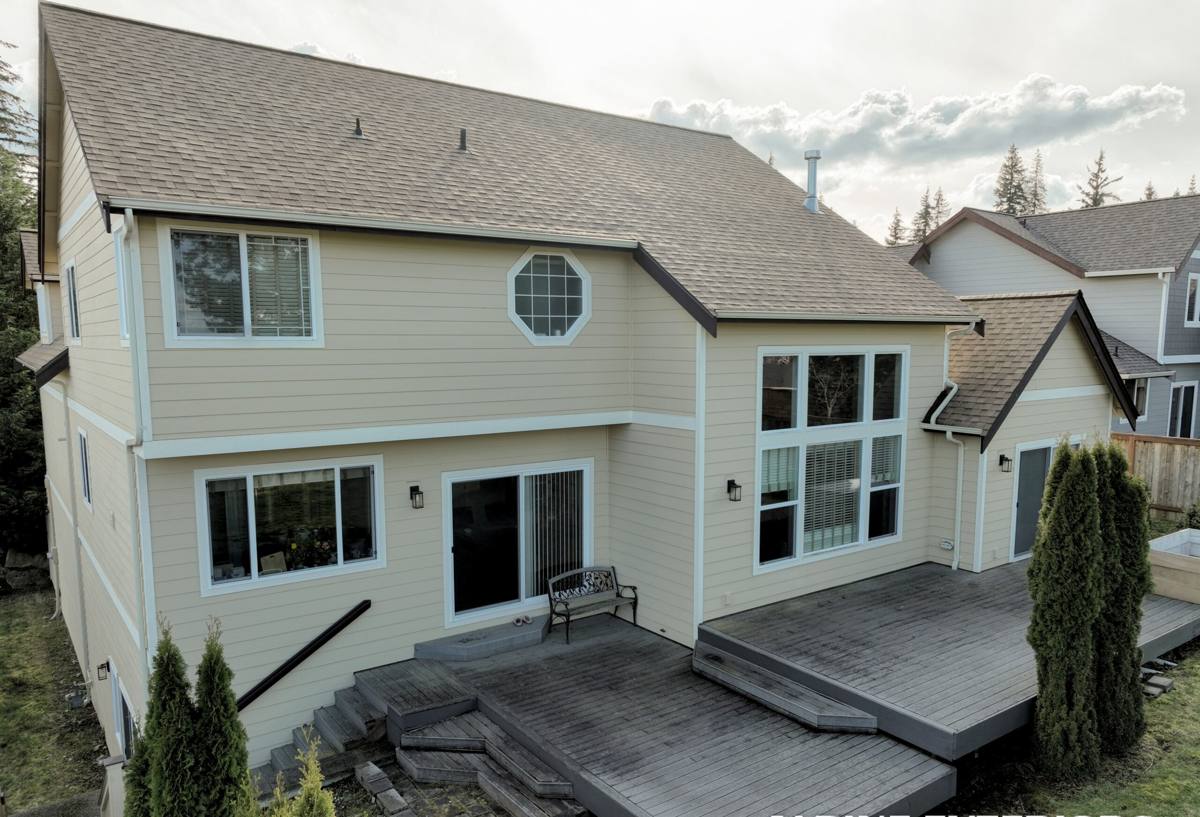
What Salt Air, Rain, and Moss Actually Do to a Deck
It helps to understand the mechanism, not just the symptom, because it changes how a repair should be done.
Salt Air and Metal Fasteners
Airborne salt accelerates corrosion in nails, screws, brackets, and joist hangers. Once a fastener starts rusting, it loses holding power long before it looks obviously bad. A board that seems solid can be barely attached underneath because the screws holding it have corroded through most of their cross-section.
Driving Rain and End-Grain Water Intrusion
Wind-driven rain doesn't just fall on a deck — it gets pushed sideways into joints, board ends, and anywhere two pieces of wood meet. End grain soaks up water far faster than the face of a board. Repeated wetting and drying at cut ends, around post bases, and at ledger connections is where rot almost always starts first.
Moss, Algae, and Trapped Moisture
A long moss season means longer stretches where deck surfaces stay damp instead of drying out between rains. Moss and algae hold moisture against the wood surface, which softens fibers, feeds decay fungi, and makes boards slick and dangerous underfoot. Left alone, what starts as a cosmetic green film becomes a structural problem within a few seasons.
Signs a Rosario Deck Needs Repair — Not Replacement
Most decks we look at don't need to be torn out and rebuilt. They need targeted, correct repair. Here's what we check for before recommending either path:
- Soft or spongy spots when you walk the deck, especially near the house or at board ends
- Screws or nail heads that are rusted, backed out, or spin freely without holding
- Visible gaps or movement where the deck ledger meets the house siding
- Persistent moss or black staining that doesn't clean off, even after washing
- Railing posts that wiggle at the base — a common sign of rotted post anchoring
- Cracking or splitting concentrated at board ends rather than across the whole board
- Discoloration or rust streaks running down from metal connectors or fastener heads
If the framing underneath — joists, beams, posts, and footings — is still structurally sound, repair is almost always the right call. Replacement becomes necessary when rot has spread into the framing itself, not just the surface boards.
What a Correct Deck Repair Actually Involves
A repair that only replaces the boards you can see is a repair that fails again in a few years. On a Rosario property, we treat every repair as an opportunity to check what caused the damage in the first place, not just what shows on the surface.
Structural Inspection First
Before any board comes off, we get underneath the deck and check the ledger connection, joists, beams, posts, and footings. This is where the real integrity of the deck lives, and it's the part most homeowners never see.
Fastener and Hardware Review
Given how hard salt air is on standard fasteners, we check hardware condition separately from wood condition. It's common to find boards that look fine but are held by corroded fasteners that need replacing regardless of the deck boards' condition.
Flashing and Water Management
A huge percentage of deck rot traces back to poor flashing at the ledger board — where the deck attaches to the house. If water has been getting behind the ledger, replacing deck boards without fixing the flashing just resets the clock on the same failure.
Matching Materials Correctly
When we replace boards, joists, or posts, we match treatment ratings and fastener types to the exposure level of that specific part of the deck. A board facing direct weather off the water needs different hardware than one tucked under a covered section.
Repair or Rebuild? How We Help You Decide
This is the question almost every homeowner asks first, and the honest answer depends on where the damage actually is.
| Situation | Repair Usually Makes Sense | Rebuild Usually Makes Sense |
|---|---|---|
| Framing (joists, beams, posts) | Solid, dry, no soft spots when probed | Rot found in multiple joists or the main beam |
| Ledger connection | Sound, properly flashed | Rotted ledger or evidence of long-term water intrusion behind it |
| Footings and posts | Stable, no movement or heaving | Undersized, shifting, or rotted at the base |
| Surface boards | Isolated soft or split boards | Widespread soft boards across most of the deck |
| Age of original build | Under 15–20 years with good bones | Original construction is old and doesn't meet current code for a growing repair |
We always inspect before quoting either option. A deck that "looks rough" can often be brought back with targeted board and hardware replacement; a deck that "looks fine" can sometimes hide a compromised ledger or beam that changes the whole conversation.
Decking Materials: What Holds Up in This Exposure
There's no single "best" decking material — there are trade-offs, and the right choice depends on how exposed a particular deck is to wind, salt, and standing moisture.
| Material | Salt-Air Behavior | Moss/Algae Resistance | Maintenance Needs |
|---|---|---|---|
| Pressure-treated fir/hem-fir | Good if fasteners are corrosion-resistant | Needs regular cleaning and sealing | Periodic sealing and inspection |
| Cedar | Naturally decay-resistant, but softer surface | Prone to graying and moss without upkeep | Regular cleaning, occasional oil/sealer |
| Composite decking | Doesn't rot, but surface can still host moss/algae | Needs periodic washing to prevent buildup | Low, but not zero — still needs cleaning |
| Structural framing (any species) | Fastener corrosion is the real risk, not the wood itself | N/A — framing rarely sees direct moss exposure | Depends entirely on hardware quality |
Whichever surface material a homeowner prefers, we treat fastener and hardware selection as the more important decision in a salt-air environment like Rosario. A premium composite board held down with the wrong screws will still fail early.
Our Deck Repair Process, Step by Step
- On-site inspection — we walk the deck surface and go underneath to check framing, ledger, posts, and footings before recommending anything
- Written scope — we tell you plainly what's structural, what's cosmetic, and what can wait a season
- Demo of only what's necessary — we remove damaged boards, hardware, or framing without disturbing sound material
- Structural correction — rotted joists, posts, or ledger issues get fixed first, before any new decking goes down
- Flashing and water management — we correct any flashing gaps at the ledger so the repair doesn't just recreate the original problem
- Rebuild with matched materials — new boards and corrosion-resistant hardware sized to the exposure level of that section of deck
- Final walkthrough — we go over what was done, what to watch for, and simple upkeep to extend the life of the repair
Maintenance That Actually Extends a Rosario Deck's Life
Repair is only half the equation. A little seasonal attention prevents small issues from becoming another repair call in a few years.
- Sweep debris and needles off the deck regularly — trapped organic matter holds moisture against boards
- Wash off moss and algae buildup before it spreads, especially in shaded or north-facing sections
- Check fastener heads once a year for rust streaks or backing-out screws
- Keep gutters and downspouts near the deck clear so runoff isn't dumping extra water onto it
- Inspect the ledger flashing line yearly for gaps, especially after a hard storm season
- Re-seal or re-oil wood decking on the schedule the product actually needs — skipping years is where damage starts
- Test railing posts by hand periodically — looseness at the base is an early warning sign, not a minor issue
Why a Crew That Already Works Rosario Makes a Difference
Deck repair isn't complicated in theory, but getting it right in this exposure means understanding how fast salt air corrodes hardware, how far wind-driven rain actually travels into a joint, and which parts of a deck in this specific area tend to fail first. A crew that works decks across San Juan County — not just occasionally, but regularly — has already seen how Rosario's shoreline exposure differs from a sheltered inland lot, and builds the repair accordingly instead of treating every deck the same.
That local pattern recognition is what separates a repair that lasts from one that needs redoing in three years. We're not guessing at what salt air and moss season will do to a repair here — we've already seen it play out on decks like yours.
Get a Straight Answer About Your Deck
If your Rosario deck has soft spots, rusted hardware, persistent moss, or a railing that doesn't feel as solid as it used to, it's worth getting an honest inspection before the problem spreads into the framing. We'll tell you plainly whether you're looking at a repair or something bigger — no upselling, no guesswork. Reach out for a free, no-pressure estimate using the form below.