 Orcas Island Siding
 Friday Harbor Roofs Fight a Different Kind of Weather
A roof in Friday Harbor doesn't fail the way a roof in a dry inland town fails. Out here, the damage is slower and sneakier. Salt-laden air off the water works on exposed fasteners, flashing, and metal edges year-round. Driving rain, pushed sideways by wind funneling through the islands, finds every weak lap and undersized flashing detail instead of just running off the field of the roof. And a long, wet moss season means anything that traps moisture — north-facing slopes, shaded valleys, low-pitch sections under tree cover — stays damp for months at a stretch instead of drying out between storms.
None of that means a roof here can't last. It means a roof replacement in this part of San Juan County has to be built with those three things in mind from the start, not patched around later. That's the difference between a roof that needs attention again in eight years and one that goes the full distance of its warranty.
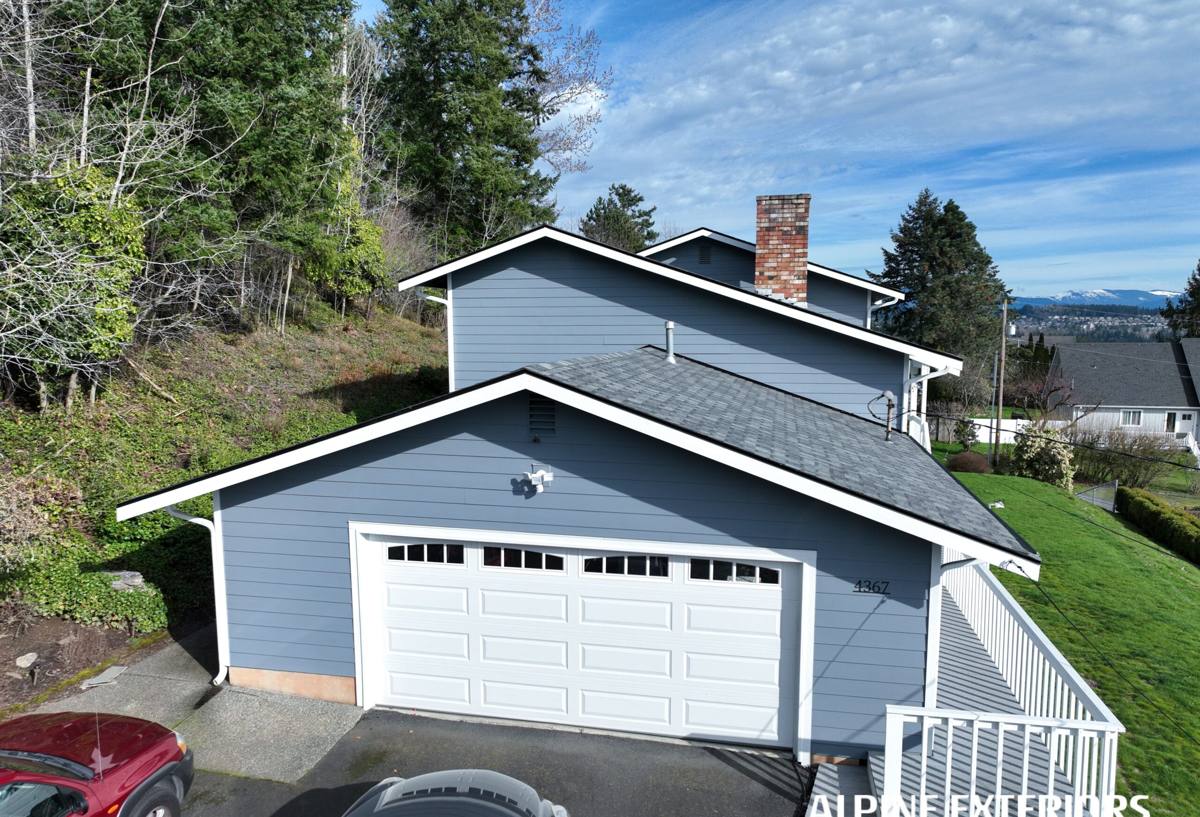
Signs a Repair Won't Cut It Anymore
Not every roof problem means a full replacement. But on Orcas Island and around Friday Harbor, we see a few patterns that consistently point to "replace, don't patch":
- Granule loss heavy enough that you're finding shingle grit in gutters and downspouts every season
- Moss established in mats rather than surface streaks — it's been lifting shingle edges long enough to hold moisture underneath
- Soft or spongy decking felt underfoot in the attic, especially near eaves and valleys
- Repeated flashing leaks around chimneys, skylights, or dormers even after past repairs
- Shingles curling, cracking, or losing their seal in multiple areas rather than one isolated spot
- The roof is 20+ years old on asphalt, or showing widespread wear regardless of age
If it's one leak in one spot, that's usually a repair. If it's several of these at once, patching becomes a losing game — you're paying to fix the same underlying moisture problem over and over instead of once.
Materials That Actually Hold Up in This Climate
There's no single "best" roofing material for every home — it depends on your roof's pitch, how exposed it is to weather off the water, your budget, and how the house looks. What we won't do is put a product on your roof that we know performs poorly in salt air and moss conditions just because it's cheaper up front. Here's how the common options actually compare for a home in this area:
| Material | Salt air resistance | Moss/moisture behavior | Wind performance | Typical lifespan here |
|---|---|---|---|---|
| Architectural asphalt shingle | Good, with corrosion-resistant fasteners | Needs proper ventilation and periodic cleaning to avoid moss buildup | Good when properly nailed and sealed | 20-25 years |
| Standing seam metal | Very good with coated/marine-grade fasteners and finishes | Sheds moisture fast, moss struggles to establish | Excellent | 40-50+ years |
| Cedar shake | Traditional island look, but needs real upkeep near salt air | Most moisture-sensitive option; moss and rot risk without diligent maintenance | Fair, sensitive to wind-driven rain if not detailed correctly | 20-30 years with maintenance |
| Synthetic/composite shingle | Good, doesn't corrode | Sheds water well, less moss-prone than wood | Good | 30-40 years |
We'll walk you through the real trade-offs — not just price, but maintenance burden and how each material behaves once it's been through a few winters of driving rain off the water. Cedar can look great here, but it asks for more upkeep than most homeowners realize before salt air and shade get involved. Metal costs more up front but shrugs off moss and wind in a way asphalt can't fully match.
Fasteners and Flashing Matter as Much as the Shingle
A lot of premature roof failure near the water isn't the shingle's fault — it's corroded fasteners, undersized flashing, or the wrong metal paired with the wrong material (which can cause galvanic corrosion). On every replacement we install corrosion-resistant fasteners and properly sized flashing, not just whatever came in the standard kit.
What a Correct Roof Replacement Actually Involves
A roof replacement is more than stripping old shingles and nailing down new ones. Done right, here's what's included:
- Full tear-off — old material removed down to the decking, not layered over. Layering over old shingles traps moisture and voids most manufacturer warranties.
- Decking inspection and repair — any soft, rotted, or moisture-damaged sheathing gets replaced before anything new goes down. This is where a lot of the moss-season damage shows up.
- Ice and water shield at eaves and valleys — a self-adhering membrane in the areas most exposed to wind-driven rain and ice damming, which matters more here than in drier inland climates.
- Synthetic underlayment across the field for a secondary water barrier that holds up better and longer than old-style felt.
- Proper flashing at every penetration — chimneys, vents, skylights, dormers, and roof-to-wall transitions — sized and installed for wind-driven rain, not just standard rainfall.
- Balanced ventilation — intake at the eaves and exhaust at the ridge, sized correctly for the attic volume, so moisture doesn't get trapped under the new roof and start the moss cycle over again.
- Final material installation with corrosion-resistant fasteners appropriate to a coastal climate.
Skip any one of these and you haven't really solved the problem — you've just bought a few years before the same symptoms come back.
How We Handle a Roof Replacement in Friday Harbor
Our process is straightforward, and we tell you what to expect at every step:
- On-site inspection and honest assessment — we look at the roof, the attic, and the trouble spots, and tell you plainly whether you need a replacement or if a repair will hold.
- Written estimate — material options, scope of work, and a clear price, with no vague allowances buried in the fine print.
- Material and logistics planning — because this is an island job, we plan material delivery and crew scheduling around ferry timing so the project isn't held up mid-tear-off waiting on supplies.
- Tear-off and decking repair — done in sections when weather requires it, with the roof protected at the end of each work day so an unexpected squall off the water doesn't become a bigger problem.
- Installation following manufacturer specs for wind and moisture exposure, not just the minimum code requirement.
- Final walkthrough — we go over the finished roof with you, including ventilation and any maintenance recommendations specific to your property's sun exposure and tree cover.
Keeping Moss and Moisture From Coming Back
Replacing the roof solves the immediate problem, but a few ongoing habits keep it from repeating:
- Keep gutters and valleys clear of needles and debris — clogged drainage is one of the biggest contributors to moss establishing on a roof
- Trim back overhanging branches where practical to cut down on shade and debris on north-facing slopes
- Have the roof looked at after major storms, not just on a fixed annual schedule
- Address moss the moment it appears as a light streak, before it becomes a mat that holds moisture against the shingle
Zinc or copper strips near the ridge can help suppress moss regrowth on some roof types — we'll tell you honestly whether that's worth it for your specific roof, rather than upselling it on every job.
Permits, Timing, and Working on an Island
Roof replacements in San Juan County typically require a building permit, and timelines can be affected by ferry scheduling for material delivery and, on some jobs, disposal hauling. We factor that into scheduling upfront so you're not caught off guard by delays that are specific to working on Orcas Island rather than the mainland. A crew that works this area regularly already knows how to plan around it — one that doesn't is learning on your project's timeline.
What Roof Replacement Typically Costs — and Why It Varies
| Cost factor | Why it matters here |
|---|---|
| Roof size and pitch | Steeper roofs take longer and need more safety setup, especially with driving rain in the forecast |
| Decking condition | Moss season and past leaks often mean some sheathing replacement is needed — this isn't always visible until tear-off |
| Material choice | Asphalt, metal, and cedar carry very different material and labor costs, and different long-term maintenance costs |
| Number of penetrations | Chimneys, skylights, and vents each need proper flashing, which adds labor |
| Ventilation upgrades | Correcting inadequate attic ventilation during the replacement costs less than doing it as a separate project later |
| Access and logistics | Island delivery and disposal logistics can affect scheduling and cost compared to mainland jobs |
We don't quote a number without seeing the roof — anyone who does is guessing, and on an older roof here, guesses tend to be wrong once tear-off reveals the decking underneath.
Questions Worth Asking Before You Hire
- Does the estimate include full tear-off, or is layering over the old roof on the table?
- Is decking repair priced as an allowance, or will you be told the real cost once it's uncovered?
- What underlayment and ice/water shield are specified, and where?
- Is attic ventilation being evaluated as part of the job, not just the shingles?
- What fasteners and flashing metal will be used, and are they rated for coastal/salt-air exposure?
- Does the crew regularly work on Orcas Island, or is this their first island job?
Why Local Experience on Orcas Island Actually Matters
A roof replacement done by a crew that's never worked in a salt-air, high-moss climate tends to make the same mistakes: standard fasteners that corrode early, ventilation sized for a drier climate, flashing details that assume rain falls straight down instead of sideways. We work in Friday Harbor and across Orcas Island regularly, which means we already know which roof details need extra attention here and which shortcuts consistently cause problems a few winters later. That experience shows up in fewer callbacks and a roof that's actually built for the weather it has to survive, not just the weather on the spec sheet.
If your roof is showing its age or you're just not sure whether it's a repair or a replacement, we're happy to take a look and give you a straight answer. Fill out the form below for a free, no-pressure estimate.