 Orcas Island Siding
 Why Orcas Roofs Wear Differently
A roof on Orcas Island earns its keep in ways a roof further inland never has to. Salt air off the surrounding water works on exposed metal year-round, corroding cheap fasteners and flashing faster than most manufacturers' warranties assume. Storms move through with driving, wind-pushed rain that doesn't just fall straight down — it gets forced sideways and upward under edges and laps that would stay dry almost anywhere else. And the heavy tree cover that makes this island beautiful also means shade, standing moisture, and a long moss season that can take hold on a roof surface within a year or two if nothing is done about it.
None of that means roofing here is impossible or exotic. It means the details that get skipped on a rushed, low-bid job are exactly the details that matter most in San Juan County. A correctly installed new roof accounts for all three of these pressures from the start, instead of trying to patch around them later.
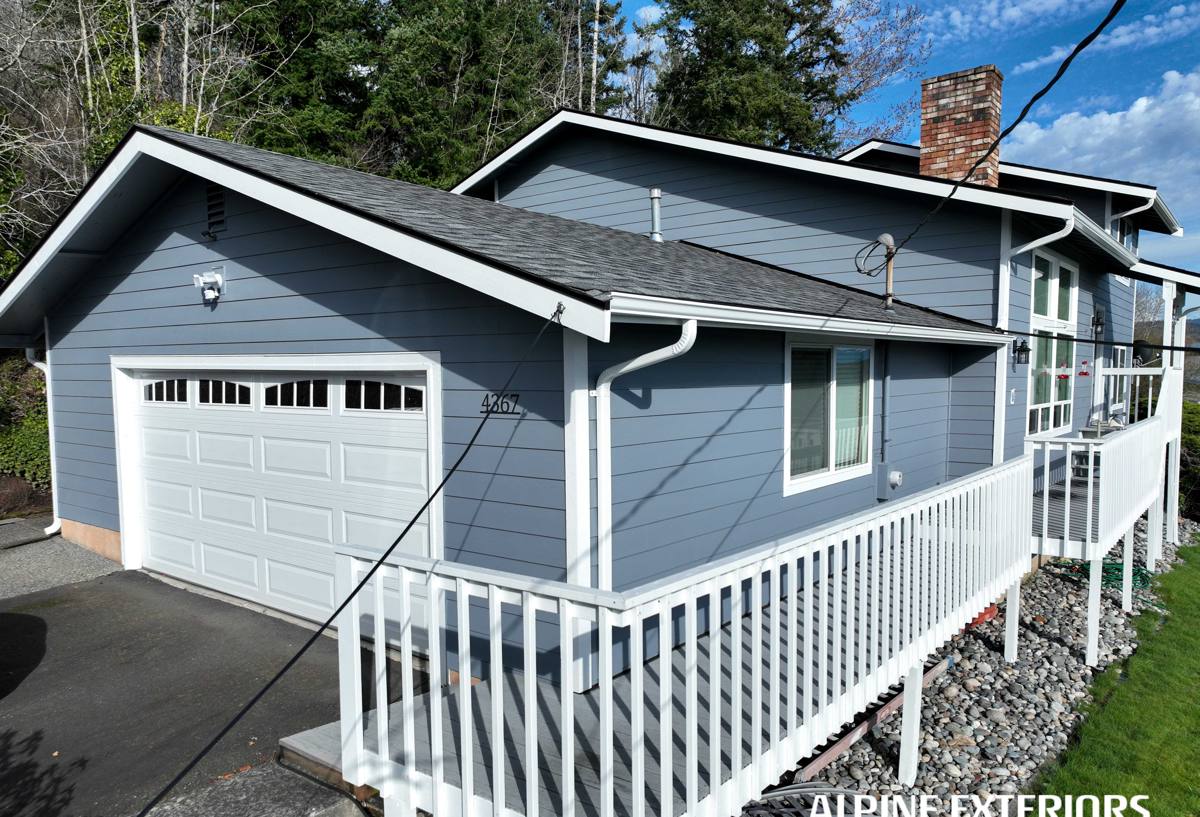
What a Correct New Roof Installation Actually Involves
A new roof is more than laying down shingles or panels over what's already there. Done right, it's a sequence of steps where each one protects the next:
- Full tear-off of the old roofing so the deck can actually be inspected, not guessed at
- Repair or replacement of any soft, rotted, or delaminated sheathing found underneath
- A synthetic or self-adhered underlayment suited to a wet marine climate, not just builder's felt
- Ice-and-water membrane at eaves, valleys, and other spots most exposed to wind-driven rain
- Correct flashing at every penetration — chimneys, skylights, plumbing vents, and roof-to-wall transitions
- Balanced intake and exhaust ventilation so the attic can actually dry out between storms
- Manufacturer-specified fastening patterns, especially important given local wind exposure
Skip the tear-off and you're guessing at deck condition. Skip the underlayment upgrade and you're relying on shingles alone to keep out rain that's coming in sideways. Every one of these steps costs a little more time upfront and saves a lot of grief later.
Choosing a Roofing Material That Fits Orcas Conditions
There's no single "best" roofing material for every home here — it depends on your roof's pitch, how much shade and tree cover it sits under, and your budget. What matters is picking with the actual climate in mind rather than whatever's cheapest at the yard that week.
| Material | Typical Lifespan | Moss & Algae Resistance | Salt Air / Wind Performance | Relative Upfront Cost |
|---|---|---|---|---|
| Architectural asphalt shingle | 20-30 years | Moderate — improves with zinc/copper strips | Good with proper fastening and flashing | Lowest |
| Standing seam metal | 40-60+ years | High — moss struggles to grip smooth panels | Very good; needs quality coating for salt exposure | Highest |
| Synthetic/composite shake | 30-50 years | Moderate to high depending on product | Good; lighter than natural shake, holds up to wind | Mid-range |
Architectural asphalt shingles remain the most budget-friendly option and perform well here as long as the underlayment, ventilation, and moss-prevention details around them are done correctly — the shingle itself is rarely the weak point. Standing seam metal costs more upfront but sheds moss almost entirely thanks to its smooth, continuous surface, and a quality coating system holds up well against salt air over decades. Synthetic and composite shake products split the difference, giving a traditional Northwest look without the moisture-absorption problems that come with real cedar shake in a climate this wet.
We'll walk through these trade-offs honestly during your estimate — including where a mid-range choice may actually outperform a premium one on a shaded, moss-prone roof, or where metal's higher upfront cost pays for itself over decades of not re-roofing.
Controlling Moss, Algae, and the Moisture Feeding Them
Moss and Algae on the Surface
Moss doesn't just sit on a roof — it holds moisture against the surface, works into shingle granules and seams, and can lift edges enough for water to get underneath. On shaded lots, which describes a lot of properties around here, it's less a question of "if" than "how often" you'll need to deal with it. Zinc or copper strips installed near the ridge let rain carry trace metal ions down the roof slope, which discourages new growth without harsh chemical treatments. They're not a substitute for occasional cleaning, but they meaningfully stretch the time between cleanings.
Ventilation and Attic Moisture
What's happening underneath the roof deck matters just as much as what's on top of it. A marine climate keeps humidity high for long stretches, and an attic without balanced intake and exhaust ventilation traps that moisture. Trapped moisture condenses on the underside of the sheathing, which rots wood, feeds mold, and — from below — actually helps moss and algae get a foothold on the surface above by keeping the whole roof assembly damper than it should be. Ridge vents paired with proper soffit or eave intake let air actually move through the attic instead of just sitting there.
Simple Maintenance That Protects a New Roof
Even a correctly installed roof benefits from a little attention over the years, and on Orcas Island that attention pays off faster than in drier climates:
- Trim back overhanging branches to reduce shade and debris buildup on the roof surface
- Clean gutters at least twice a year so water has somewhere to go besides under the shingles
- Rinse off moss or algae buildup before it has a chance to establish, rather than waiting for a thick mat to form
- Schedule a quick visual inspection after any major windstorm to catch lifted flashing or shingles early
Flashing and Water Management for Wind-Driven Rain
Most roof leaks don't come from a hole in the shingles — they come from a flashing detail that was rushed or skipped. That risk goes up here because rain doesn't always fall straight down. Wind off the water can push it sideways and even drive it slightly upward under loose or improperly lapped edges.
The details that matter most on an Orcas roof include step flashing woven correctly at every wall intersection, kick-out flashing where a roof edge meets a wall to direct water into the gutter instead of behind the siding, properly sized and lapped valley flashing, and correctly flashed curbs on any skylights. None of this is unique to this island, but the consequence of getting it wrong shows up faster and more often here than in a drier, calmer climate.
The Logistics of Roofing Work on an Island
Any contractor who hasn't worked here before is learning these lessons on your project, which costs you time and sometimes money:
- Ferry schedules dictate when material deliveries and crew arrivals actually happen — a missed sailing can push a start date by most of a day
- Weather windows for tear-off need real planning, since an open deck exposed to a sudden squall is a serious problem
- San Juan County permitting and inspection scheduling has its own rhythm and timelines worth knowing in advance
- Narrow driveways, septic fields, and well locations need to be respected when staging material, a dumpster, or equipment
- Debris haul-off has to be planned around ferry capacity rather than a quick dump run down the street
These aren't exotic obstacles, but they're real ones, and a crew that's already worked through them on other Orcas projects plans around them instead of discovering them mid-job. Ask any contractor early how they plan around ferry timing and weather, and you'll learn quickly whether they've actually done island work before.
Our New Roof Installation Process
- On-site inspection of your current roof, attic ventilation, and any problem areas you've noticed
- Honest material recommendation based on your roof's exposure, shade, pitch, and budget
- Written estimate with a clear scope, so you know exactly what's included before any work starts
- Permitting handled through San Juan County ahead of any tear-off
- Material and dumpster delivery scheduled around ferry logistics and the forecast
- Full tear-off, deck inspection and repair, underlayment, and flashing installed to spec
- New roofing installed with attention to ventilation and moss-prevention details discussed at estimate
- Full site cleanup, including magnetic sweep for stray fasteners
- Final walkthrough so you can see and understand the completed work before we consider the job done
Signs Your Roof Needs Replacing, Not Just Patching
Not every roof problem calls for full replacement, but on Orcas Island these signs usually mean patching is just delaying the bigger job:
- Shingles that are curling, cracked, or losing granules across large sections rather than one isolated spot
- Heavy, persistent moss coverage that returns quickly even after cleaning
- Daylight visible through the roof deck from inside the attic
- Soft or spongy spots underfoot when walking the roof
- Staining or active leaks showing up on interior ceilings after storms
- A roof already past, or close to, its material's expected lifespan with no major upgrades since installation
Why Hire a Crew That Already Works on Orcas
Roofing know-how matters everywhere, but on Orcas Island local experience shows up in specific ways: knowing which materials actually hold up under this much salt air and shade, having the ventilation and moss-prevention details dialed in from repeated experience rather than a manual, and having ferry logistics, permitting timelines, and site-access quirks already worked out instead of figured out on your dime. It's the difference between a crew that treats your roof like just another job and one that treats it like the specific island roof it is.
If you're weighing a new roof for your Orcas Island home, we're happy to take a look and talk through what actually makes sense for your situation — no pressure, no hard sell. Use the form below to request a free estimate.