 Orcas Island Siding
 Board & Batten Siding for Olga Homes
Olga sits on the quieter, working side of Orcas Island, and the homes here run the gamut from older farmhouses and waterfront cabins to newer builds tucked into the trees along the east side of the island. Board and batten is a natural fit for a lot of these properties — it reads as clean, vertical, and unmistakably Northwest, and it works whether the house is a century-old farmstead or a new build going for a modern-rustic look. But board and batten is also a siding style that punishes sloppy work faster than most others, and Olga's climate is exactly the kind of environment that finds every weak point in a wall assembly within a few winters.
This page covers what board and batten siding actually needs to hold up in Olga specifically, what a correct installation involves, and why we only install it in James Hardie fiber cement rather than the wood or engineered-wood versions still common on the island.
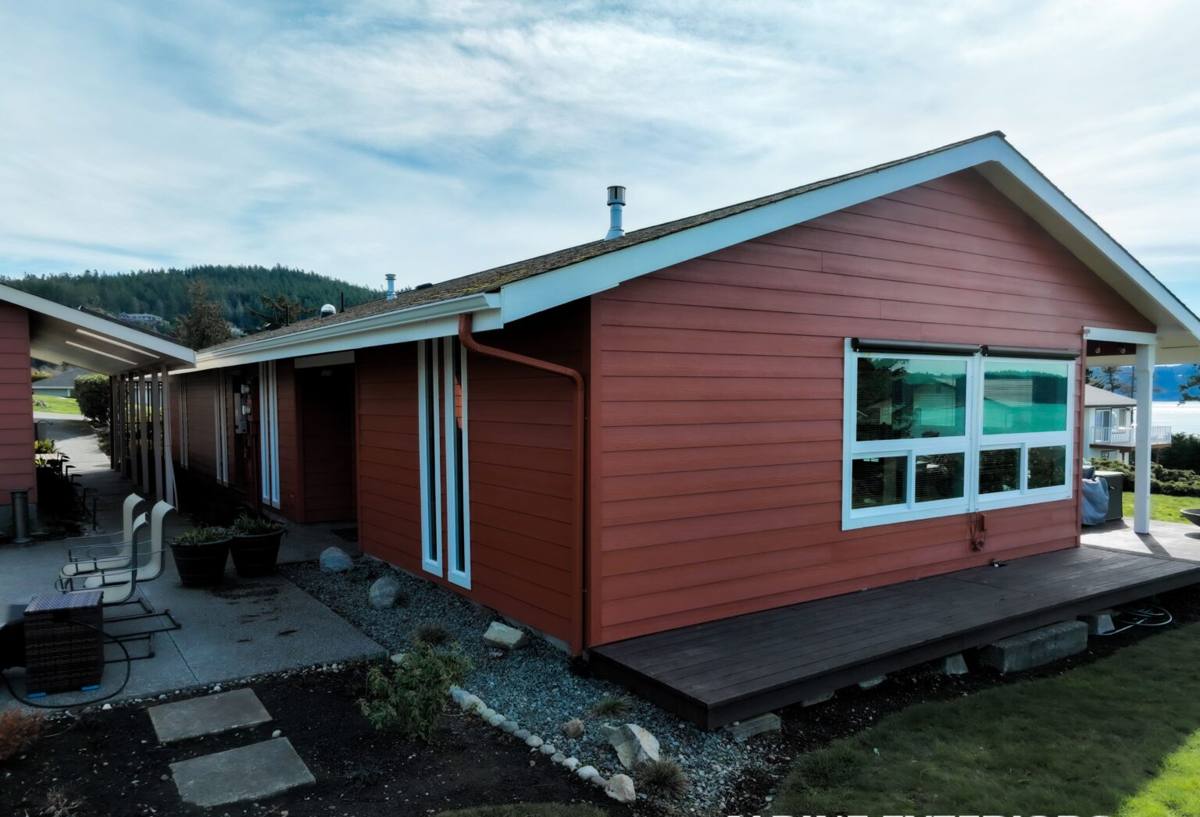
Why Olga's Climate Is Hard on Vertical Siding
Olga faces a combination that's tougher than it looks on paper. You've got salt-laden air coming off the water, long stretches of driving rain in the fall and winter, and a moss and lichen season that can run most of the year on north- and east-facing walls that don't get much direct sun. None of these individually is unusual for San Juan County — it's the combination, applied to vertical board and batten profiles specifically, that causes problems.
Salt Air and Fasteners
Salt-laden air accelerates corrosion on any fastener or flashing that isn't rated for it. On board and batten, the battens themselves are typically face-nailed or blind-nailed at intervals down their length — more fastener penetrations per square foot than a lot of horizontal lap profiles. Every one of those penetrations is a place water can find its way in if the fastener corrodes, backs out, or was never properly sealed to begin with.
Driving Rain and Vertical Joints
Board and batten relies on the overlap between the batten and the boards (or panel seams) to shed water. In a straight vertical rain, that works fine. In wind-driven rain coming off the water at an angle — which is a regular occurrence on this side of the island — water gets pushed sideways into those seams. If the batten spacing, fastening, and underlying water-resistive barrier aren't done right, that wind-driven moisture works its way behind the siding instead of running down the face of it.
Moss, Shade, and Trapped Moisture
Olga has plenty of tree cover, and shaded, tree-lined walls stay damp longer after every rain. Moss and lichen take hold on any surface that retains moisture, and once established they hold water against the siding constantly rather than just during storms. On wood-based products this accelerates rot from the surface inward. On fiber cement, correctly finished and maintained, it's a surface cleaning issue rather than a structural one — which is a meaningful difference over a 20- or 30-year ownership period.
What a Correct Board & Batten Job Involves
A lot of board and batten failures we see on the island don't trace back to the siding material at all — they trace back to what's underneath it or how it was fastened. The visible boards and battens are the last five percent of the job. The other ninety-five percent is water management that nobody sees once the job is done.
- A continuous water-resistive barrier (house wrap or equivalent) installed shingle-style so every seam drains outward, not inward
- Properly flashed windows, doors, and any wall penetrations before a single board goes up
- A drainage plane or furring strategy behind the siding so bulk water and incidental moisture can escape rather than sit against the wall sheathing
- Correct batten spacing and fastening pattern matched to the specific board width and manufacturer specs — not just "what looks even"
- Rated, corrosion-resistant fasteners suited to a marine/coastal environment, not standard interior-grade nails or screws
- Sealed, factory-finished cut edges wherever boards are trimmed on site, so raw material is never left exposed to weather
- Proper clearance at grade, decks, and roof lines so the bottom of the siding isn't sitting in standing water or snow load
Skip any one of these steps and the siding on the surface can look perfect for a year or two while damage builds underneath it. This is why we don't treat board and batten as a "nail it up and move on" job — the sequence matters as much as the material.
Why We Install James Hardie, Not Wood or Engineered Wood, for This Look
Board and batten has traditionally been a wood siding style — that's where the look comes from. A lot of Orcas Island homes still have real cedar or primed spruce board and batten, and some contractors will still offer LP SmartSide or similar engineered-wood panel products to get the same look at a lower upfront cost. We don't install any of those, and on a property in Olga specifically, that decision matters more than it would somewhere drier and further from salt water.
The Trade-Offs With Wood and Engineered Wood
Cedar and primed spruce board and batten can look excellent when new, and cedar in particular has real appeal for owners who want a natural wood look. The honest trade-off is moisture management: wood siding depends on paint film integrity and regular maintenance to keep water out of the wood fiber, and in a climate with this much sustained dampness and shade-driven moss growth, that maintenance window shrinks. Engineered wood products (OSB-core panel systems like LP SmartSide) improve on solid wood in some respects but still rely on an intact factory coating and sealed edges — any breach at a fastener, cut edge, or seam lets moisture into the wood-based core, and once that happens the repair is rarely a small one.
Why Fiber Cement Holds Up Differently
James Hardie fiber cement doesn't have a wood fiber core to swell, rot, or feed moss growth. It's dimensionally stable in the swings between soaked winter conditions and dry summer stretches, it's non-combustible, and the ColorPlus factory finish is baked on and warranted against fading and cracking well beyond what field-applied paint typically holds up to. For board and batten specifically, Hardie's vertical panel and batten trim systems are engineered to the same reveal and shadow-line proportions homeowners want from the traditional look, without the maintenance clock that comes with a wood-based product on this side of the island.
Comparing Board & Batten Material Options for Olga
| Factor | Cedar / Primed Spruce | Engineered Wood (LP SmartSide) | James Hardie Fiber Cement |
|---|---|---|---|
| Moisture tolerance in coastal/shaded conditions | Depends on paint maintenance | Depends on factory coating integrity | Not wood-based; moisture doesn't compromise the material itself |
| Moss/lichen impact | Feeds surface rot if untreated | Can feed core moisture if coating fails | Cosmetic only; cleanable |
| Fire resistance | Combustible | Combustible | Non-combustible |
| Factory finish warranty | Field-applied paint, shorter cycle | Factory coating, moderate warranty | ColorPlus factory finish, strong transferable warranty |
| Recoating/repainting interval | Every few years typically | Longer than raw wood, still finite | Extended interval per warranty terms |
This isn't a knock on wood as a material — cedar in particular has genuine character. It's a reflection of what a specific island microclimate does to that material over decades, and why we've standardized on one product we can stand behind for the full life of the installation.
Our Process for a Board & Batten Project in Olga
Every board and batten job on the island starts with an on-site look at the specific exposure of the walls being sided — which faces get direct sun, which stay shaded and damp, how close the walls are to the water, and what condition the existing water-resistive barrier and sheathing are in. That inspection drives the plan more than the finish color does.
- On-site assessment of wall exposure, existing moisture damage, and drainage conditions
- Removal of failing material and inspection of sheathing for hidden rot before anything new goes up
- Installation or repair of the water-resistive barrier and flashing details at every penetration
- Installation of James Hardie panel or board-and-batten trim system to manufacturer fastening specs, with corrosion-resistant fasteners
- Final detailing at trim, corners, and grade clearance, followed by a walkthrough with the homeowner
Maintenance Once It's Installed
Fiber cement board and batten isn't zero-maintenance, but what it needs is straightforward and infrequent compared to wood siding in this environment.
- An annual rinse-down on shaded or north-facing walls where moss tends to establish
- A visual check of caulking at trim and window details every year or two, since caulk is the one component that ages faster than the siding itself
- Keeping vegetation and sprinkler spray off the wall face where practical, to reduce constant surface wetting
- Prompt attention to any impact damage so it doesn't sit exposed through a wet season
Why Hire a Crew That Already Works Olga
Orcas Island isn't a place where a mainland crew shows up, does the job, and leaves the same day — logistics alone (ferry schedules, material delivery timing, weather windows) shape how a project gets sequenced. A crew that regularly works this side of the island already knows how to plan around that, knows what wall exposures on the island tend to need extra attention, and isn't learning San Juan County conditions on your project. That familiarity shows up in fewer surprises mid-job and a finished install that's actually detailed for where it sits, not just for a generic spec sheet.
If you're weighing board and batten for a home in Olga, we're happy to come take a look, walk the specific exposures of your walls, and give you a straightforward assessment — no pressure, no upsell, just what the house actually needs. Reach out below for a free estimate.