 Orcas Island Siding
 Composite Decking Built for Obstruction Pass Conditions
Obstruction Pass sits on the exposed southeastern edge of Orcas Island, where the water is close, the wind carries salt, and the tree cover keeps a lot of surfaces damp longer than homeowners expect. A deck out here isn't just an outdoor living space — it's a piece of exterior structure that takes a real beating from moisture, salt exposure, and the shade-and-drip cycle that comes with the island's timber. Composite decking, installed correctly, is one of the few decking systems that holds up to that combination without the annual maintenance grind of a wood deck.
We work Orcas Island regularly, including the Obstruction Pass area, and we've built our decking process around what actually fails out here — not around a generic install checklist written for a drier climate.
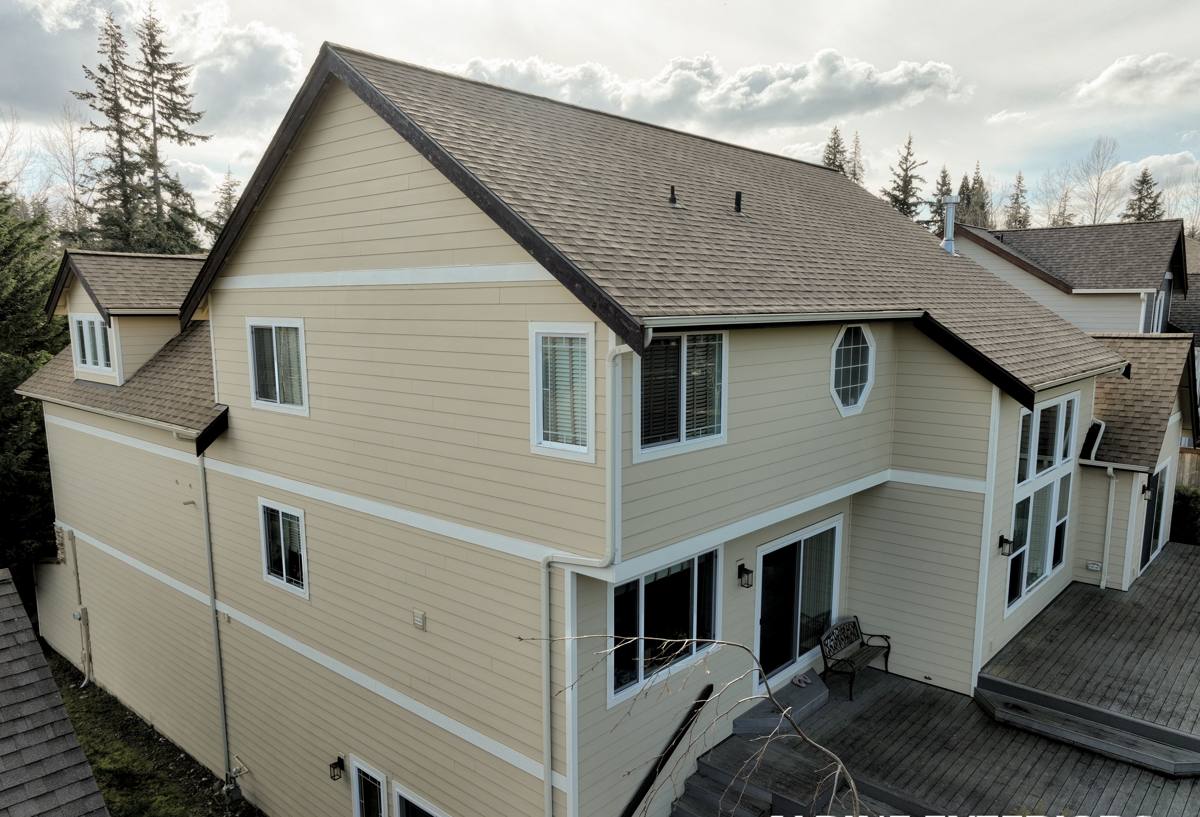
What San Juan County's Climate Does to a Deck
Three things drive most of the decking problems we see on Orcas Island, and Obstruction Pass gets a concentrated dose of all three:
- Salt air: Proximity to the water means airborne salt settles on every exterior surface, accelerating corrosion on fasteners, hardware, and any metal framing components that aren't rated for a marine-adjacent environment.
- Driving rain: Storms off the water don't just fall straight down — wind-driven rain gets under rail caps, into board end cuts, and behind ledger connections if those details weren't sealed properly at install.
- Moss and algae season: Long stretches of shade, moisture, and mild temperatures give moss and algae months to establish themselves on any surface that doesn't shed water and dry out quickly. Wood decking is especially vulnerable; composite is far more resistant, but it isn't immune if a deck is under a dense canopy with poor airflow.
None of this is unique to any one property — it's the baseline condition for anything built outdoors in this part of San Juan County. The difference between a deck that lasts and one that needs early repairs almost always comes down to the details at installation, not the brand of board.
Why This Matters More at Obstruction Pass Specifically
Properties closer to the water and tucked among trees tend to combine salt exposure with reduced sun and airflow — the two conditions that, together, do the most damage to a deck's substructure and fastener system over time. A deck design that works fine in an open, sunny yard elsewhere on the island may need different spacing, drainage, and hardware choices in a shadier, more exposed spot like this.
What a Correct Composite Deck Install Actually Involves
Composite decking gets marketed as low-maintenance, and the boards themselves are — but "low-maintenance" only holds true if what's underneath and around the boards is done right. A correct install includes:
- A framing and ledger connection that's properly flashed and sealed against wind-driven rain, not just caulked as an afterthought
- Joist spacing and blocking that match the manufacturer's specification for the specific composite product being used — composite boards flex differently than wood and are unforgiving of under-spec framing
- Corrosion-resistant fasteners and hardware rated for coastal or high-moisture exposure, not standard interior-grade hardware
- Hidden fastener systems installed with the correct gap tolerances for thermal expansion — composite boards expand and contract with temperature more than most homeowners expect
- Ventilation underneath the deck so moisture doesn't get trapped against the framing, which matters even more under shaded canopy conditions
- Properly finished board ends and picture-frame trim details so cut edges aren't left exposed to standing water
Skipping any of these doesn't show up as a problem on day one. It shows up two or three winters later, after enough driving rain and moss growth have found the weak point.
Composite vs. Wood: An Honest Comparison for This Climate
We install both, and we'll tell homeowners honestly which one fits their situation. For a shaded, salt-exposed property like those around Obstruction Pass, composite generally makes more sense — but it's worth understanding the actual trade-offs rather than taking that as a blanket rule.
| Factor | Composite Decking | Wood Decking |
|---|---|---|
| Moss/algae resistance | Higher — denser, less porous surface sheds moisture faster | Lower — porous surface holds moisture, needs regular cleaning and treatment |
| Ongoing maintenance | Occasional washing; no staining or sealing required | Annual or biennial staining/sealing to prevent rot and graying |
| Salt air exposure | Not affected by salt itself; hardware still needs corrosion resistance | Salt accelerates weathering and can speed up fastener corrosion issues |
| Upfront cost | Higher material cost | Lower material cost |
| Long-term cost | Lower over 15-20 years due to reduced maintenance | Higher over time when factoring in maintenance labor and materials |
| Repair approach | Board replacement is straightforward; color-matching may vary by product age | Easier to spot-sand or spot-treat, but rot repair often means structural work |
Neither option is wrong. Some homeowners like the look and feel of real wood enough to accept the maintenance schedule. Our job is to lay out what each choice actually requires in this climate and let the homeowner decide with real information.
Choosing a Composite Product
Composite decking isn't one product — it spans a range of construction types and price points, and the differences matter more in a wet, shaded climate than they do in a dry one.
Capped vs. Uncapped Composite
Capped composite boards have a protective polymer shell wrapped around a wood-plastic core. That cap is what actually resists moisture absorption, staining, and moss growth. Uncapped or older-generation composite products absorb more moisture at the core over time, which is a real liability under the kind of sustained damp conditions common on Orcas Island. We install capped composite as our standard for this reason — it's a maintenance and moisture-behavior decision, not a brand preference.
Board Density and Core Type
Higher-density composite cores resist moisture intrusion and flexing better than lower-density budget lines. In a shaded, high-moisture spot, the cheaper core options tend to show their weaknesses first — usually as swelling at cut ends or fastener points.
Color and Heat Considerations
Darker composite boards absorb more heat in direct sun, which matters less in shaded Obstruction Pass settings but is still worth factoring in for any part of the deck that does get afternoon sun. Lighter and mid-tone colors also tend to show less visible moss staining over time in shaded conditions.
Our Process for a Composite Deck Build or Replacement
- On-site assessment: We look at sun/shade exposure, drainage patterns, existing framing condition, and proximity to the water to understand what this specific deck needs to handle.
- Design and product selection: We walk through composite options, board layout, railing style, and any structural changes needed, with straightforward pricing for each choice.
- Framing and structural work: If existing framing is undersized, water-damaged, or not properly ventilated, we address that before a single composite board goes down — this is the step that gets skipped on rushed jobs and causes problems later.
- Installation: Boards, hidden fasteners, trim, and railing are installed to manufacturer spec, with attention to expansion gaps and end-cut sealing.
- Final walkthrough: We go over care basics — what light cleaning it needs, what to watch for near tree cover — so the deck performs the way it's supposed to for the long haul.
Maintenance: What a Composite Deck Actually Needs Out Here
Composite decking is low-maintenance, not zero-maintenance, especially in a moss-prone environment. A short seasonal checklist covers most of what's needed:
- Sweep or rinse off accumulated debris, needles, and organic material regularly, especially under tree cover
- Wash the deck surface periodically with a soft-bristle brush and mild cleaner to prevent moss and algae from establishing
- Check railing connections and fastener points once a year for any signs of loosening or corrosion
- Keep gutters and nearby drainage clear so water isn't sheeting onto the deck surface more than necessary
- Trim back overhanging branches where possible to improve airflow and sun exposure on shaded sections
Why Hire a Crew That Already Works Obstruction Pass
Decking work on Orcas Island comes with logistics that don't apply on the mainland — ferry scheduling, material delivery timing, and site access that can be tighter on wooded or water-adjacent lots. A crew that regularly works this island already has that figured out, which means fewer delays and fewer surprises once a project starts.
More importantly, we've seen firsthand what salt air, driving rain, and moss season do to decks in this specific part of San Juan County over multiple seasons — not in a training manual, but on actual jobs. That local pattern recognition is what shapes decisions like fastener selection, ventilation detailing, and where extra flashing attention is worth the time.
Get a Straightforward Estimate
If you're planning a new composite deck or replacing an aging one at your Obstruction Pass property, we're glad to take a look and give you honest options — no pressure, no upsell. Fill out the form below for a free estimate, and we'll walk the site with your climate and conditions in mind, not a generic spec sheet.