 Orcas Island Siding
 The Mountain Lake Microclimate: What Your Siding Is Actually Up Against
Homes around Mountain Lake sit in the forested, elevated interior of Orcas Island, inside and around Moran State Park. That's a different setting than an open, wind-scoured shoreline lot elsewhere on the island — and it changes what siding has to deal with. Heavy conifer canopy blocks a lot of the direct sun and steady wind that would otherwise dry a wall assembly out after a storm. So while the whole of San Juan County shares the same marine climate — salt-laden air moving in off the surrounding water, long stretches of driving rain through fall and winter, and a moss season that can run more than half the year — the Mountain Lake area gets an extra dose of it. Shade holds moisture on the wall longer, moss and algae find a more comfortable foothold, and wood-based siding materials in particular stay damp for days after a rain event instead of hours.
None of that means the siding on a Mountain Lake home has to fail early. It means the material and the installation both have to be chosen with this specific microclimate in mind, not a generic "coastal Pacific Northwest" spec sheet. That's the whole reason we standardized on one product and stopped installing the alternatives.
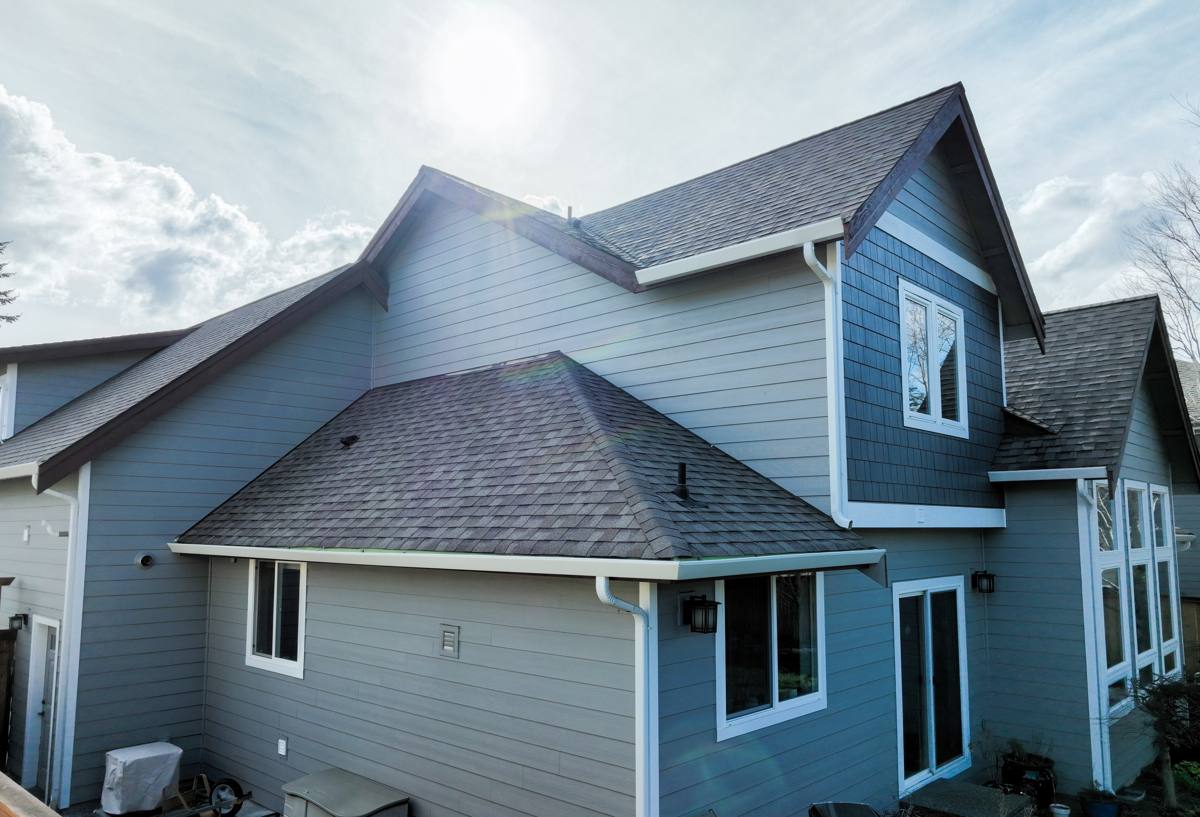
Why We Install James Hardie in This Setting
A Fiber Cement Core That Doesn't Feed Moss and Rot
James Hardie siding is fiber cement — sand, cement, and cellulose fiber, not wood. It doesn't provide the organic food source that moss, algae, and mildew feed on the way wood-based products do, and it doesn't swell, cup, or delaminate when it sits damp for extended periods. On a shaded lot near Mountain Lake, where a wall can stay wet for days between drying windows, that non-organic, dimensionally stable core is the difference between a wall that just needs periodic cleaning and one that's slowly rotting under a coat of paint.
The HZ5 Climate-Engineered Line
James Hardie engineers its products by climate zone, and our region falls under the HZ5 line, formulated for high-moisture, freeze-and-thaw-adjacent conditions like the Pacific Northwest. It's a meaningful distinction from a one-size-fits-all siding product — the moisture resistance and durability testing behind HZ5 assumes exactly the kind of prolonged damp exposure a shaded Orcas Island lot delivers.
ColorPlus Factory Finish
Most Hardie products we install carry the ColorPlus factory finish — a baked-on, multi-coat finish applied under controlled conditions rather than field-painted on site. It resists fading and holds its color far longer than a site-applied paint job, which matters on a shaded lot where mildew and grime show up faster against a dull, chalking finish. It also means less recoating maintenance over the life of the siding, which is worth a lot on a job that isn't cheap or quick to redo.
What We Typically Find Pulling Old Siding Off Homes Near Mountain Lake
When we tear off old siding on a shaded, damp lot in this area, a few patterns show up again and again. Moisture trapped behind wood lap or vinyl siding with no functioning drainage plane. Moss and organic buildup wedged under laps and around trim where it's held water against the wall for years. Soft, rotted sheathing at low-clearance areas near grade or under overhangs that don't get enough sun to dry. Failed caulk joints that were doing the water-management work the flashing detail should have handled in the first place. These aren't signs of a bad original product so much as signs that whatever was installed wasn't matched to how wet and shaded this specific setting stays — which is exactly the mismatch we're trying to correct with the material and the install method both.
What a Correct Installation Involves Here
Water Management First
Siding is only as good as the water management behind it. On a Mountain Lake home, that means a properly lapped weather-resistive barrier, correctly integrated flashing at every window, door, and horizontal trim transition, and kick-out flashing wherever a roofline meets a wall. In a setting that stays wet longer than most of the county, any shortcut here shows up as rot years before the siding itself would ever fail.
Fastening and Gaps for a Shaded, Damp Site
James Hardie specifies exact fastener types, spacing, and clearances, along with expansion gaps at butt joints and trim. Those gaps matter more, not less, in a shaded environment — the material still needs room to move seasonally even where it dries out slowly. We also hold minimum clearance from grade, decks, and roof lines, since low-clearance areas are exactly where we find the worst moisture damage on older siding.
Finish That Doesn't Need Recoating
Because most of what we install carries the factory ColorPlus finish, there's no field painting to get right or wrong on-site — no thin coat, no missed back-priming, no color mismatch from a site-mixed batch. The finish arrives consistent and warrantied, which removes one whole category of failure point on a job in a hard-to-dry setting.
Siding Options Compared for the Mountain Lake Climate
| Material | Behavior in shade & prolonged moisture | Moss / algae tendency | Ongoing maintenance |
|---|---|---|---|
| James Hardie fiber cement | Dimensionally stable; doesn't swell or absorb moisture into the core | Non-organic core resists growth; surface can still be cleaned periodically | Low — factory finish holds up for years |
| Cedar / wood siding | Absorbs and holds moisture; slow to dry under canopy | Organic material feeds moss and mildew readily | High — regular sealing, staining, spot repair |
| Vinyl siding | Doesn't rot itself, but traps moisture against sheathing behind it with limited drainage | Moss and algae readily colonize the surface in shade | Moderate — cleaning helps, but hidden moisture issues go unseen |
| LP SmartSide (engineered wood) | Wood-strand core is more moisture-sensitive than fiber cement; edge swelling is a known risk if seals fail | Still an organic substrate; more prone to growth than fiber cement | Moderate to high — depends heavily on installation and caulk maintenance |
We don't install cedar, vinyl, or LP SmartSide, and a shaded, damp lot like the ones around Mountain Lake is exactly why. Each of those products can perform reasonably well in a drier, sunnier setting with diligent upkeep. In a microclimate that keeps walls wet longer than most of the county, the trade-offs — moisture sensitivity, moss-friendly surfaces, or ongoing sealing and staining — stack up faster than they would elsewhere.
What Affects the Cost of a Mountain Lake James Hardie Project
| Factor | Why it matters here |
|---|---|
| Condition of the old siding and sheathing | Hidden rot from long-term moisture exposure often isn't visible until tear-off, and repair scope drives cost more than the siding itself |
| Site access and staging | Forested, sloped lots common around Mountain Lake can limit equipment and material staging, affecting labor time |
| Trim and architectural detail | Cabin-style and multi-gable homes common in this area have more flashing and trim transitions than a simple rectangular wall |
| Siding profile and accessories chosen | Lap width, shingle-style panels, and trim/accessory selections affect material cost independent of labor |
| Delivery and scheduling logistics | Material has to arrive via the ferry system, so lead times and scheduling need to be planned further ahead than a mainland job |
We don't quote a number without seeing the house — a moss-heavy, shaded wall with hidden rot behind it costs differently than one that's dry and sound underneath. But those are the real variables, and we'll walk through them plainly during the estimate rather than let them surprise you mid-project.
How Our Process Works
- On-site assessment, with particular attention to shaded walls, low-clearance areas, and any spots showing moss or soft material — the places most likely to be hiding moisture damage.
- A written scope that spells out water management details — flashing, weather-resistive barrier, clearances — not just "replace siding."
- Material ordered and scheduled with realistic lead time built in for island delivery and weather windows.
- Installation to James Hardie's fastening, gapping, and clearance specifications, with flashing integrated as work progresses rather than caulked over afterward.
- Final walkthrough and warranty registration, so you have both the manufacturer warranty and our workmanship warranty on file.
What to Look for When Hiring a Siding Crew for This Area
- Actual experience working on Orcas Island or elsewhere in San Juan County — not just a mainland crew willing to make the trip once
- A clear understanding of shaded, moisture-heavy wall assemblies, not only sunnier, wind-exposed shoreline conditions
- Manufacturer training on James Hardie installation specifics, not general siding experience alone
- A written scope that names flashing, drainage plane, and clearance details specifically
- A timeline that accounts honestly for ferry scheduling and weather windows, instead of a generic mainland estimate
- Warranty terms — both manufacturer and workmanship — explained clearly in writing before work starts
Why Local, Hardie-Only Experience Matters at Mountain Lake
A crew that only occasionally works San Juan County treats every job like a first attempt at the logistics — figuring out ferry timing, material staging on a forested lot, and how differently a shaded wall behaves compared to an open one. We work this island regularly, we install one product, and we've seen what happens when that product goes in correctly versus when it doesn't, on exactly this kind of site. That's not a marketing line — it's the reason the water-management details above get treated as non-negotiable rather than optional add-ons.
If you're planning a siding project for a home near Mountain Lake, we're glad to take a look and talk through what your specific walls need. Use the form below to request a free, no-pressure estimate.