 Orcas Island Siding
 Siding Repair Built for Lopez Village, Not a Mainland Checklist
Lopez Village sits close to the water, ringed by the kind of marine weather that makes San Juan County beautiful and hard on a house at the same time. A siding repair crew that mostly works mainland subdivisions will treat your home like any other job. A crew that actually works the islands week in and week out knows that a repair here has to account for salt-laden air, wind-driven rain that finds every gap, and a moss season that can run most of the year in shaded, north-facing spots. That's the difference this page is about.
This is not a general siding overview. It's specifically about repairing siding on homes in and around Lopez Village, what causes damage here, what a correct repair actually involves, and why we install only James Hardie fiber cement siding when repair work turns into replacement.
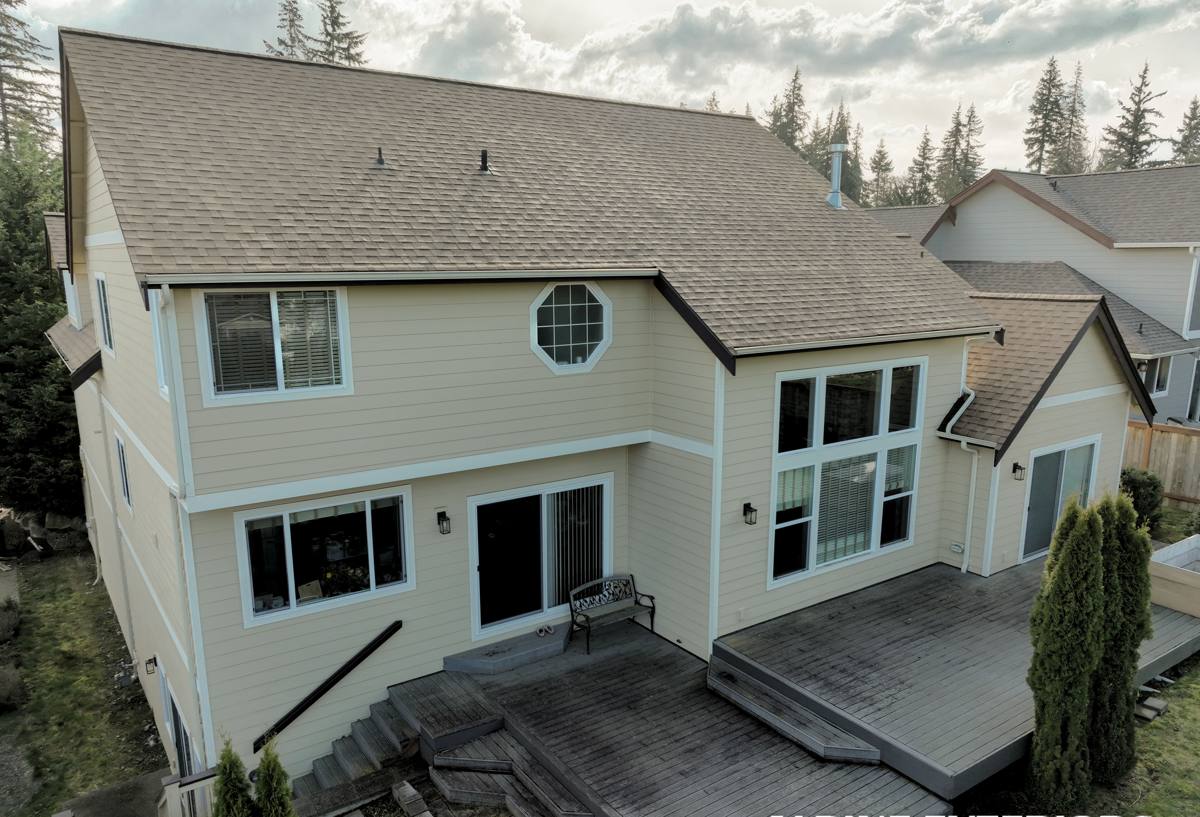
What San Juan County Weather Does to Siding
Three conditions drive most of the repair calls we see in this part of the islands:
Salt Air
Proximity to saltwater means airborne salt settles on exterior surfaces and accelerates corrosion of fasteners, flashing, and any metal trim. Over years, this shows up as rust streaking below nail heads, corroded J-channel, and premature failure of lower-grade hardware that wasn't rated for a marine-adjacent environment.
Driving Rain
Storms off the water don't just fall straight down — wind pushes rain sideways into siding laps, window trim, and butt joints. Homes with south and west exposure toward open water or wide channels take the worst of it. Water that gets behind siding and can't drain or dry out is the single biggest cause of rot we find during repair calls.
A Long Moss Season
Shaded roof lines, tree-covered lots, and the persistent damp common to the islands mean moss and algae get a foothold on siding faster here than in drier parts of the state, especially on north-facing walls and anywhere organic debris collects. Moss holds moisture against the siding surface far longer than open air would, which speeds up decay on anything that isn't genuinely moisture-resistant.
Common Siding Repair Issues We See in Lopez Village
- Soft or delaminating panels at butt joints and corners where water has been getting behind the siding for one or more seasons
- Rust-streaked or failed fasteners from salt exposure, especially on lower-grade nails or staples used in older installations
- Cracked or split boards from age, impact, or repeated wet-dry cycling in older wood or composite products
- Moss and algae buildup that's trapping moisture against the siding surface rather than just sitting on top of it
- Gapped or failed caulking around trim, window returns, and penetrations, letting wind-driven rain track behind the siding
- Localized rot at the base of walls near grade, decks, or planting beds where water sits longer
What a Correct Repair Actually Involves
A siding repair that just patches the visible damage and moves on is a repair that comes back. Doing it right on a coastal home means treating every repair as a chance to check the systems behind the siding, not just the siding itself.
Step 1: Find the Real Cause, Not Just the Symptom
Soft siding is a symptom. The cause is almost always moisture getting in somewhere — a failed caulk joint, missing or damaged flashing, a gap where trim meets siding, or a section where drainage behind the cladding was never right in the first place. We open up the damaged area enough to see what's actually happening before deciding on a fix.
Step 2: Inspect the Water-Resistive Barrier
Whatever siding is on your home, there should be a water-resistive barrier and proper flashing doing the real work of keeping bulk water out. If that layer is torn, missing, or was never lapped correctly, replacing siding boards on top of it just resets the clock on the same failure.
Step 3: Match or Upgrade the Repair Material
Small, isolated repairs on healthy siding can sometimes be patched in kind. But when we find rot, delamination, or repeated failure in the same area, patching with the original material — especially if it's a wood product, older composite, or vinyl — usually just delays the next repair call. In those cases we talk through replacing the affected section, or the wall, with James Hardie fiber cement, which we explain more below.
Step 4: Fastener and Flashing Detail
Given the salt air in this area, we don't use whatever fastener happens to be on the truck. Corrosion-resistant fasteners and properly lapped, corrosion-resistant flashing matter more here than in an inland town, and skipping that detail is exactly how you end up with the rust streaking and repeat rot we get called out for.
Step 5: Finish and Seal to Spec
Caulk and sealant only work if they're the right product for the joint, applied to a clean and dry surface, and placed where they're actually supposed to go — not smeared over a gap as a shortcut. We finish repairs so the joint sheds water the way it was designed to, not just so it looks sealed on the day we leave.
Repair vs. Replacement: How We Help You Decide
| Situation | Usually a Repair | Usually Points to Replacement |
|---|---|---|
| Damage extent | Isolated to one board, joint, or small section | Recurring in multiple spots or spreading along a wall |
| Underlying barrier | Water-resistive barrier and flashing are intact | Barrier is compromised across a wider area |
| Age and material | Newer siding, isolated impact or fastener issue | Original siding is old, discontinued, or a product prone to moisture problems |
| Cause | One-time event (impact damage, single flashing failure) | Systemic issue: poor original installation, chronic moisture exposure |
| Cost over time | Cost of the patch is well below cost of a wall section | Repeated repair costs are approaching what a proper re-side would cost |
We'll always tell you honestly which side of that table your home falls on. If a targeted repair will hold, we do the repair. If we're looking at the third or fourth call to the same wall, we'll say so and explain why continuing to patch it isn't doing you any favors.
Why We Only Repair With and Replace to James Hardie
When a repair does turn into a section or full-wall replacement, we install James Hardie fiber cement siding exclusively. We don't carry LP SmartSide, vinyl, Cemplank, Allura, primed spruce, or cedar, and that's a deliberate standard, not a lack of options.
In a marine climate like San Juan County's, the products we've chosen not to install each carry a real trade-off: engineered wood products remain wood-based and need careful edge sealing and ongoing maintenance to resist moisture; vinyl can warp or become brittle with age and UV exposure and doesn't hold paint if you ever want to change color; unbranded or off-market fiber cement alternatives don't carry the same track record or factory finish system; primed spruce and cedar are natural wood, which means they're the most exposed to rot and moss in a climate this damp, no matter how well they're finished. None of these are bad products in every setting — they're just not what we're willing to warranty on a house that has to stand up to this specific climate.
James Hardie fiber cement is non-combustible, engineered specifically for moisture resistance, and available in HZ5 product lines built for harsher climate zones. The ColorPlus factory finish is baked on under controlled conditions rather than field-painted, which means better color consistency and a finish that holds up to salt air and UV without the touch-up cycle wood siding demands. It carries a strong transferable warranty when installed to manufacturer spec — which is exactly why our installation process follows that spec closely rather than treating it as a formality.
What Correct Hardie Installation Requires
- Proper water-resistive barrier and flashing behind every course, lapped correctly for water to shed outward
- Correct fastener type, spacing, and penetration depth per manufacturer specification
- Field-cut edges primed or sealed as required to protect the cut edge
- Proper clearance from grade, decks, and roof lines to keep the bottom edge out of standing water and splash-back
- Caulking and joint treatment matched to Hardie's own installation guidance, not a generic approach
Getting these details right is what makes the difference between siding that earns its 30+ year expectation and siding that starts causing the same problems as whatever it replaced.
Why a Crew That Already Works the Islands Matters
Logistics on Lopez Village jobs are different from a mainland job. Materials, scaffolding, and crew all have to move by ferry on a schedule, weather windows for exterior work are narrower, and a contractor unfamiliar with island scheduling can turn a two-day repair into a two-week wait. Working regularly in San Juan County means we plan material orders and crew days around ferry schedules and tide-dependent access where it applies, so a repair doesn't stall out waiting on a part that should have been on the boat the first trip.
It also means we've already seen how this specific stretch of coastline treats a house — which walls take the worst of the driving rain, which shaded corners hold moss longest, and which older installations in the area are prone to the same recurring issues. That local pattern recognition speeds up diagnosis and keeps us from guessing at what's normal for a home in this pocket of the islands.
What to Check Before You Call Anyone for a Repair Quote
- Is the damage limited to one area, or showing up in more than one spot on the same wall?
- Is there visible moss or algae buildup where the siding meets trim, roof lines, or grade?
- Do you see rust streaking below fastener heads or trim edges?
- Does the siding feel soft or spongy when pressed near joints, corners, or the base of the wall?
- Has the same area been patched or repaired before?
If you can answer a few of these before a crew shows up, it helps us scope the visit accurately and gives you a more honest read on whether you're looking at a repair or a bigger conversation.
Get an Honest Look at Your Siding
If you're dealing with soft spots, moss buildup, or a repair that keeps coming back on a Lopez Village home, we'll come take a straightforward look and tell you what we actually see — repair, partial replacement, or full re-side — with no pressure either way. Use the form below to request a free estimate.