 Orcas Island Siding
 San Juan Island homes take a specific kind of beating year-round — salt-laden marine air, storms that drive rain sideways instead of straight down, and a moss season that on shaded, north-facing walls barely lets up. This company installs James Hardie fiber cement siding exclusively, and San Juan Island is exactly the kind of coastline that product line was engineered for. This page is about that one product, installed correctly, on this one island — not a general siding overview.
What San Juan Island's Climate Actually Demands From Siding
Being surrounded by the Salish Sea means San Juan Island homes deal with airborne salt moving across the property constantly, which accelerates the breakdown of paint film, corrodes cheap fasteners, and pits flashing faster than an inland site ever sees. Storms off the water rarely fall straight down — wind pushes rain sideways into south- and west-facing walls, and that driving rain finds its way into every seam, corner, and cut end a siding system has. Add in the tree cover and shaded coves common across San Juan County, and a lot of walls here simply stay wet longer after a storm passes than a sun-exposed site would, which is precisely the condition moss needs to take hold and spread.
None of that is unusual for the San Juan Islands — it's just the baseline. But it does mean a siding product and an installation both have to be built for sustained moisture exposure, not just occasional rain, and that's the standard we hold every San Juan Island job to.
Where a Weak Installation Shows Up First
On this coastline, problems rarely start in the middle of a wall. They start at the edges — an under-flashed window head, a butt joint without the right gap or sealant, a bottom course set too close to grade or a deck, or a fastener that wasn't rated for salt exposure and starts bleeding rust down the face of the board. Any one of those gaps gives wind-driven rain a way in, and once moisture is behind the cladding instead of running off it, the siding material almost stops mattering — the installation detail is what failed.
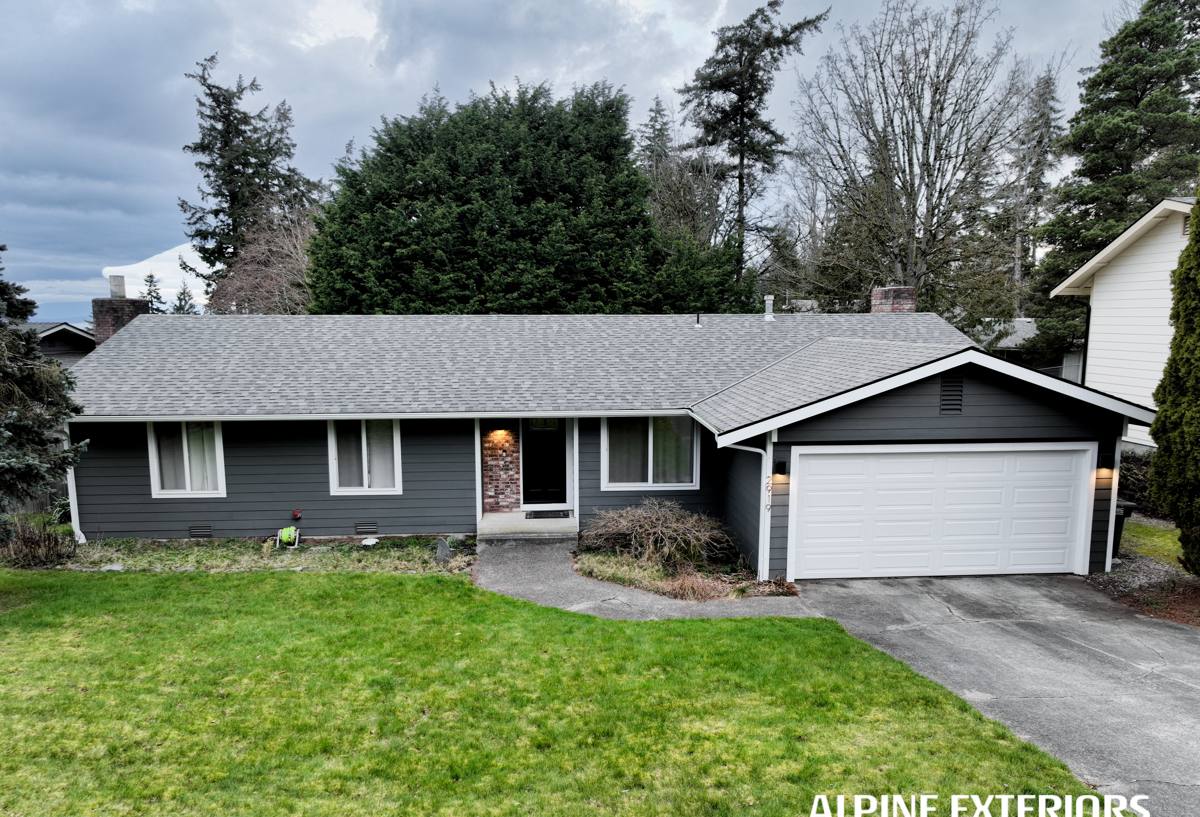
Why James Hardie Fits This Coastline
James Hardie fiber cement has no organic core for salt air, driving rain, or a long moss season to work into over time the way it works into wood-based products. It's made from cement, sand, and cellulose fiber, so it doesn't swell, cup, or feed the kind of organic growth that shaded, damp walls on San Juan Island are prone to. That's the material-level reason we standardized on it rather than offering a menu of options.
ColorPlus Finish vs. Field-Applied Paint
Hardie's ColorPlus technology bakes the color finish on at the factory under controlled, consistent conditions, rather than relying on a field-applied paint job exposed to whatever the weather is doing on install day. That factory finish is backed by its own finish warranty against fading and peeling — a real advantage in a place with long gray stretches and salt exposure working against any painted surface, since it removes the recoating cycle that a field-painted product would otherwise need on this coastline.
HZ5 Engineering for Marine Exposure
Hardie doesn't sell one generic formulation everywhere — its HZ product lines are engineered for different regional exposure levels, and San Juan Island's marine climate is exactly the kind of sustained-moisture environment those HZ5 formulations are built to handle. Combined with the product's non-combustible core, which matters on a wooded island where wildfire risk is a real seasonal concern, it's a siding system built around the actual conditions here rather than a lowest-common-denominator product.
What a Correct James Hardie Installation Involves Here
The product itself is only half the equation. Every one of the installation details below is where a job either holds up through repeated wet seasons or starts developing problems within a few years:
| Detail | What correct looks like | What happens if it's skipped |
|---|---|---|
| Clearance from grade, decks, and roof lines | Minimum clearance per Hardie spec, checked at every elevation | Splash-back and reduced drainage keep the bottom course wet longer, inviting rot in framing behind it |
| Flashing at windows, doors, and roof-to-wall intersections | Continuous, correctly lapped flashing tied into the water-resistive barrier | Wind-driven rain finds a direct path behind the siding at exactly the spots most exposed to storms off the water |
| Fasteners | Corrosion-resistant fasteners rated for marine exposure, placed to Hardie's spacing spec | Fasteners corrode, streak the finish, and eventually lose holding power |
| Joint treatment | Properly gapped and sealed butt joints per manufacturer detail | Cracked or tight joints trap moisture or let it track behind the board |
| Cut-edge sealing | Factory edges and field cuts sealed per Hardie's installation guide | Unsealed cut ends are the fastest point for moisture to enter the board itself |
Every item on that list is a Hardie specification, not a judgment call — which is exactly why we install the product ourselves and warranty the work rather than treating it as an afterthought behind whatever crew happens to be available for the week.
How We Approach a San Juan Island Job
A San Juan Island project starts the same way any siding job should: a walk of the property to check sun exposure, wall orientation relative to prevailing storms, current moisture damage, and any trouble spots near grade, decks, or roof intersections. From there we spec the right Hardie product line and profile for the house — lap siding, shingle-style panels, or a mix with trim — and the ColorPlus color that fits the home and the neighborhood.
Because the job is on an island, materials and crew scheduling get planned around ferry access up front, not discovered as a delay mid-project. That means ordering full material lists in one trip rather than making repeated runs, and building the install schedule around weather windows that actually work for a multi-day exterior job here. It's a logistics detail that doesn't show up in a brochure, but it's the difference between a job that runs on schedule and one that stalls waiting on a part that should have been on the first boat over.
Product Lines and Colors That Make Sense for This Coastline
Most San Juan Island homes fall into a straightforward decision between HardiePlank lap siding for a classic horizontal look, HardieShingle for a more textured, Pacific Northwest coastal profile, and HardieTrim for corners, fascia, and window surrounds. All three carry the same ColorPlus finish options and the same HZ5 engineering, so the choice usually comes down to the home's style rather than a performance trade-off.
On color, darker ColorPlus tones show less streaking from salt residue and organic growth than very light colors on shaded, north-facing elevations, though any ColorPlus finish will outlast a field-painted equivalent here. We walk homeowners through actual color chips against their home's orientation rather than picking off a screen, since how a wall faces the weather changes how a color reads and holds up over time.
Cost Factors for a San Juan Island Siding Job
| Factor | Why it matters here |
|---|---|
| Home size and wall complexity | More corners, gables, and dormers mean more flashing and trim detail work, which is where labor time concentrates |
| Existing siding removal and substrate condition | Moisture damage found behind old siding — common on shaded or poorly flashed walls — adds repair scope before new siding goes up |
| Product line and profile | HardieShingle and detailed trim work run higher in labor than a straightforward HardiePlank lap job |
| Logistics and scheduling | Ferry-dependent material delivery and crew travel are planned into the project timeline rather than priced as a surprise |
| Color and finish selection | ColorPlus factory finish costs more upfront than an unfinished substrate but eliminates a recurring paint cycle |
We don't quote broad ranges without seeing the house — every one of those factors changes the number, and a walk-through gives a far more honest estimate than a per-square-foot guess would.
Why a Crew That Already Works San Juan Island Matters
A contractor who works this island regularly already knows which wall orientations on a typical San Juan Island property stay wet longest, where extra flashing attention actually pays off, and how to plan a job around ferry schedules instead of discovering the logistics mid-project. That familiarity shows up in fewer surprises during the job and a faster response if a warranty or maintenance question comes up years later — a call to a crew still working in the area, not a company that quoted the job once and never came back to this part of the county.
It also means the crew has actually seen how Hardie siding performs here over multiple wet seasons, not just in a training manual. That's a different kind of confidence than a contractor quoting the same product from a mainland base with no track record on this specific coastline.
What to Check Before Hiring Anyone for This Job
- Are they certified to install James Hardie products, with a warranty they can actually back?
- Do they give a specific answer on flashing and fastener choices, not just a general assurance the job will be "done right"?
- Do they have a real plan for material delivery and crew scheduling around island access, not a mainland-standard timeline?
- Will they walk the property with you and explain sun exposure, moisture risk, and product choice specific to your home?
- Do they still work in San Juan County regularly, or was this a one-time job outside their normal service area?
A well-installed product with the right details will outperform the same product installed carelessly, every time — and on an island, that gap tends to show up sooner, not later, because the climate here doesn't forgive shortcuts.
If you're weighing a siding project for a home on San Juan Island, we're glad to take a look at your property, walk through product and color options, and give you a straight, no-pressure estimate.