 Orcas Island Siding
 Window installation looks like a simple trade from the outside — pull the old unit, set the new one, caulk the edges. On Orcas Island it isn't that simple, and Eastsound homes make that clear faster than most. Salt air off the water works on hardware and seals year-round, wind-driven rain finds any gap in the flashing that a calmer climate would never test, and a moss season that runs most of the year keeps moisture sitting against sills and trim longer than manufacturer installation guides assume. A window that's set and sealed the way a mainland crew would do it in a drier county can start failing here in a fraction of the time. This page covers what Eastsound homes specifically need from a window installation, what a correct job actually involves, and how our process runs from first look to finished trim.
Why Eastsound Window Installation Isn't a Generic Job
Eastsound sits at the head of the bay it's named for, and most of the homes around it — whether they're older cottages close to the water or newer builds set back on wooded lots — deal with some combination of salt exposure, exposed wind fetch across the bay, and shaded, damp corners where moss and mildew get a foothold. A window opening is one of the highest-risk points on any exterior wall, because it's a manufactured seam cut directly into the water-resistive barrier. Get the flashing and sequencing wrong, and that seam becomes the path water uses to get behind the siding, into the framing, and into the wall cavity — often invisibly, for years, before it shows up as a soft spot, a stain, or a drafty room.
None of that is unique to any one house in Eastsound. It's the baseline condition for window work across San Juan County, and it's why we treat every installation here as a full weatherproofing project built around a window, not just a window swap with some caulk around it.
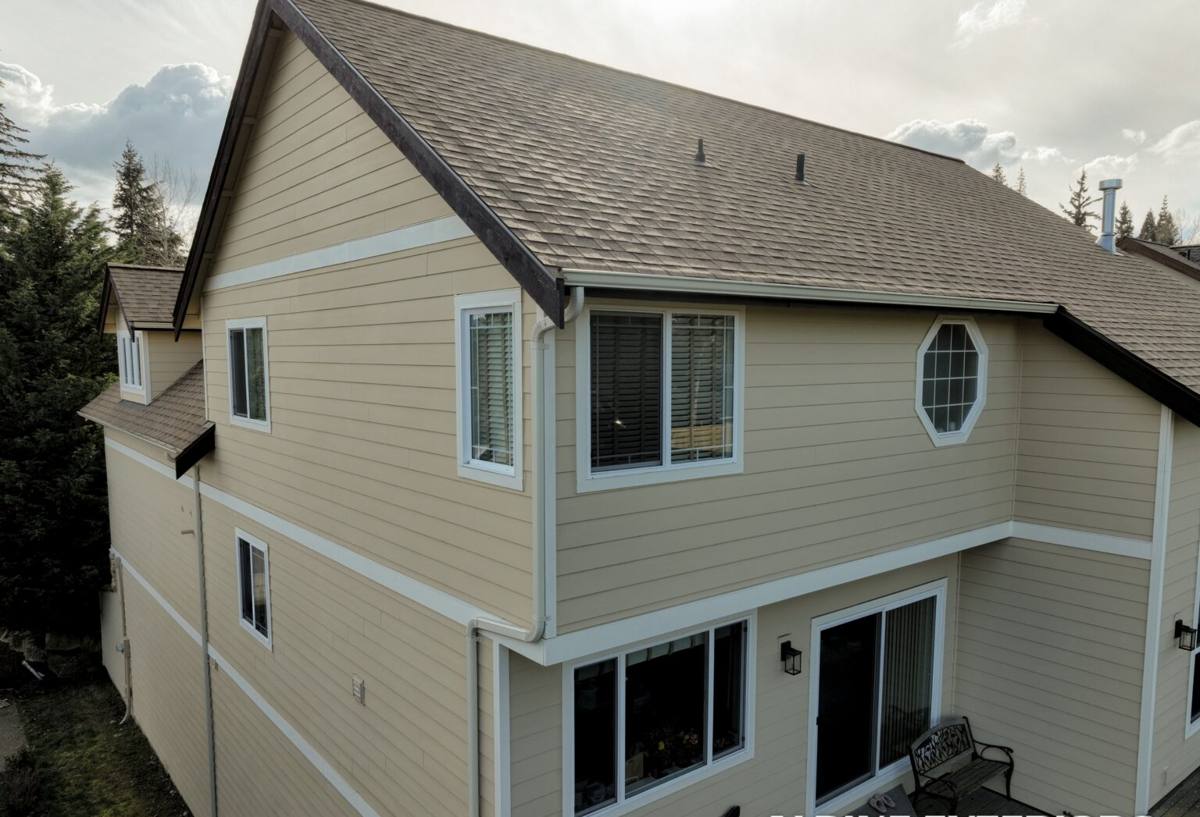
What Eastsound's Climate Puts a Window Through
Salt Air Off the Bay
Eastsound's position at the head of a protected bay means the water itself is usually calm, but the air carries salt inland regardless of how sheltered the shoreline looks. Over years, that salt exposure corrodes cheaper window hardware, fasteners, and flashing metal faster than it would inland. It's a slow failure mode — locks get stiff, hinges start to bind, screws rust — and by the time it's visible, the same slow corrosion has usually been working on flashing you can't see behind the trim.
Driving Rain and Wind
Winter storms across the San Juan Islands don't drop rain straight down onto a roof and let gravity handle it. Wind drives rain sideways into wall assemblies and directly at window openings, pressurizing gaps that a calmer climate's installation standards were never designed to resist. A window that's shimmed loosely, flashed with short laps, or sealed with caulk standing in for proper flashing will get tested by that wind-driven rain — and eventually it fails, usually at the bottom corners of the opening first, where water collects.
A Long Moss Season
Eastsound properties range from open, sun-exposed lots to heavily treed parcels, and the moss and mildew pressure varies accordingly — but it's rarely absent for long. Mild, wet conditions support a growing season for moss that can run close to year-round on shaded walls, and any sill, trim board, or flashing detail that holds moisture instead of shedding it becomes a surface moss and mildew can colonize over time. That matters at a window opening specifically because a sill that traps water is also a sill that's slowly rotting the framing underneath it.
Signs a Window Needs Replacing, Not Just Resealing
Not every window problem calls for full replacement — sometimes a failing seal or worn weatherstripping is a simpler fix. But on Orcas Island, where moisture problems compound quietly behind trim, it's worth knowing which signs mean the opening itself needs attention rather than a surface patch.
- Visible daylight or a draft around the frame even with the window fully latched
- Soft or spongy trim, sill, or siding directly around the opening
- Fogging or moisture trapped between panes on a double-pane unit — a sign the seal has failed
- Paint or finish bubbling or peeling specifically around the window, not the wall generally
- Difficulty opening, closing, or latching that's gotten noticeably worse over a season or two
- Visible rust streaks running down from hardware, fasteners, or flashing at the top of the opening
- A musty smell near the window that doesn't clear with ventilation
What a Correct Window Installation Involves
Removal and Opening Assessment
Pulling the old window is also the first real inspection of the opening. Rot, old flashing failures, or framing that's been slowly compromised by years of moisture rarely show up until the window is out, and finding that early changes the plan — it's far better to address it before the new unit goes in than to seal a new window over a compromised opening and have the same failure repeat in a few years.
Flashing and Weatherproofing Sequence
This is the step that decides whether a window lasts. Flashing has to be layered correctly — sill pan first, then side flashing, then head flashing — so that any water that does get past the window sheds down and out rather than pooling or working its way behind the siding. Getting the lap order wrong is one of the most common shortcuts in rushed window work, and it's invisible once the trim goes back on, which is exactly why it matters that it's done right the first time.
Setting, Shimming, and Insulating
A window has to be set plumb, level, and square, then shimmed and fastened according to the manufacturer's spec — not eyeballed. Gaps between the window frame and the rough opening get insulated properly, since an uninsulated or poorly insulated gap is both an energy loss point and a condensation risk in a damp climate like this one.
Trim and Finish Integration
The exterior trim and finish work around a new window has to match the surrounding siding and hold up to the same salt air and rain exposure the rest of the wall deals with. On an older Eastsound home, that sometimes means addressing trim material or detailing that wasn't built for the moisture load it's actually seeing.
Choosing Windows for This Climate
Frame material matters more here than it does in a drier, calmer market, because the material is dealing with sustained salt air and moisture on top of normal wear. We'll walk through the honest trade-offs for your specific home rather than defaulting to whatever's easiest to install.
| Frame Material | How It Holds Up Around Eastsound |
|---|---|
| Vinyl | Reasonable cost and low maintenance; quality varies significantly between manufacturers, and lower-grade vinyl can become brittle over years of UV and salt exposure |
| Fiberglass | Dimensionally stable through temperature swings and generally holds up well to sustained coastal moisture with minimal upkeep |
| Aluminum | Strong and slim-profile, but a poor insulator unless thermally broken, and more prone to condensation in a damp, mild climate like this one |
| Wood | Warm appearance but needs ongoing paint and moisture maintenance; usually makes more sense as a clad-exterior/wood-interior combination unit than an all-wood exterior frame here |
| Wood-clad (composite exterior, wood interior) | Combines a low-maintenance exterior facing with a wood interior look; a common middle ground for homeowners who want the interior appearance without the exterior maintenance burden |
Our Process, Start to Finish
- On-site assessment — we look at the existing openings, note any signs of moisture damage or failing seals, and talk through what's actually driving the need for replacement
- Honest recommendation — full replacement, opening repair plus new window, or targeted resealing, explained with the reasoning behind it
- Product and material selection — we walk through frame material and performance trade-offs specific to your home's exposure, not a one-size answer
- Removal and opening prep — old units come out carefully, and any hidden rot or old flashing failures get addressed before the new window goes in
- Installation and flashing — each window is set, shimmed, insulated, and flashed in the correct sequence for wind-driven rain
- Trim and finish — exterior trim is integrated to match the surrounding siding and hold up under the same climate load
Costs and Trade-Offs to Know Before You Start
We won't quote a number without seeing the openings, but the factors that actually move price on window installation are consistent from house to house.
| Factor | Why It Matters |
|---|---|
| Number of openings | A whole-house project typically has better per-window economics than one or two units at a time |
| Opening condition | Rot, old flashing failures, or out-of-square framing add repair work before a new window can go in |
| Frame material and size | Larger units and higher-performance frame materials cost more up front but often less to maintain over time |
| Access and site conditions | Second-story openings, tight lot access, or ferry-dependent material delivery can add time and cost |
| Trim and siding integration | Matching new trim to existing siding cleanly takes more labor than a bare install with no finish work |
| New construction vs. replacement | Replacement work in an existing wall generally involves more careful flashing sequencing than a new-construction opening built from scratch |
Why a Crew That Works Eastsound Regularly Matters
Manufacturer installation instructions are written for average conditions, and Eastsound's conditions aren't average — the combination of salt air, wind-driven rain off the bay, and a long wet season stacks the deck against a shortcut install more than it would in a drier inland town. A crew that actually works this island regularly, rather than passing through for a single job, knows which parts of the manufacturer's guidance are non-negotiable here and where extra time on flashing or sealant work is worth it even when it's technically optional elsewhere.
There's also a practical, island-specific reason local experience matters: getting materials and crews to Orcas Island runs on ferry schedules, not same-day trucking. A contractor who's built that reality into how they plan and stage a job is less likely to leave an opening exposed to weather for longer than necessary while waiting on a part or a return trip.
Ready When You Are
If a window in your Eastsound home is drafty, hard to operate, showing moisture damage, or just past its useful life, it's worth having someone look at the actual opening before you start pricing units. We offer free, no-pressure estimates for window installation in Eastsound and the surrounding Orcas Island area — use the form below to get a time on the schedule.