 Orcas Island Siding
 Why Decks Wear Out Faster in Eastsound
A deck in Eastsound doesn't age the same way one does thirty miles inland. San Juan County sits in a marine environment, and Eastsound's mix of harbor-side exposure and heavy tree cover means decks here take on moisture and salt air from two directions at once. Salt-laden air corrodes fasteners and hardware faster than it does in a dry climate, driving rain drives water into joints and ledger connections that were never properly flashed, and shaded, tree-covered lots hold onto damp longer after every rain. Add in a moss and algae season that can run from fall through spring, and you've got conditions that quietly break down decks that would last decades somewhere drier.
Most of the deck failures we see in Eastsound aren't dramatic. They're slow: a ledger board that's been wicking water into the house framing for years, joists that look fine on top but are soft underneath, or fasteners that have corroded to the point where the deck is structurally weaker than it looks. By the time boards are visibly cupping or springy underfoot, the framing underneath is usually further gone than the surface suggests.
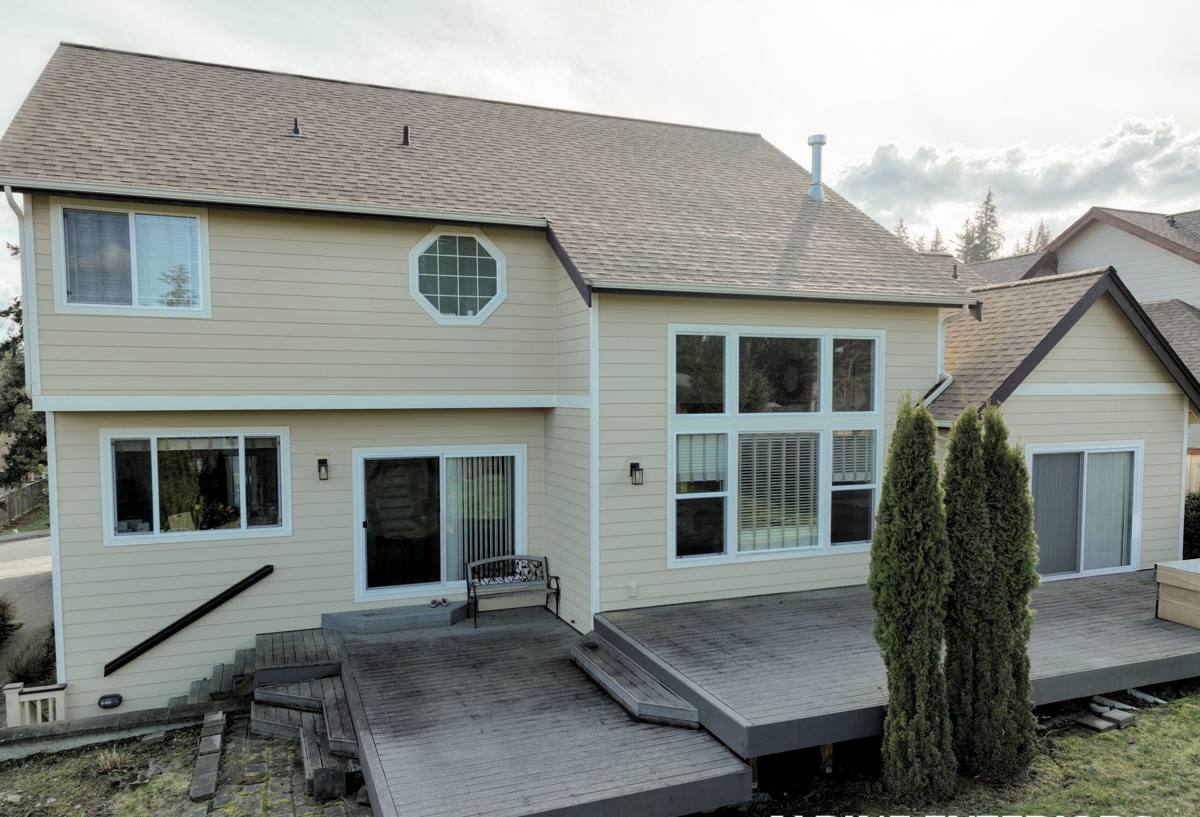
Signs Your Eastsound Deck Needs Replacement, Not Repair
Repair makes sense when the framing is sound and the damage is limited to surface boards or railings. Replacement is the honest answer when the structure itself has been compromised. Here's what tells us which situation we're looking at:
- Soft, spongy, or bouncy spots underfoot, especially near the house or in shaded corners
- Visible rot or dark staining where the deck attaches to the house (the ledger board)
- Rust streaks running down from fasteners, screws, or joist hangers
- Persistent moss or algae growth that comes back within weeks of cleaning
- Gaps opening up between boards, or boards that have cupped and won't lie flat
- Railings or stairs that flex or feel loose when you put weight on them
- A deck more than 15-20 years old that's never had the framing inspected
If you're only seeing one or two of these, a repair or partial rebuild might genuinely be enough. We'll tell you that if it's true — a full replacement isn't the right call for every deck, and we'd rather say so up front than sell you more than you need.
What a Correct Deck Replacement Involves Here
A deck built for Eastsound's climate needs more attention at a handful of specific points than a deck built somewhere drier. Getting these right is what separates a deck that lasts 25+ years from one that's showing rot again in eight.
Ledger Flashing and House Connection
The ledger board — where the deck attaches to your house — is the single most common failure point we find on older decks in this area. Driving rain pushes water sideways and up under poorly flashed ledgers, and once water gets behind that board it has nowhere to go but into the house framing. A correct replacement means proper flashing (both the ledger flashing and the housewrap or building paper integration above it), a clear gap for drainage, and lag bolts or through-bolts rated for the load, not just deck screws.
Footings and Drainage
Orcas Island's clay-heavy and rocky soils drain unevenly from lot to lot. Footings need to go below frost depth and bear on undisturbed, stable soil — cutting corners here shows up years later as a deck that's settled unevenly or heaved. We also grade and manage water flow under the deck itself, since standing water under a low deck is one of the fastest ways to rot joists from below where nobody's looking.
Fasteners and Hardware
In a marine air environment, standard galvanized hardware corrodes faster than the wood around it. We use stainless steel or heavy-duty coated fasteners and connectors rated for coastal exposure, particularly at the ledger, joist hangers, and any hardware near ground level where moisture sits longest. This is a small cost difference at install time and a large difference in how long the deck actually holds together.
Choosing Decking Material for Eastsound's Climate
There's no single "best" decking material — there's the right material for your budget, your sun exposure, and how much maintenance you actually want to do. Here's how the common options hold up in a coastal, moss-prone climate like Eastsound's:
| Material | How It Handles This Climate | Maintenance |
|---|---|---|
| Cedar | Naturally rot- and insect-resistant; ages well if sealed and kept clean; shaded areas still need moss management | Annual cleaning and re-sealing/staining every 2-3 years |
| Pressure-treated fir/pine | Budget-friendly but more prone to checking and moisture absorption over time in wet shade | Regular sealing; watch for softening at fastener points |
| Capped composite | Excellent moisture and salt-air resistance; won't rot; can still grow surface moss/algae in deep shade | Periodic washing; no staining or sealing needed |
| Uncapped composite | Better than wood for moisture but the exposed core can absorb water at cut edges over time | Moderate; more prone to staining than capped versions |
For lots with heavy tree cover and limited direct sun — common around Eastsound — we usually steer homeowners toward capped composite or well-sealed cedar. Both handle prolonged dampness better than budget pressure-treated lumber, which tends to hold moisture against fasteners in shaded spots.
Moss, Algae, and Long-Term Surface Care
Moss isn't just cosmetic — it holds moisture against the deck surface and, over time, that moisture works its way into seams, fastener holes, and end grain. Decks under tree canopy or on the north side of a house are the most affected. A correctly built deck won't eliminate moss entirely, but good board spacing for drainage, proper airflow underneath, and a decking material suited to shade all slow it down significantly. We also talk homeowners through a simple seasonal cleaning routine so moss doesn't get the chance to establish before it's addressed.
Permitting and Building Code in San Juan County
Deck replacement projects in San Juan County typically require a building permit, especially when the work involves structural elements like footings, framing, or the ledger connection to the house — not just swapping surface boards. Requirements can vary depending on the deck's size, height, and whether it's attached to the primary structure. We handle the permitting conversation as part of the process so you're not left guessing what's required or chasing paperwork mid-project.
Our Deck Replacement Process
- On-site assessment: We inspect the existing deck's framing, ledger connection, footings, and fasteners — not just the surface — to see what's actually failing.
- Honest scope and estimate: You get a written estimate that spells out materials, structural work, and what's included, with no surprise add-ons later.
- Permitting: We pull the necessary San Juan County permits when the scope requires it.
- Demolition and structural rebuild: Old decking, framing, and hardware come out; footings, ledger flashing, and framing go in correctly the first time.
- Decking, railings, and finish work: Your chosen material goes down with fasteners and connectors rated for coastal exposure.
- Final walkthrough: We go over the finished deck with you, including any maintenance recommendations specific to your site's sun and shade.
What Affects the Cost of a Deck Replacement
Every Eastsound property is a little different, but a few factors consistently drive cost up or down:
| Factor | Why It Matters |
|---|---|
| Deck size and height | Larger decks and multi-level decks need more framing, footings, and often stairs or extra railing |
| Decking material | Composite typically costs more upfront than cedar or pressure-treated but needs less ongoing maintenance |
| Ledger and structural condition | Hidden rot at the ledger or joists adds framing repair that isn't visible until demolition |
| Site access | Waterfront, sloped, or tree-covered lots can add labor time for material staging and equipment access |
| Railings and stairs | Code-compliant railing systems and stairs add material and labor beyond flat decking |
We give a straightforward range once we've actually looked at your deck — not a number pulled from a phone call, since so much of the real cost depends on what's underneath the surface boards.
Why Hire a Crew That Already Works Eastsound
Working on Orcas Island means factoring in ferry schedules for materials and crew logistics, understanding which fastener and flashing details actually hold up against this island's weather, and knowing what San Juan County permitting expects before a project starts, not after. A contractor who builds decks primarily for drier, inland climates can still do competent framing — but they won't necessarily think to spec stainless hardware at the ledger, or flag that a shaded corner of your lot is going to need a different material approach than the sunny side. Local experience shows up in the details that don't get noticed until they fail.
If your deck is showing its age — or you're just not sure whether it needs a repair or a full replacement — we're happy to take a look and give you a straight answer. Reach out for a free, no-pressure estimate using the form below.