 Orcas Island Siding
 Doe Bay sits on the quieter, more exposed southeastern side of Orcas Island, and a deck built there has to earn its keep in a way a deck in a sheltered inland yard doesn't. Between the salt air coming off the water, driving rain that doesn't fall straight down, and a moss season that can run most of the year on shaded framing, a deck out here either gets built for those conditions from the start or it starts showing problems within a few seasons. This page is about what that actually looks like — the materials, the framing choices, and the details that separate a deck that holds up on Doe Bay from one that doesn't.
What Doe Bay Homes Need From a Deck
Most decks in this part of San Juan County are doing more than one job. They're outdoor living space, they're often the transition between the house and a sloped or wooded lot, and on water-oriented properties they're frequently built to take advantage of a view, which usually means more exposure to wind and weather, not less. A deck design that would be perfectly fine in a protected inland yard can be the wrong call on a site that catches wind off the water and stays damp under tree cover for days after a storm.
That means the questions worth asking before a single board goes down aren't just "what does it look like" — they're about drainage, fastener selection, how the structure ties into the house, and what kind of footing the specific piece of ground can actually support. Get those right and a deck here can last decades. Skip them and you're looking at soft boards, corroding hardware, and a slick, moss-covered surface well before the structure should be showing its age.
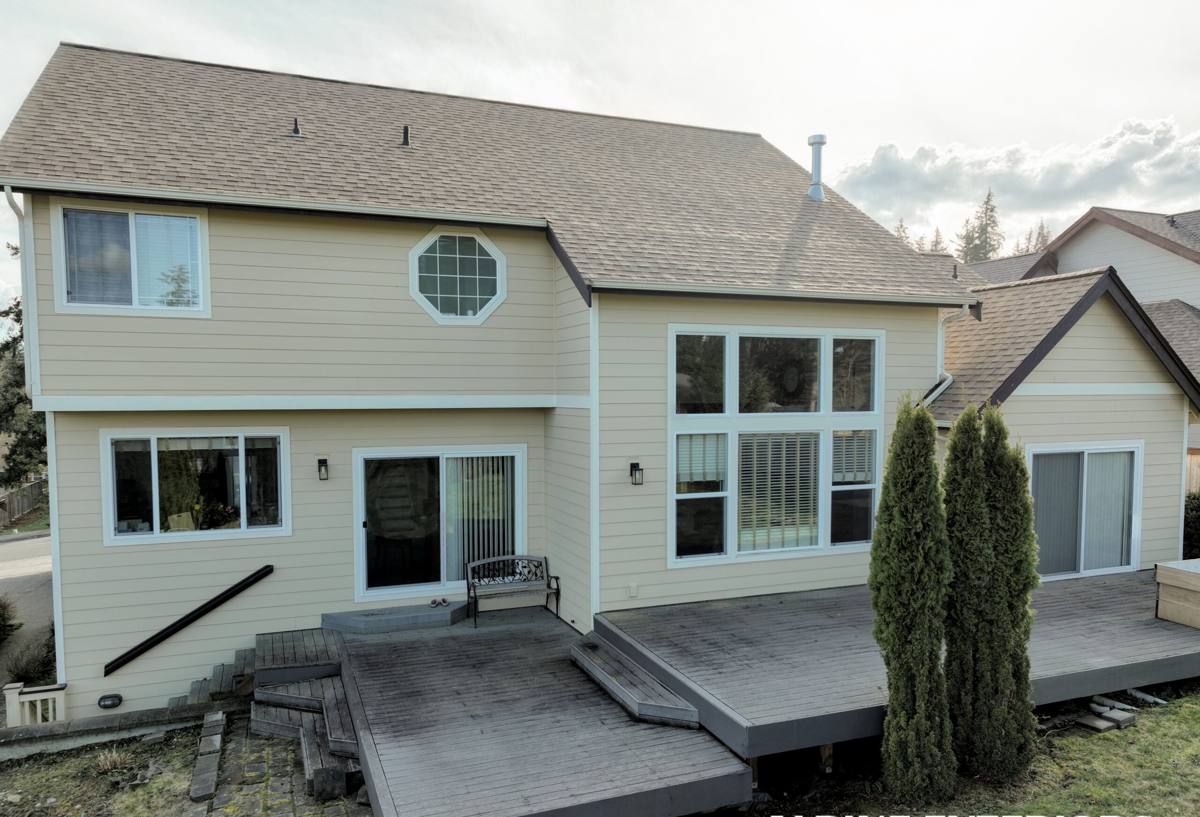
What Salt Air, Driving Rain, and Moss Actually Do to a Deck
Orcas Island's marine exposure isn't an abstract talking point — it has specific, predictable effects on an outdoor structure, and Doe Bay's more open, water-facing position means those effects tend to show up faster than they would on a sheltered lot further inland.
Fasteners and Hardware
Salt-laden air accelerates corrosion in any metal that isn't rated for it. Standard hot-dipped galvanized screws and joist hangers can start streaking and weakening years before they should on an exposed deck here, and once a fastener starts to go, it's usually failing quietly, inside a joist hanger or under a deck board, long before it's visible from the surface.
The Ledger Board and House Connection
The ledger board — the piece that bolts the deck to the house — is the single most common point of failure on decks in wet coastal climates, and it's almost always a moisture problem, not a structural one. Wind-driven rain gets behind an improperly flashed ledger, and because that spot is hidden behind the decking and often behind house siding too, water can work into the band board and framing for a long time before anyone notices — sometimes not until the ledger connection itself has softened.
Moss and Slip Risk
Shaded, north-facing decks under fir or madrona canopy — common on wooded Doe Bay lots — stay damp longer after a storm than open, sun-exposed decking does, which is exactly the condition moss needs to take hold. Beyond looking neglected, moss on a deck surface is a genuine slip hazard, especially on stairs, and it holds moisture against the board surface, which shortens the life of whatever decking material is underneath it.
Choosing the Right Decking Material for This Site
There's no single "correct" decking material for every project — it depends on budget, how much maintenance a homeowner actually wants to keep up with, and how exposed the specific deck location is. Here's how the common options actually compare in a climate like this one.
| Material | Upfront Cost | Maintenance Here | How It Handles This Climate |
|---|---|---|---|
| Pressure-treated wood | Lowest | Annual cleaning, periodic re-staining or sealing | Affordable and workable, but the most sensitive to moisture at fastener holes and cut ends if the finish isn't kept up |
| Cedar | Mid-range | Re-staining every 2-4 years, more often on exposed sides | Natural rot resistance and good looks, but still an organic material that needs a maintained finish to keep moisture and moss from taking hold |
| Composite decking | Highest | Occasional washing, no staining or sealing | Doesn't absorb moisture the way wood does and resists moss better on shaded decks, at a higher material cost |
For a deck that gets regular shade and dampness — which describes a lot of wooded Doe Bay lots — composite decking's resistance to moisture absorption tends to pay for itself in reduced maintenance over time. For a sunnier, more open site, a well-maintained wood deck can perform just fine and costs less upfront. We'll walk the specific site with you before recommending one over the other rather than defaulting to whatever's easiest to sell.
Framing and Foundation Choices for Doe Bay's Terrain
A lot of lots in this area aren't flat, and the ground underneath isn't uniform either — some sites have shallow soil over rock, others have slopes that need to be accounted for in how the deck is supported. The footing and framing plan has to match the actual site, not a generic template.
- Concrete footings poured below frost depth for standard, accessible sites with workable soil
- Helical piles where soil is shallow, sloped, or difficult to excavate without heavy equipment access
- Proper beam and joist spacing sized to the actual span and load, not just "what's typically done"
- Ledger flashing that sheds water away from the house band board, not just caulk relied on to seal the gap
- Corrosion-resistant, marine-rated fasteners and joist hangers throughout, especially anywhere water can pool
- Grading and gapping under and around the deck so water has somewhere to go instead of sitting against framing
On a sloped or wooded lot, getting equipment and materials to the actual build site can be its own logistical puzzle, and it's worth having that conversation honestly during the estimate rather than discovering it mid-project.
Permits and Code Requirements in San Juan County
Most new decks and many substantial repairs or replacements require a permit through San Juan County, and the requirements aren't just paperwork — they cover things like guardrail height, stair rise and run, footing depth, and ledger attachment method, all of which matter more in a wet coastal climate where a marginal connection has less room for error. Properties near the shoreline can also have additional setback considerations depending on the specific parcel. A contractor who's pulled permits in this county before knows what the reviewer is going to ask for and builds to that standard from the start, which avoids the expensive version of this problem: a deck that has to be partially rebuilt after the fact to pass inspection.
How Our Process Works
We keep the process straightforward because the details are where the real work is, not the paperwork.
- Site visit and design. We look at the actual lot — slope, soil, shade, sun exposure, and how the deck will tie into the house — and talk through material and layout options based on what that specific site needs.
- Permitting. We handle the San Juan County permit application and design documentation so the project is built to code from the first footing, not adjusted after the fact.
- Footings and framing. Footings go in to the depth and spacing the site requires, the ledger gets flashed properly at the house connection, and framing uses corrosion-resistant hardware throughout.
- Decking, railing, and finish work. Decking is installed with proper gapping for drainage and airflow, railings are set to code height and spacing, and any stairs are built to the same standard as the deck itself.
- Final walkthrough. We go over the finished deck with you, including what maintenance the specific material you chose will actually need going forward.
Keeping a Doe Bay Deck in Good Shape
Whatever material a deck is built from, a little regular attention goes a long way in this climate. Here's what we recommend homeowners stay on top of:
- Sweep debris and needles off the deck surface regularly, especially under tree cover, so moisture doesn't sit trapped against the boards
- Treat moss growth on shaded sections before it spreads, particularly on stair treads where it becomes a slip hazard
- Inspect and re-stain or reseal wood decking on the schedule the material actually needs, not just when it starts to look worn
- Check fastener heads and hardware yearly for early signs of corrosion or staining
- Confirm the gap between boards stays clear so water keeps draining through rather than pooling on the surface
- Have the ledger connection and any hidden framing checked periodically, since that's the spot most likely to have a hidden moisture problem
Why It Matters That We Already Work Doe Bay
A deck built to a generic mainland spec doesn't automatically hold up on Orcas Island, and a crew that hasn't dealt with this island's soil, slopes, and permitting office before is learning those lessons on your project instead of bringing them with them. Knowing what San Juan County's permit reviewers expect, knowing which footing approach actually works on a rocky or sloped Doe Bay lot, and knowing which fasteners hold up against this specific salt-air exposure isn't guesswork for us — it's what we've already built for out here. That also matters after the build is done: if something needs a follow-up look, we're not coordinating a ferry crossing to get back out to you.
If you're planning a new deck or need to replace one that's showing its age, we're happy to come take a look at the site, talk through material and framing options for your specific lot, and give you a straight answer on what it'll take. Reach out for a free, no-pressure estimate.