 Orcas Island Siding
 Composite Decking on Orcas Island
Orcas gets asked to do more than hold up a chair and a grill. A deck here sits in salt-laden air off the water, takes on months of driving rain every winter, and spends a good part of the year shaded and damp enough to grow moss on anything that doesn't drain or dry quickly. Composite decking handles that combination better than most wood species, but only when it's specified and installed with San Juan County's climate in mind — not just snapped together per the manufacturer's generic instructions and left at that.
This page covers what we actually do when we build or replace a composite deck for a home in the Orcas area: how we handle the substructure, the fasteners, the drainage, and the board selection so the deck still looks and performs the way it should five, ten, and fifteen years out.
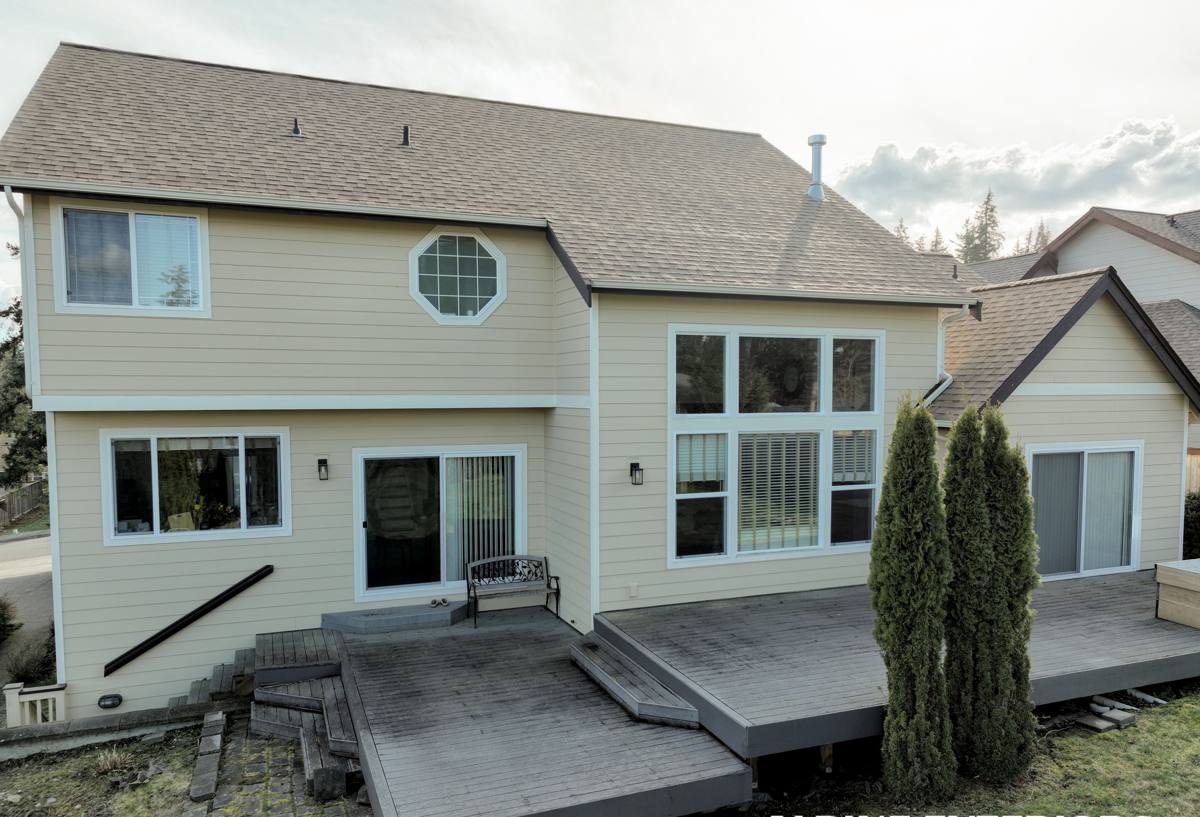
How Salt Air, Rain, and Moss Season Affect a Deck
Salt and Marine Air
Even on the more inland parts of Orcas Island, homes close enough to the water pick up airborne salt that accelerates corrosion on anything metal — fasteners, joist hangers, post bases, railing brackets. Composite boards themselves don't corrode, but a deck is only as good as the hardware holding it together. If that hardware rusts and weakens under the boards, the surface can still look fine while the structure underneath is failing.
Driving Rain and Moisture Cycling
San Juan County's weather isn't just wet — it's wind-driven wet, which pushes water sideways into ledger connections, under railing posts, and into any gap that wasn't flashed or sealed correctly. Composite boards don't absorb water and rot the way solid wood does, but the framing underneath them still can if it's not protected. A deck built without ledger flashing, joist tape, or proper drainage is trading one moisture problem (rotting boards) for another (rotting frame) — the composite decking just hides it longer, which is worse, not better.
Moss and Algae in Shaded, Damp Yards
People sometimes choose composite decking assuming it's immune to moss and algae growth. It isn't — any surface that stays damp and shaded long enough will grow something on it, composite included. What composite gives you is a denser, more consistent surface that's easier to clean and doesn't provide the soft, porous grain that algae spores anchor into as readily as raw wood. Board spacing, airflow underneath, and tree cover around the deck all matter more than the material alone.
Composite vs. Wood vs. PVC Decking
| Factor | Composite | Cedar / Wood | Cellular PVC |
|---|---|---|---|
| Moisture resistance | Very good — won't rot, can still grow surface algae | Fair — needs regular sealing to resist our rain season | Excellent — fully synthetic, no organic material to feed growth |
| Salt air durability | Good, board itself is inert; hardware is the weak point | Fair — fasteners and wood both take a beating near the water | Very good, similar hardware caveat as composite |
| Maintenance | Occasional wash-down, no staining or sealing | Annual cleaning, sealing, and spot repairs | Occasional wash-down, no staining or sealing |
| Upfront cost | Mid-range | Lowest | Highest |
| Feel underfoot / heat in sun | Solid, can run warm in dark colors and direct sun | Natural feel, moderate heat retention | Lighter feel, tends to run cooler in most colors |
For most Orcas homes, composite lands in the sweet spot: it doesn't need the yearly upkeep wood does in this rain pattern, and it costs less up front than full PVC systems. Where we'd steer someone toward PVC instead is a deck with heavy, near-constant shade and standing moisture — situations where even composite's algae resistance won't do much without design changes to fix the drainage first.
What a Correctly Built Composite Deck Includes
Substructure and Framing
The boards get the attention, but the framing underneath does the real work. We use framing lumber rated for ground contact or exterior exposure where it's called for, and we size joists and spacing to the composite manufacturer's span tables — composite boards flex differently than wood and are less forgiving of undersized framing over time.
Ledger Flashing
Where a deck attaches to the house, the ledger board connection is the single most common source of hidden water damage on any deck, composite or not. We flash that connection properly — Z-flashing or manufacturer-approved membrane behind and over the ledger — so wind-driven rain can't work its way into the rim joist or the wall assembly behind it.
Fasteners and Hardware
Given the salt air around much of Orcas Island, we spec stainless steel or heavy hot-dip galvanized fasteners and connectors rather than standard coated hardware. It costs a little more up front and it's the difference between hardware that's still sound in fifteen years and hardware that's rusting and loosening in five.
Drainage and Airflow
Board gapping is set to the manufacturer's spec for both drainage and thermal expansion — composite moves with temperature more than people expect. We also keep the space under the deck ventilated rather than boxed in tight, so moisture has somewhere to go instead of sitting under the boards feeding moss and mildew.
Choosing the Right Composite Board
Capped vs. Uncapped
Capped composite boards have a plastic shell wrapped around the composite core, which resists staining, fading, and moisture absorption far better than uncapped boards. In a climate with this much rain and this many damp months, we recommend capped composite for almost every Orcas project — the small price difference pays for itself in reduced staining and cleaning.
Color and Heat
Darker board colors look sharp but run hotter underfoot in direct sun and can make small color or fade differences more visible over time. On decks with real afternoon sun exposure, we'll talk through lighter or mid-tone colors as a practical trade-off, not just an aesthetic one.
Grain and Texture
Deeper wood-grain textures help hide the fine surface film that can develop in a damp climate, and they give better slip resistance on stairs and landings that see rain and morning dew most of the year — worth prioritizing over a smoother, flatter board finish for anything other than a fully covered deck.
Our Process on Orcas Island
Site Visit and Permitting
We start with an on-site look at the existing structure or the build area, drainage patterns, sun and shade exposure, and how the deck ties into the house. Depending on scope, San Juan County permitting may apply — we'll tell you upfront whether your project needs it and handle the paperwork as part of the job.
Material Logistics
Building on an island means material deliveries run on the ferry schedule, not a same-day truck. We plan lead times around that from the start so a project isn't sitting half-finished waiting on a board order — a scheduling detail that catches off-island crews by surprise but doesn't slow down a team that already works Orcas regularly.
Installation
Framing and flashing go in first and get inspected before a single composite board is laid, since that's the part nobody sees again once the deck is finished. Boards are then installed with hidden fastener systems where the product allows, for a clean surface with no exposed screw heads to collect moisture or grime.
Walkthrough
Before we call the job done, we walk the finished deck with you — checking board gapping, railing security, stair details, and drainage — and go over basic care so you know what routine maintenance actually looks like versus what would be a warranty issue.
Maintaining a Composite Deck in a Marine Climate
Composite decking is genuinely low-maintenance compared to wood, but "low" isn't "none" — especially with the moss and algae pressure common around Orcas. A short seasonal routine keeps a composite deck looking and draining the way it should:
- Sweep off leaves, needles, and debris regularly, especially in fall — trapped organic matter under piles of debris is what feeds moss and mildew fastest
- Wash the deck surface with a mild soap and soft-bristle brush a couple times a year; avoid pressure washing directly into board seams
- Check railing posts, stair connections, and any visible hardware for rust staining or looseness once a year
- Keep nearby shrubs and tree limbs trimmed back so sun and airflow can reach shaded corners where moss tends to start
- Confirm gutters and downspouts near the deck aren't dumping extra water onto or under it
- Clear debris from under the deck occasionally so ventilation gaps stay open
What It Costs
Composite decking costs more per square foot than pressure-treated wood and less than full PVC systems, but the total project price depends heavily on structure, access, and site conditions specific to your property. Rough cost drivers we walk through with every Orcas estimate:
| Cost Factor | Why It Matters |
|---|---|
| Deck size and shape | More linear footage of board edges, stairs, and framing complexity adds labor |
| Height off grade | Taller decks need more substantial framing, railing, and often stair runs |
| Existing structure condition | Reusing sound framing costs less than a full tear-off and rebuild |
| Board tier and color | Capped composite and premium colors/textures run higher than base-tier boards |
| Site access | Tight lots, ferry-dependent delivery timing, and material staging affect labor time |
| Railing and hardware choice | Cable, glass, or metal railing systems cost more than standard composite balusters |
We give straight, itemized numbers rather than a single vague estimate, so you can see exactly what's driving the cost and where there's room to adjust the scope if needed.
Ready for an Estimate?
If you're planning a new composite deck or replacing an aging one on Orcas Island, we're glad to come take a look. There's no cost and no pressure — just a straightforward assessment of your site and a clear estimate to work from. Fill out the form below to get started.