 Orcas Island Siding
 Why Decks Around Mountain Lake Face a Different Mix of Conditions
A deck at Mountain Lake doesn't live the same life as one on Orcas Island's open shoreline, but it isn't spared the island's weather either. Tucked into the wooded, sloping terrain in and around Moran State Park, homes here sit under heavy fir, cedar, and madrona canopy that filters the sun most homeowners assume will be the main threat to a deck. What actually wears on a Mountain Lake deck is a different combination: shade that keeps surfaces damp far longer after a storm, salt-laden air that still reaches inland lots on an island this size, and a moss season that can run most of the year on the shadiest, north-facing decks.
Composite decking handles that combination well when it's the right product, installed the right way. It handles it poorly when a homeowner picks a board based on a showroom sample and a contractor frames it the same way they'd frame a deck anywhere else. This page covers what a Mountain Lake home actually needs from a composite deck, what a correct build looks like given the site conditions here, and why a crew that already works this part of San Juan County builds it differently than one that doesn't.
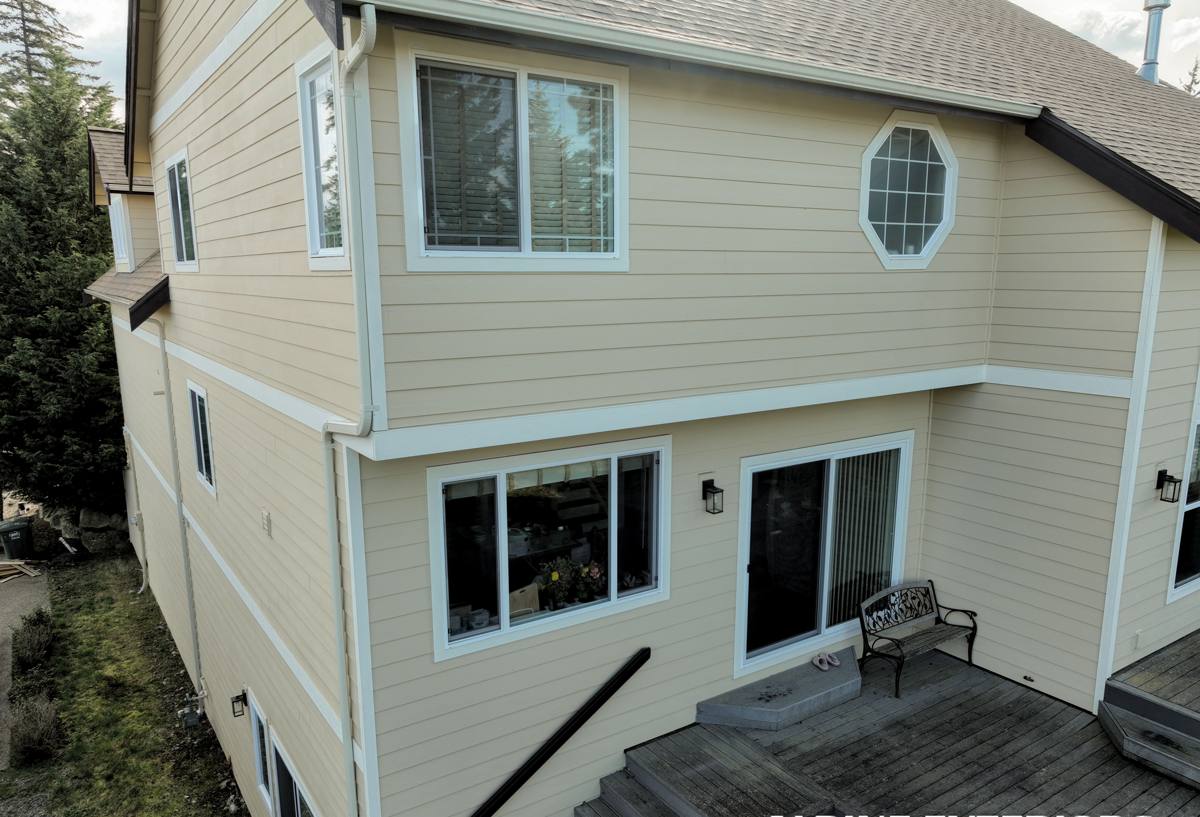
What Mountain Lake's Setting Actually Does to a Deck
Shade Instead of Sun — Which Trades One Problem for Another
A deck in full sun fights UV fade and surface heat. A deck under Mountain Lake's canopy mostly doesn't have that problem — but it trades it for one that's arguably harder to manage: it rarely gets enough direct sun and airflow to dry out quickly after rain. Boards, gaps, and the framing underneath can stay damp for days at a stretch, especially on decks facing the lake or tucked against a slope where air doesn't move much. That extended dampness is the single biggest factor in how a composite deck performs here, and it's very different from what drives decking choices on an open, sun-exposed lot.
Salt Air Reaches Inland Lots Too
It's easy to assume salt exposure is a shoreline problem only, but Orcas Island is small enough that marine air off the Salish Sea moves across the whole island, including the interior terrain around Mountain Lake. It's a less intense exposure than a waterfront lot gets, but it's steady, and it still corrodes standard-grade fasteners, brackets, and railing hardware over time — just on a slower timeline that can lull a homeowner into using lower-grade hardware than the site actually calls for.
A Moss and Debris Season That Runs Most of the Year
Moss and algae need shade and moisture to establish, and Mountain Lake's canopy provides both for a large part of the year. Add in the steady drop of needles, leaves, and pollen from the surrounding trees, and a deck here collects organic debris in board gaps, corners, and around railing posts at a rate a deck out in the open never sees. That debris holds moisture against the surface exactly where it shouldn't, and it's the main reason a deck that looks fine from a distance can have a mold or algae film building in the grooves.
What "Composite Decking" Actually Means
Capped vs. Uncapped
Capped composite boards have a protective plastic shell wrapped around a wood-plastic composite core. That cap is what keeps moisture, mold, and staining from working into the core — it's the single most important spec for a shaded, damp site like Mountain Lake. Uncapped composite is the older style of the product, with the wood-plastic blend exposed on all sides, so it absorbs moisture more readily and is more prone to surface mold and fading. In a canopy-covered, lake-adjacent setting, that difference shows up faster than it would on an open, dry lot, which is why we standardize on capped composite here.
PVC as an Alternative
Cellular PVC decking contains no wood fiber at all, which means it has nothing for moisture to absorb into and nothing organic for mold to feed on directly, even if a surface film forms in shade. It can flex a bit more than composite under heavy point loads and generally costs more, but on the shadiest, dampest Mountain Lake lots it's worth putting on the table alongside capped composite rather than assuming one product fits every site around the lake.
What a Correct Composite Deck Build Requires Here
The decking boards get most of a homeowner's attention, but around Mountain Lake the substructure, drainage, and site prep are what actually determine whether the deck holds up. A build done right for this setting includes:
- Framing rated for ground contact and sustained moisture, since a shaded, sloped lot dries out slower than an open one
- Footings and posts set correctly for uneven, rocky, or root-filled ground, which is common on wooded island lots rather than flat, cleared building sites
- Corrosion-resistant fasteners throughout, sized for marine air exposure even though the lot sits inland from open water
- Hidden fastener systems on the deck surface where the product allows, which reduce the visible metal exposed to moisture and give debris fewer places to lodge
- Board gapping set for drainage first and expansion second, since a shaded deck needs water and airflow moving through the gaps more than a sun-exposed one does
- Ventilation and clearance underneath the deck so ground moisture and slope runoff don't sit trapped against the framing
- Correct ledger flashing where the deck ties into the house, since a damp, shaded wall behind the ledger is slower to dry than an open one
- Grading or drainage work at the base of sloped lots so water is directed away from footings instead of pooling against them
Skip any one of these and the deck usually still looks fine for a season or two. The failure shows up later, as a soft spot in framing that stayed wet too long, a post that's loosened in ground that never fully dried, or a mold film that keeps returning no matter how often the surface gets washed because moisture is getting trapped from underneath.
How Our Process Works
We start with a site visit, because a Mountain Lake lot tells us more than a set of plans would. We look at canopy density and how much of the day the site actually sees direct sun, the slope and drainage pattern around the build area, existing framing condition on a replacement job, and how site access and staging will work on a wooded lot before we ever talk product selection. From there we walk through composite and PVC options that make sense for that specific site's sun and moisture exposure, not a one-size answer used across the island.
Permitting on Orcas Island generally runs through San Juan County, and inland lots can carry their own considerations around setbacks, slope, or septic and well locations that a waterfront lot doesn't. We handle that process as part of the job. Once permitted, the build follows the sequence above — grading and footings first, framing built for the site's actual moisture exposure, then the composite surface, railing, and trim. We finish with a walkthrough covering what the specific product you chose needs going forward, since that's genuinely different for a shaded lake lot than for an open, sunny one.
Composite Decking Compared to the Alternatives
| Material | How It Handles Shade, Moisture & Moss | Maintenance | Typical Lifespan Here |
|---|---|---|---|
| Capped composite | Strong — cap layer resists moisture absorption and surface staining | Periodic washing to clear debris and any surface film | Long-term, backed by manufacturer warranty |
| Cellular PVC | Excellent — no wood fiber to hold moisture even in constant shade | Periodic washing; no sealing or staining | Long-term, generally at a higher upfront cost |
| Uncapped composite | Weaker — absorbs moisture readily, more prone to mold in shaded areas | Frequent cleaning needed to manage mold and staining | Shorter than capped products in this setting |
| Pressure-treated wood | Poor in constant shade — retains moisture, feeds decay and moss | Regular sealing or staining, more often than in sun | Shortest, with the most ongoing upkeep |
| Cedar decking | Attractive but moisture-sensitive — shade slows drying between rains | Frequent oiling or sealing to manage graying and moisture | Shorter here than in a drier, sunnier setting |
What Composite Decking Still Needs From You Here
Composite is low-maintenance compared to wood, not maintenance-free, and the maintenance that matters most around Mountain Lake is different from what a sunny, open-lot homeowner deals with:
- Clear leaf, needle, and pollen debris out of board gaps regularly, since that's what traps moisture against the surface in shade
- Wash the deck surface periodically to remove any algae or mold film before it sets into the cap layer
- Trim back overhanging branches where reasonable to let a little more air and light reach the deck surface
- Check railing posts and fasteners annually, since corrosion here moves slower than at the shoreline but doesn't stop entirely
- Keep an eye on drainage at the base of sloped lots so runoff doesn't start pooling against footings over time
Why It Matters That We Already Work This Part of Orcas Island
A crew that mostly builds decks on open, sunny lots can still install composite decking competently, but a wooded lot near Mountain Lake has variables that don't come up as often elsewhere on the island — footings set into sloped, root-filled ground instead of flat cleared soil, framing built for a site that dries out slowly instead of quickly, and access roads that are often narrower and less direct than a shoreline lot's, which changes how materials and equipment get staged. Working this part of San Juan County regularly means we're not guessing at any of that. We know which composite and PVC lines actually resist mold in constant shade rather than just UV in full sun, and we know how to frame and drain a deck so a lot's natural dampness doesn't get trapped against the structure.
That familiarity is also what keeps us honest with homeowners here — telling you plainly when a sunnier composite line that works well on a shoreline lot isn't the right call for a canopy-covered site, and what a Mountain Lake deck genuinely needs instead.
Get a Straight Answer About Your Deck
Whether you're replacing an aging wood deck near Mountain Lake, building new, or just want an honest read on what your specific lot needs, we're glad to walk the site with you and lay out the options plainly. Reach out below for a free, no-pressure estimate.