 Orcas Island Siding
 Why Cascade Lake Decks Take More Punishment Than Homeowners Expect
Cascade Lake sits inside a pocket of San Juan County that gets the worst of both worlds: salt-laden air drifting up from the surrounding marine waters, and a lake environment that keeps humidity high and shade heavy for much of the year. Add in driving rain off the water during fall and winter storms, and a moss season that can run eight months or longer under the fir and cedar canopy common to this part of Orcas Island, and you have conditions that are genuinely hard on any outdoor structure.
A deck built to a generic spec — the kind you'd see in a big-box installation guide written for a dry inland climate — will show problems here years before it should. Fasteners corrode faster near salt air. Framing that isn't properly vented traps moisture underneath the boards. Shaded, low-airflow spots become moss and algae magnets. None of this means composite decking is a bad choice for Cascade Lake — it's actually one of the better choices — but it means the installation details matter more here than they do almost anywhere else on the mainland.
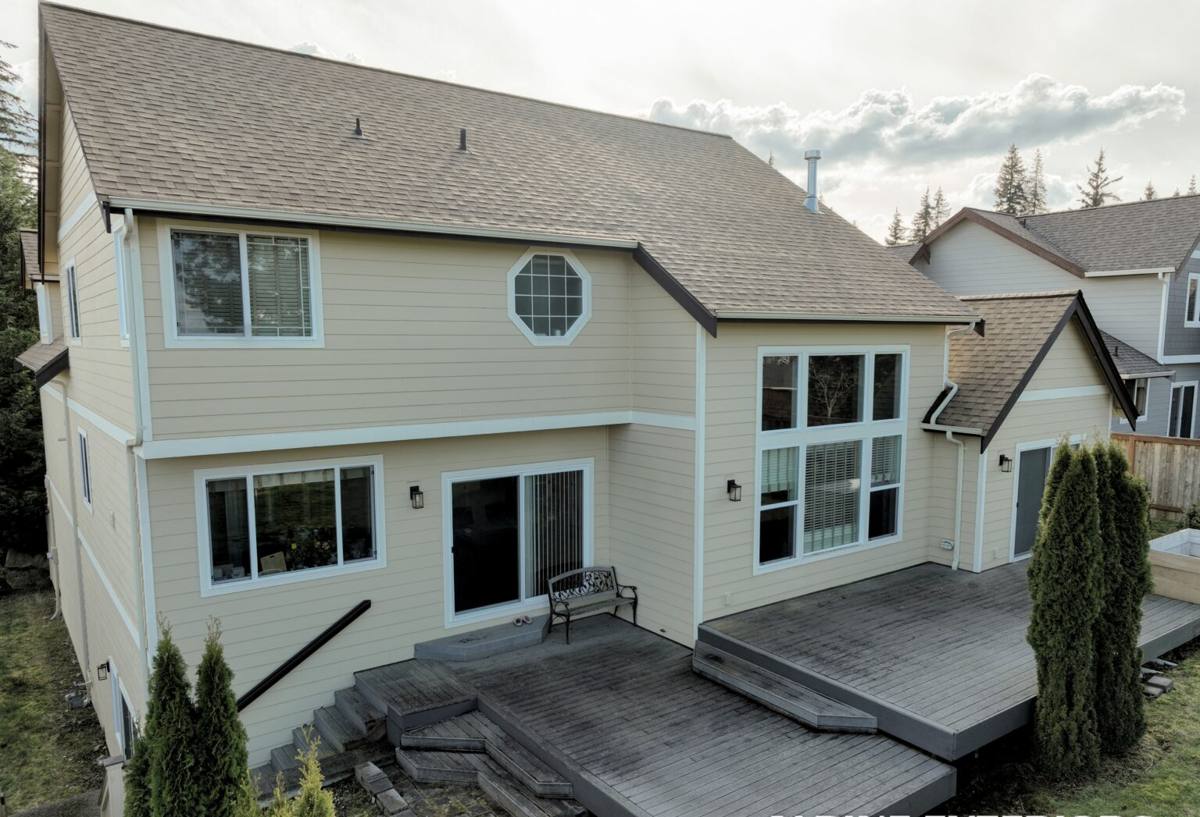
What a Correctly Built Composite Deck Looks Like Here
Substructure and Framing
The composite boards are the part everyone sees, but the framing underneath is what determines whether the deck lasts fifteen years or thirty. In a damp, shaded lake environment, we build with pressure-treated joists protected by joist tape, proper beam sizing for our snow and wind loads, and footings set to the depth our local soil and drainage actually require — not the bare minimum a spec sheet allows.
Fasteners and Hardware
Salt air corrodes standard fasteners faster than most homeowners realize, especially on decks with any lake exposure. We use stainless steel or coated hardware rated for coastal and marine-adjacent use throughout — structural connectors, joist hangers, and the hidden fastener systems used with most composite boards. It costs a little more up front. It's also the single biggest reason decks in this area fail early when it's skipped.
Ventilation and Drainage
Composite boards don't rot, but the framing beneath them still can if moisture has nowhere to go. Correct joist spacing, a slight slope away from the house, and clear airflow paths under low-to-ground sections all matter more here than in a dry climate, where a builder can get away with sloppier drainage and never notice.
Choosing the Right Composite Board for a Lake-Adjacent, Marine Climate
Not all composite decking performs the same in a salt-air, high-moisture environment. The differences matter most in how the board handles moisture at the surface and how much upkeep it asks of you afterward.
| Board Type | Moisture Behavior | Maintenance in This Climate | Typical Fit |
|---|---|---|---|
| Uncapped composite | Absorbs some surface moisture; more prone to mildew staining in shaded, damp spots | Periodic cleaning required to stay ahead of algae and moss | Budget-conscious builds in sunnier, better-drained yard areas |
| Capped composite | Polymer shell resists moisture penetration and staining much better | Occasional rinse; holds up well through the moss season | Most Cascade Lake homes, especially shaded or lake-facing decks |
| PVC / cellular decking | Fully moisture-resistant, no wood fiber to feed mildew | Lowest upkeep of the three | Heavy-shade lots, dock-adjacent decks, homeowners who want minimal maintenance |
We don't push one brand as a universal answer. The right call depends on how much sun and airflow your specific deck site gets, how much upkeep you actually want to do, and your budget. What we won't do is install an uncapped board on a deeply shaded, low-airflow lake lot and let you find out the hard way that it needed more attention than expected — we'll tell you that up front.
Our Cascade Lake Composite Decking Process
- On-site assessment. We look at sun exposure, shade patterns, existing framing condition (if this is a replacement), soil and drainage at the footing locations, and how close the deck sits to the lake or shoreline.
- Structural evaluation. If we're building over or replacing an existing structure, we check the ledger board attachment, framing rot, and footing condition before quoting — problems here get fixed as part of the job, not discovered mid-project.
- Board and layout selection. We walk through capped versus uncapped versus PVC options against your specific site conditions and budget, plus color and board direction.
- Permitting. San Juan County permitting requirements depend on deck height, size, and attachment to the home — we handle what applies to your project.
- Build. Framing first, with full attention to fastener grade and ventilation, then decking, railing, and any stairs.
- Final walkthrough. We go over the finished deck with you, including what maintenance (if any) your specific board choice needs going forward.
The Substructure Work That Doesn't Show — But Determines the Lifespan
Most composite deck complaints we get called out to inspect on existing decks aren't actually about the decking material — they're about what's underneath it. Ledger boards flashed incorrectly let water into the house rim joist. Footings set too shallow shift over a wet winter. Joists without protective tape rot from the top down even though the composite boards on top look brand new.
This is the part of the job that's invisible once the deck is finished, and it's exactly where corners get cut on a rushed build. It's also where the driving rain and lake humidity common to this part of Orcas Island do the most damage over time if it's not handled correctly the first time.
Managing Moss, Algae, and Mildew Through the Long Cascade Lake Season
Composite decking doesn't rot or splinter, but it isn't maintenance-free in a climate like this. Shaded areas near tree lines or on the lake side of a house can develop a thin film of algae or moss growth during the wetter months, especially on uncapped boards or in spots with poor airflow underneath.
The fix isn't complicated, but it does need to happen on a schedule rather than only when it's visibly bad:
- Sweep debris — needles, leaves, seeds — off the deck regularly so it doesn't trap moisture against the board surface
- Rinse with a garden hose and a soft-bristle deck brush a few times a year, more often in heavily shaded sections
- Avoid pressure washers on composite boards — they can damage the surface texture or capping layer
- Keep gutters and downspouts near the deck clear so runoff isn't dumping directly onto or under the decking
- Trim back overhanging branches where practical to let more light and air reach shaded deck areas
Boards installed with proper spacing and ventilation underneath need far less of this attention than boards crammed tight against a damp foundation wall with no airflow — another reason the build details matter as much as the material choice.
What Affects Cost for a Cascade Lake Composite Deck
Every deck is different, but the same handful of factors drive most of the cost difference between a straightforward project and a more involved one.
| Cost Factor | Why It Matters |
|---|---|
| Board tier (uncapped vs. capped vs. PVC) | Material cost scales up with moisture resistance and lower long-term maintenance |
| Existing framing condition | Rot or undersized framing on a replacement job means repair or full rebuild before decking goes down |
| Height, stairs, and railing | Elevated decks and multi-level layouts require more structural work and code-compliant railing |
| Site access | Lake-adjacent lots, slopes, and limited equipment access add labor time |
| Footings and permitting | Soil conditions and San Juan County permit requirements can affect footing depth and inspection timing |
We give a firm, itemized quote after the on-site assessment — not a ballpark over the phone. On an island, material delivery timing and access also factor into scheduling more than they would on the mainland, and we account for that up front rather than surprising you with it mid-project.
A Simple Maintenance Checklist for Composite Deck Owners
- Clear leaves and debris off the deck surface every few weeks during fall
- Rinse and brush shaded sections at least twice a year
- Check that gutters and downspouts near the deck are directing water away, not onto it
- Inspect railing and stair connections annually for movement
- Look underneath the deck once a year for any signs of moisture pooling or framing damage
- Avoid pressure washing composite boards; use a soft brush and mild soap instead
Why Hiring a Crew That Already Works Cascade Lake Matters
Building on Orcas Island isn't the same as building on the mainland. Material deliveries have to be scheduled around ferry timing, site access on lake lots is often tighter, and the specific way salt air and lake humidity attack framing and hardware here is something you learn by doing the work locally — not from a general contracting manual. A crew that already builds decks around Cascade Lake knows which fastener grades hold up, which shaded spots need extra ventilation planning, and how San Juan County permitting actually works for waterfront and near-waterfront properties.
That local familiarity shows up in fewer surprises during the build and a deck that's actually built for the conditions it will sit in for the next two or three decades, not a generic spec pulled from a climate that doesn't match ours.
If you're considering a composite deck for your Cascade Lake property, we're happy to walk your site, look at your framing if it's a replacement, and give you a straightforward, no-pressure estimate — just fill out the form below to get started.